“The influence of the magazine sprang almost entirely from fear, but its prestige was due to its never-failing accuracy.” (Logan, Part 2, 47)
Notorious for its merciless coverings of the newest and hottest gossip, nobody seemed to be safe in Town Topics: The Journal of Society. But was there really no one safe? Well, unless one “either bought advertising in the magazine or a block of its essentially worthless stock” (Caldwell 19), you could not consider yourself safe. Even if you were President Roosevelt’s daughter (for more information on her, see also project The Princess of the White House — Alice Roosevelt’s Rise to Celebrity on this website).
However, nobody would have thought that it would take only one man to bring Town Topics to its knees. One man, who decided to speak up and not pay the price for Town Topics’ silence. So, over the course of two years (1905-1906), the popular magazine crumbled in a domino-like manner until it fully ceased publishing in 1937.
If you’re curious about the full chaos that unfolded (with receipts), you’re in the right place. Enjoy this blog and just zoom in on the newspaper articles to read them like a contemporary witness, living through it all.
The following images of Town Topics magazine are from various issues, all taken from the Everyday Life & Women in America archive.
The following images of The New York Times are from various issues, all taken from The New York Times archive.

The First Stone Falls
It all began with a single phone call from a certain gentleman named Charles Stokes Wayne, the managing editor of Town Topics. He suggested to Mr. Edwin Post, “a Wall Street stockbroker mired in a financial bad patch” (Caldwell 19), that he meet with a young man by the name of Charles P. Ahle.
The following day, it came to light that Post had been seen with a woman who was not his wife. She seemed to have a fondness for “white shoes with red heels and patent leather tips.” If Post didn’t pay $500 for a “flattering writeup about himself in a forthcoming publication, a sort of society Who’s who to be called America’s Smart Set”, the “Saunterer” would expose his scandalous behavior in the next issue of Town Topics (Logan, Part 1, 37).
It is July 11th, 1905, 2 o’clock in the afternoon. Two men meet “in the gentlemen’s bathroom of the Holland House, a hotel at the corner of Fifth Avenue” (Logan 37). An envelope containing five $100 bills passes from one man to the other. Remarks are made about how Post got off easy; others hadn’t been so fortunate.
Feeling secure, Ahle even remarks:
“In fact, Town Topics makes most of its money from the suppression of stories.” (Logan, Part 1, 37)
What he didn’t know was that, in one of the stalls, a detective was waiting for the right moment to arrest Ahle.
Three days later, Post testified against Ahle, putting him into a cell.
Charles Stokes Wayne, managing editor of Town Topics and editor of America’s Smart Set, dismissed the entire episode as a “fearful misunderstanding,” claiming that Post must have been “half insane” to interpret things the way he did (Logan, Part 1, 38). Moses Ellis Wooster, a former Town Topics employee and current director of America’s Smart Set, expressed outrage, although not at the blackmail attempt, but at Post’s behavior. He insisted that Charles P. Ahle was “well known as a most gentlemanly solicitor” (Logan, Part 1, 38).
Still, reporters began to piece together what seemed like a suspiciously cozy relationship between Town Topics and America’s Smart Set. Was it really just “sheer chance,” as Wooster insisted, that both gentlemen were somehow involved with both magazines? (Logan, Part 1, 38)
Justice Joseph M. Deuel, vice-president of Town Topics and, in his own words, “a personal adviser for my friend Colonel Mann” (Logan, Part 1, 40), had a different take. Speaking to reporters, he made it clear that Ahle would not be spared. He called him “that wretch,” declaring he must be prosecuted to the full extent of the law. Ahle, he said, was no “innocent victim in the case”; he had even deceived Wayne, who had written the letter of introduction to Post “out of the kindness of his heart” (Logan, Part 1, 38).
Colonel William d’Alton Mann, the powerful publisher of Town Topics, was a “Civil War hero, entrepreneur, business tycoon, millionaire [and] inventor” (Caldwell 15) who had reinvented himself as the iron-fisted editor of New York City’s most feared gossip magazine. He wielded his editorial control like a weapon, mixing scandal, snobbery, and satire into a weekly threat few dared to ignore.
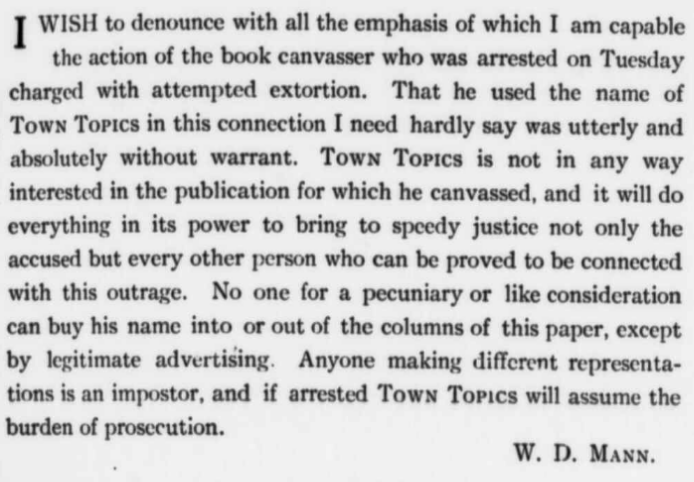
In a formal statement, Mann denied that Town Topics had anything to do with Ahle’s actions. He insisted that:
“No one, for a pecuniary or like consideration, can buy his name into or out of the columns of this paper […]. Anyone making different representation is an impostor, and, if arrested, Town Topics will assume the burden of prosecution” (Town Topics, Vol. 54, No. 2, 1905, 1)
However, it was later revealed that this firm statement of principle wasn’t written by Mann at all. It was posted by his close friend Justice Deuel (Logan, Part 1, 40).
Meanwhile, the press drew more troubling parallels. The business model of America’s Smart Set bore an uncanny resemblance to another Mann-backed publication: Fads and Fancies of Representative Americans. The core pitch seemed to be the same. “Pay up or get roasted in Town Topics”, but the price for a flattering feature varied wildly, anywhere from $1,500 to $10,000 (Logan, Part 1, 38). However, the America’s Smart Set that Edwin Post was told he could appear in was not the well-known literary magazine The Smart Set, founded in 1900. Instead, Mann’s associates appear to have appropriated the name or created a phantom vanity publication under a similar title, pitching it as a sort of “Who’s Who” of high society. The New York Times described it as a “biographical work.” (NYT, 12.07.1905, Part 1) There’s no evidence that a real magazine by that name ever published such content, only that the title was used to lend credibility to the blackmail scheme (Logan, Part 1, p. 37).
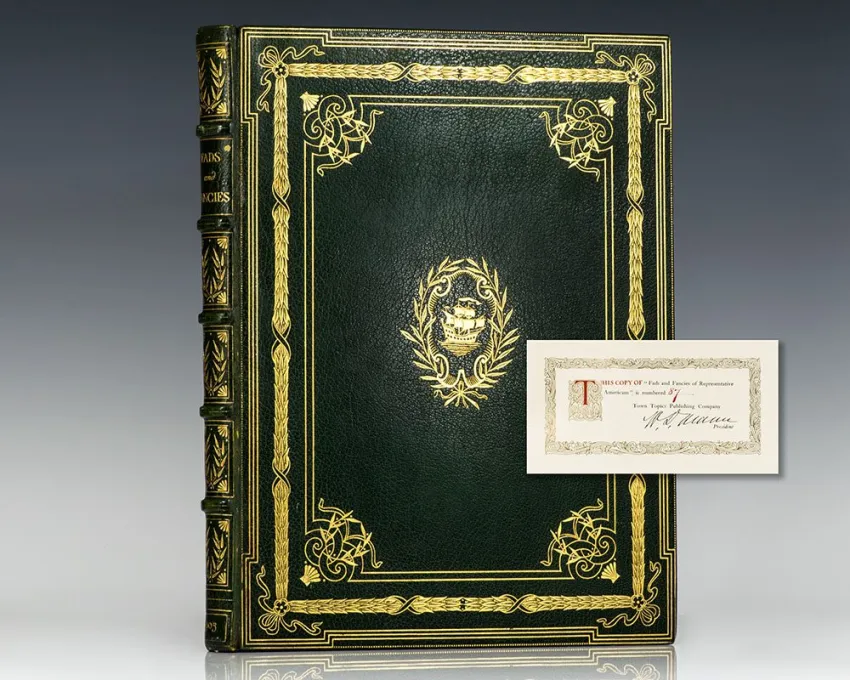
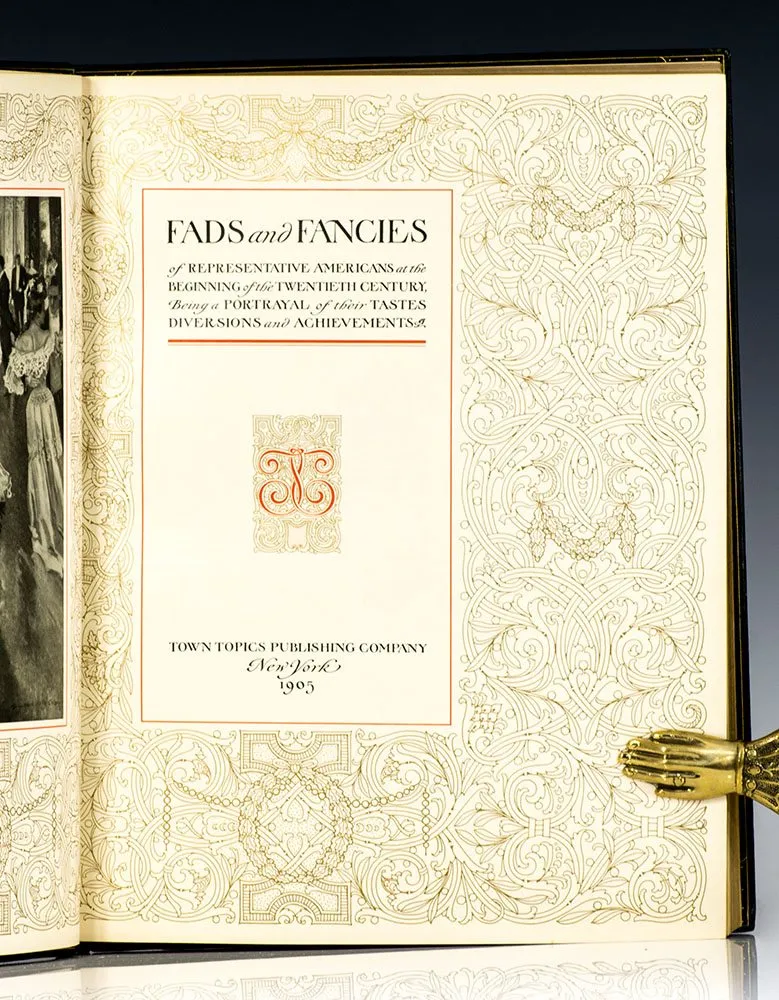
Fads and Fancies was to be a vanity book that portrayed the tastes, diversions, and achievements of the rich. The idea was simple: those of high social standing would pay to be included, and in return, receive glowing write-ups within its pages once the book was eventually published.
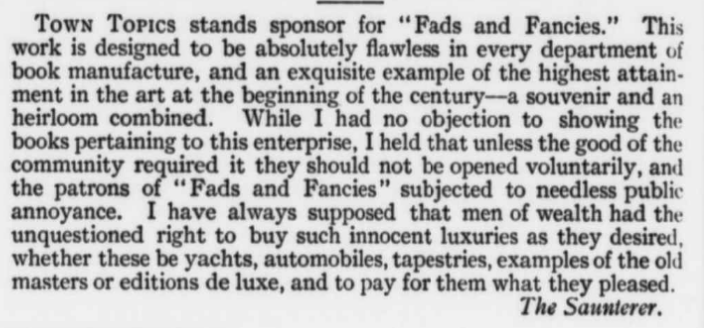
But here’s the catch: no one had been able to subscribe to it for the past two years, and yet, it still hadn’t been published. It too seemed to be “a front for blackmail and extortion, but here the stakes were higher” (Caldwell 20). When questioned, Deuel denied any wrongdoing and claimed the project was delayed due to its sheer lavishness. Mann wanted it to be “the volume of the century,” printed “on Japanese vellum and bound in the flawless hide of an entire calf. (Logan, Part 1, 38)” This, Deuel explained, was why it was taking so long and why they were likely to lose money on it. Mann also issued a statement in the “Saunterer” defending Fads and Fancies of Representative Americans:
“I have always supposed that men of wealth had the unquestioned right to buy such innocent luxuries as they desired, whether these be yachts, automobiles, tapestries, examples of the old masters or editions deluxe, and to pay for what they pleased.” (Town Topics, Vol. 54, No. 3, 1905, 11)
By July 18th, Ahle had spent a week in jail. His wife managed to persuade a friend to pay his $3,500 bail. Afterwards, they sold off all their belongings and left the bustling city behind, quietly disappearing from public view (Logan, Part 1, 46).
Wooster and Wayne were also quietly cast out, most likely because they had done the one thing Colonel Mann could never forgive: they got caught (Logan, Part 1, 50).



Two Men and One Plan
The Holland House arrest rattled more than just the walls of Town Topics. In the offices of Collier’s Weekly, it set off a firestorm. Publisher Robert J. Collier had already taken issue with Town Topics in the past. When the magazine ridiculed twenty-year-old Alice Roosevelt’s Newport debut, Collier reportedly kicked over a basket of firewood in his study (Logan, Part 1, 55) and vowed to take the Colonel down.
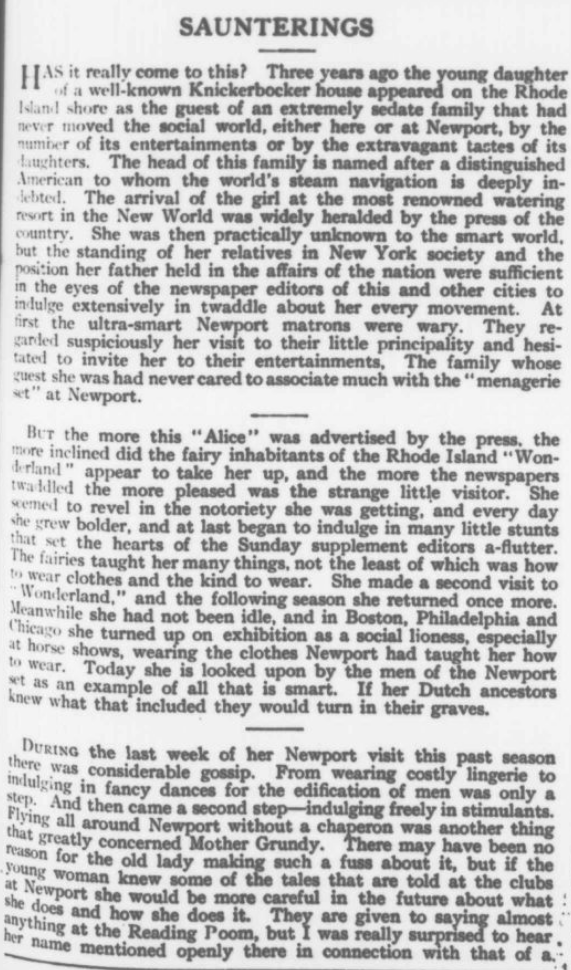
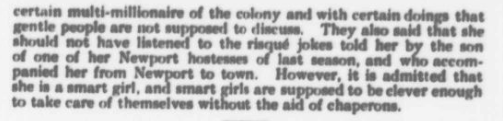
In one particularly vicious edition of The Saunterer, the magazine published a long, sarcastic profile of “Alice,” clearly referring to President Roosevelt’s daughter. The column ridiculed her social climbing, mocked her for dressing like a character from “Wonderland”, and accused her of using her family name to leapfrog into high society. It claimed she had once been “unknown to the smart world” and now returned to Newport, RI to “turn up on exhibition as a social lioness,” dressed for attention at horse shows and “indulging freely in stimulants.” The article even accused her of traveling without a chaperone, gossiping with the wrong sort of men, and listening to risqué jokes told by the son of a Newport hostess. It ended with a patronizing twist of the knife:
“However, it is admitted that she is a smart girl, and smart girls are supposed to be clever enough to take care of themselves without the aid of chaperons.” (Town Topics, Vol. 52, No. 16, 1904, 1)
Collier’s anger was also fueled by the years of ridicule directed at his Irish immigrant father, Peter Fenelon Collier, who had founded the magazine Collier’s Weekly in 1888. Robert Collier had finally reached his limit and sensed an opportunity to strike, seeing Edwin Post’s revelations as the opening needed to expose Mann’s blackmail operations (Logan, Part 1, 87).
His editor, Norman Hapgood, was equally fed up. He had recently earned his law degree, and after reading Post’s testimony in the Ahle case, he paid a visit to District Attorney William Travers Jerome. Jerome was honest. He said that Colonel Mann had covered his tracks for years, that no direct evidence of blackmail could stick to him because he always used intermediaries. In Post’s case, Jerome said that “the Colonel was too clever and too grasping to have anything to do with the petty maneuverings of the likes of Ahle”(Logan, Part 1, 88). The only way to trap him, he explained, was to provoke him. If Mann could be baited into suing for libel, he and his men would be forced to take the stand and answer under oath.
Hapgood and Collier immediately agreed to the plan. Beginning on August 5th, 1905, Collier’s Weekly published a series of veiled but unmistakable critiques. The editorials never named Town Topics directly, but the references were thinly disguised. Readers knew. Mann knew. The magazine was being accused of blackmail. Of extortion. Of selling silence.
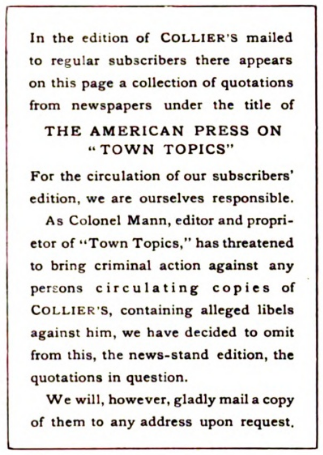
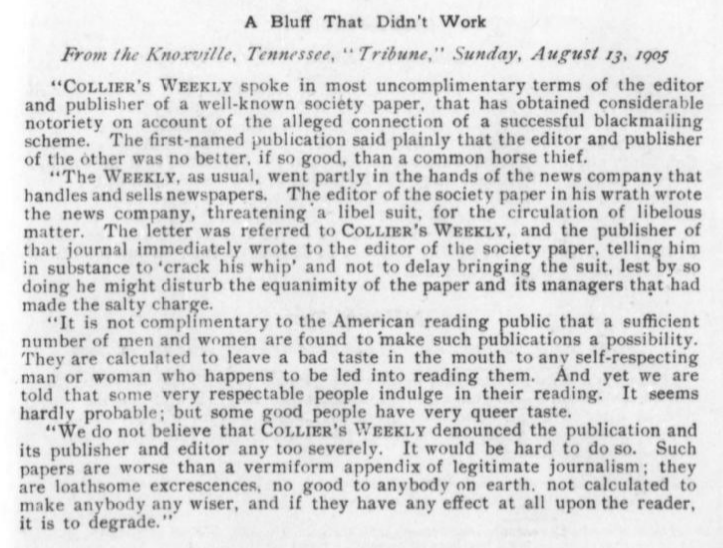
In one of their later issues, they reprinted reactions from other periodicals. This material appeared only in the subscribers’ edition, since Mann had threatened legal action against anyone who circulated copies through public newsstands. Still, these excerpts offer a glimpse into just how explosive those original articles must have been. One such reaction read:
“COLLIER’s WEEKLY spoke in most uncomplimentary terms of the editor and publisher of a well-known society paper, that has obtained considerable notoriety on account of the alleged connection of a successful blackmailing scheme. The first-named publication said plainly that the editor and publisher of the other was no better, if so good, than a common horse thief.” (Collier’s Weekly, Vol. 36, Iss. 8, 1905, 33)
And Mann did exactly what Collier and Hapgood hoped he would. First, his associate Justice Joseph M. Deuel filed criminal libel charges against Hapgood on September 11th. Then Mann himself launched his own libel suit on October 27th, naming Hapgood and the Colliers (Logan, Part 1, 89). Although both Deuel and Colonel Mann initiated libel proceedings, only Deuel’s case ever reached the courtroom. In the end, it was Hapgood alone who stood trial, with Deuel as the official complainant (Logan, Part 2, 42).
This marked the beginning of a spectacle that would pull Mann into court not as a judge of morals, but as the subject of national scrutiny. With the trap sprung, the man who ran the most feared gossip magazine in New York City would be forced to explain how the system worked.
Not the Only One on Trial
The courtroom at Centre Street may have had Norman Hapgood in the defendant’s chair, but it quickly became clear that it was Town Topics itself that was being judged. Colonel William d’Alton Mann, the magazine’s flamboyant publisher, stood at the center of it all, no matter who held the official title of complainant.
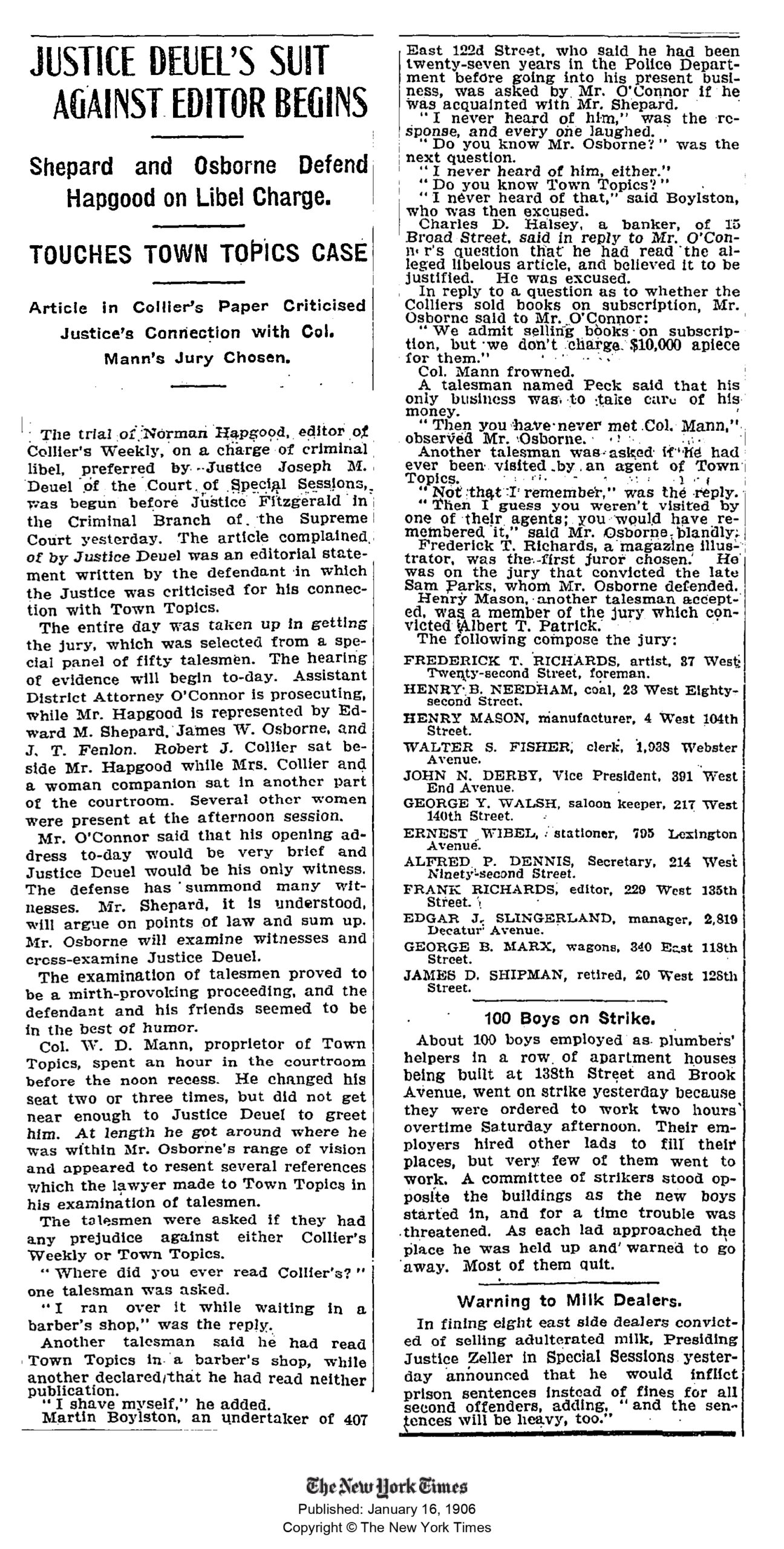
The trial opened on January 15th, 1906, drawing a crowd that spilled into the courthouse corridors. Inside the courtroom, the mood felt more like that of a theatrical premiere than a legal proceeding. The trial was even described as “an attraction of carnival proportions” (Logan, Part 2, 50). Benches were filled with journalists, curious citizens, and society women who treated the trial like a social event. Mr. Hapgood was represented by Edward M. Shepard, James W. Osborne, and J. T. Fenlon.
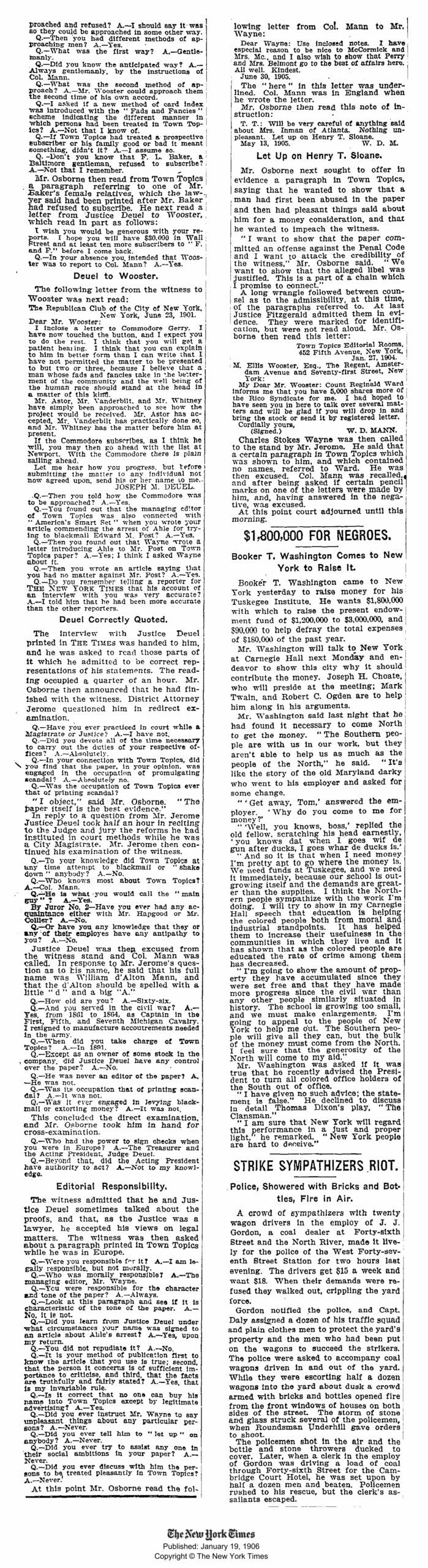
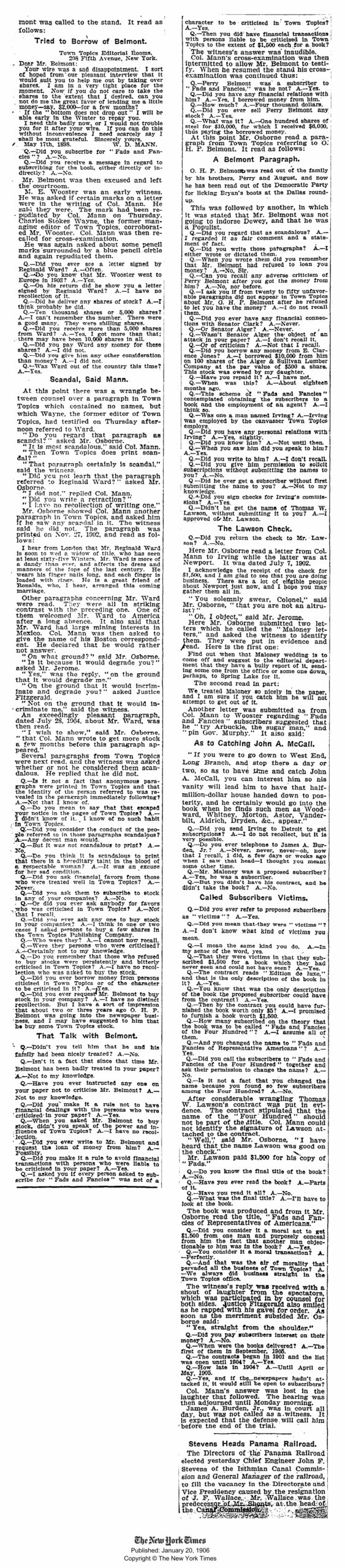
In the opening days, Mann tried to present himself as a reputable publisher. But under questioning, his demeanor began to shift. When asked if he had borrowed money and not repaid it, Mann grew visibly uncomfortable. He hesitated, became red in the face, and whispered to Justice Fitzgerald that he didn’t like to answer these questions (NYT, 20.01.1906, Part 1). At several points, the courtroom even laughed at his answers. His methods of how he operated became most obvious when the prosecution brought up a key example: the case of O. H. P. Belmont.
H. P. Belmont had declined to make financial contributions to Town Topics, which in this case meant purchasing shares or investing in the magazine. Mann had also attempted to borrow money from Belmont, a request that Mann could not recall at first during his courtroom testimony. In addition, he refused to pay for inclusion in Fads and Fancies. Not long after, Town Topics published a scathing article aimed directly at him. The implication in court was difficult to ignore. Mann’s magazine did not simply reward cooperation. It retaliated against resistance. Belmont’s experience illustrates how Town Topics operated through a calculated mix of flattery and pressure, favoring those who paid and punishing those who refused. (Logan, Part 2, 63; NYT, 20.01.1906, Part 1)
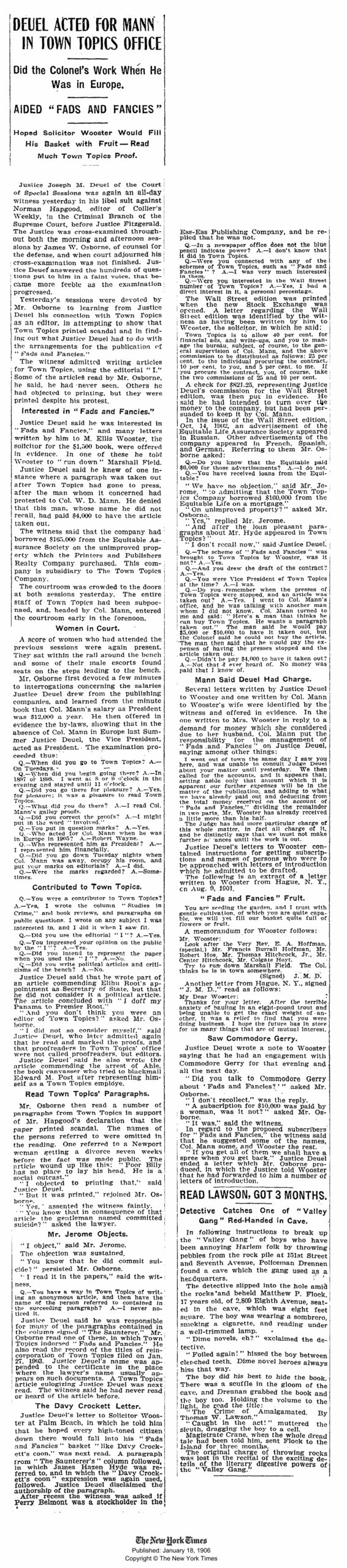
Another pivotal example came in the testimony surrounding Reginald Ward. Early items about Ward in Town Topics were unflattering, calling his fiancée “a widow of title who has seen at least sixty-five winters” (Logan, Part 2, 62), hinting at personal scandal and raising questions about his past. But after Ward arranged to pay for favorable attention, not in cash but in stock certificates, the tone of the magazine shifted dramatically. A later issue praised him in glowing terms. Suddenly, it was said about him that “few men have gone from the States to London and established themselves more successfully in both the social and financial worlds than Reginald Ward” (Logan, Part 2, 62). This before-and-after pattern was not subtle. The defense used it to illustrate how Town Topics functioned: as a publication where content was a direct reflection of private negotiations.
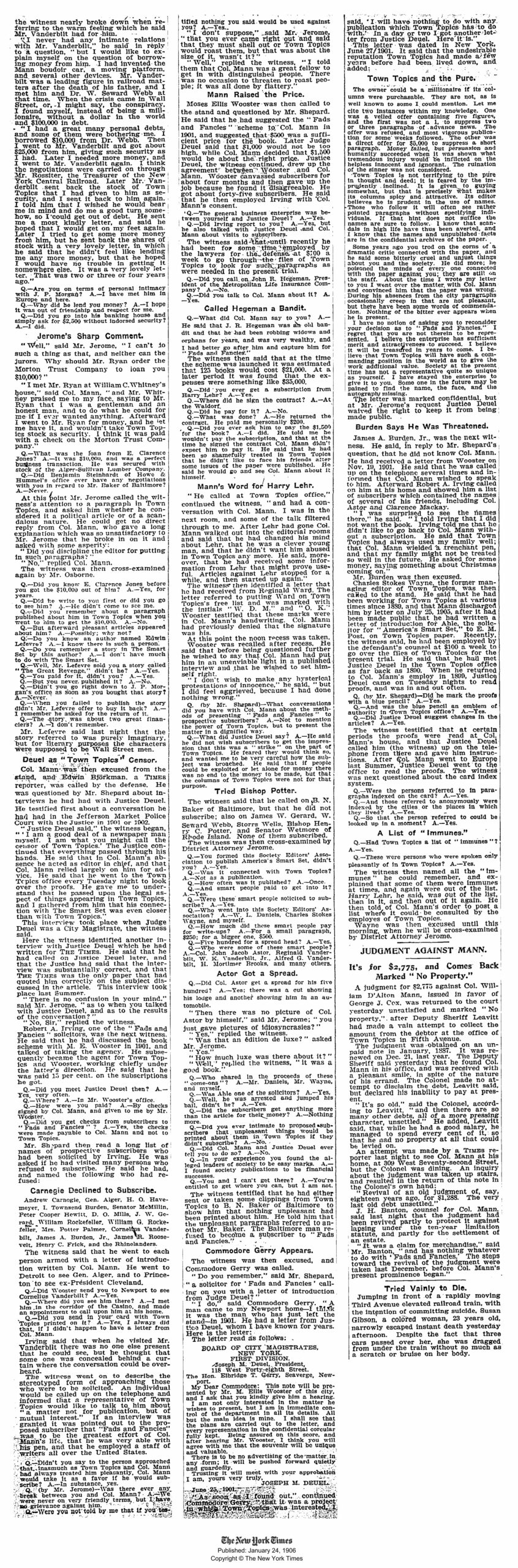
Perhaps the most damaging testimony came from Moses Ellis Wooster, a former associate of Mann’s who had since aligned himself with the Collier’s camp. He stated clearly that he had seen Mann initial a letter regarding Reginald Ward with the now-infamous notation “O.K. – W.D.M”. This was the very letter Mann had claimed never to have seen. The contradiction between Mann’s sworn denial and Wooster’s firsthand observation became even more significant later on. (NYT, 21.01.1906)
Throughout these proceedings, Justice Joseph M. Deuel, the plaintiff in the libel case, was largely absent. Although he had filed the complaint against Hapgood, Deuel failed to return to court after the opening day. His empty seat next to Mann in the front row remained vacant throughout the trial. (Logan, Part 2, 80)
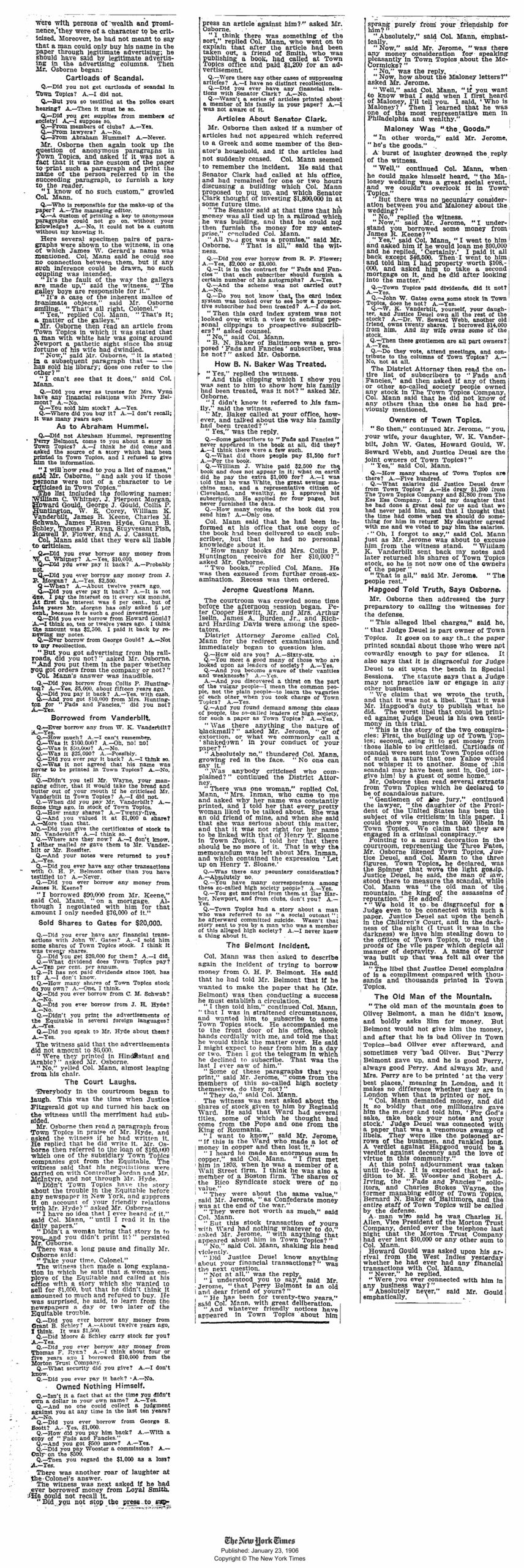
The closing days of the trial turned attention back to Norman Hapgood, who explained that his editorials in Collier’s Weekly had been written after consulting with District Attorney William Travers Jerome. Hapgood testified that Jerome had told him it would be difficult to prosecute Colonel Mann directly, and that the most effective course of action would be to provoke Mann and Justice Deuel into filing a libel suit. This, Jerome reasoned, would bring them into court and force them to testify under oath (Logan, Part 2, p. 80).
James W. Osborne, Hapgood’s defense attorney, argued that the articles were not libel at all. “They wrote the truth,” Osborne told the jury, “and it was not a libel. It was Mr. Hapgood’s duty to publish what he did. The worst libel that could be printed against Judge Deuel is his own testimony in this trial” (NYT, 23.01.1906, Part 2).
Shepard, who also argued on behalf of the defense, offered a final reflection that struck directly at Mann’s courtroom discomfort.
“It is a splendid thing that there is an act which can be used to make a man, against his will, tell the truth about himself” (Logan, Part 2, 82).
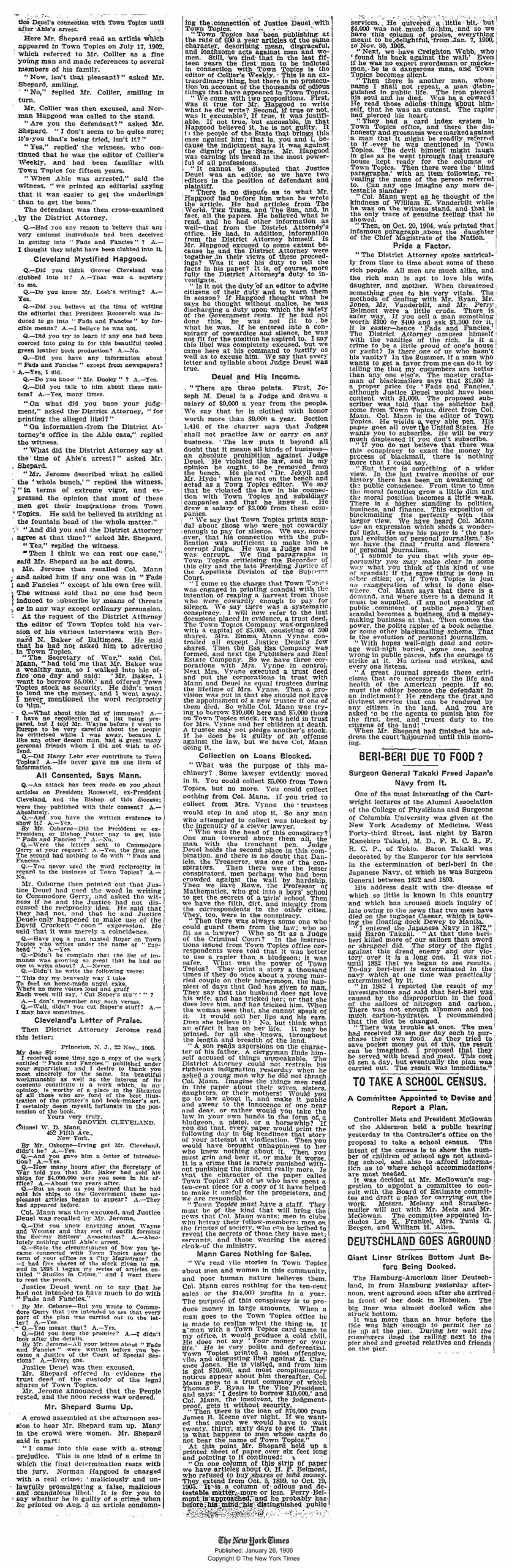
On January 26th, 1906, the jury returned its verdict. After only seven minutes of deliberation, they found Hapgood not guilty. The courtroom broke into applause. The editor who had called out the structure of Town Topics left vindicated. Mann, though not on trial in name, had been exposed before the public. Jerome walked out of the courthouse with Hapgood and the Colliers, all three arm in arm, heading to lunch at Delmonico’s. (Logan, Part 2, 82) The group passed Colonel Mann on their way out. When reporters asked him for comment, he muttered:
“Why should I say anything? I wasn’t the prisoner.” (Logan, Part 2, 82)
He was right in the strictest legal sense, but to anyone who had followed the trial, it was clear that Town Topics had been weighed, questioned, and publicly exposed.
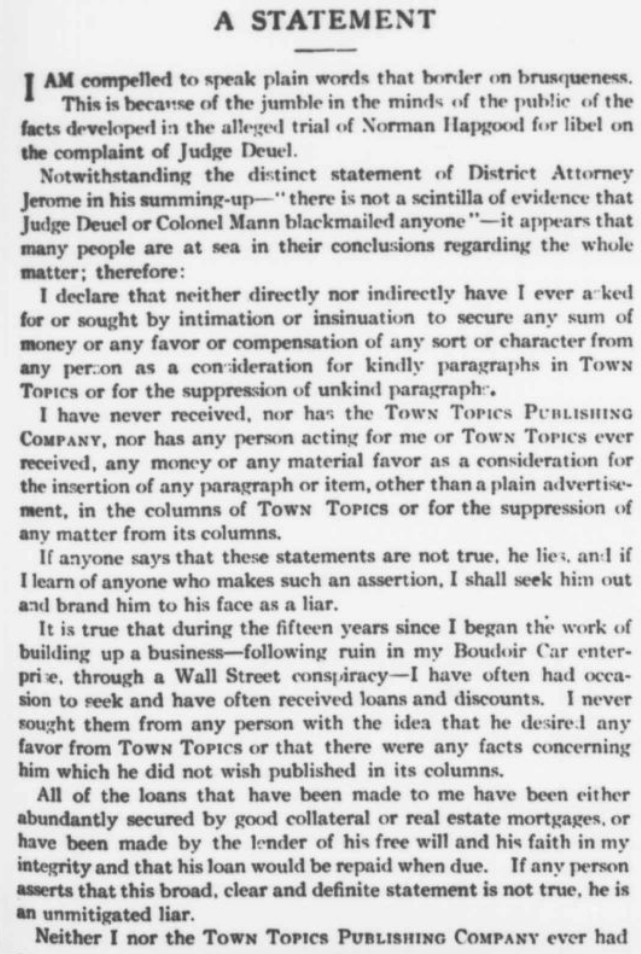
On March 1st, 1906, William d’Alton Mann issued a formal statement in Town Topics:
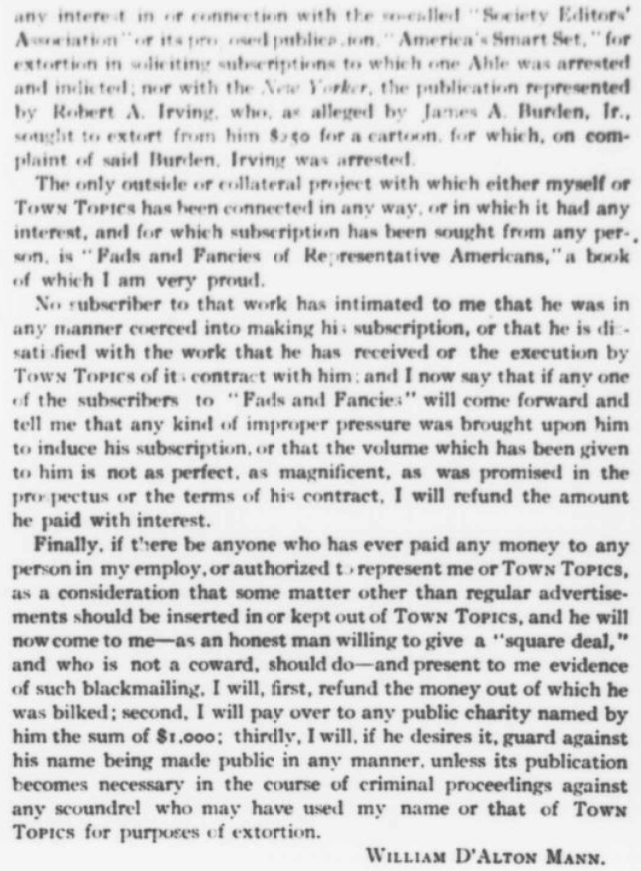
“I declare that neither directly nor indirectly have I ever asked for or sought by intimidation or insinuation to secure any sum of money or any favor or compensation of any sort or character from any person as a consideration for kindly paragraphs in Town Topics or for the suppression of unkind paragraphs. […] If anyone says that these statements are not true, he lies, and if I learn of anyone who makes such an assertion, I shall seek him out and brand him to his face as a liar.” (Town Topics, Vol. 55, No. 9, 1906, 22)
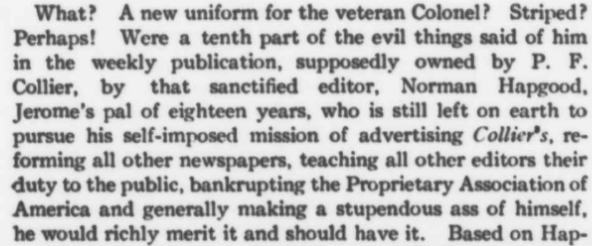
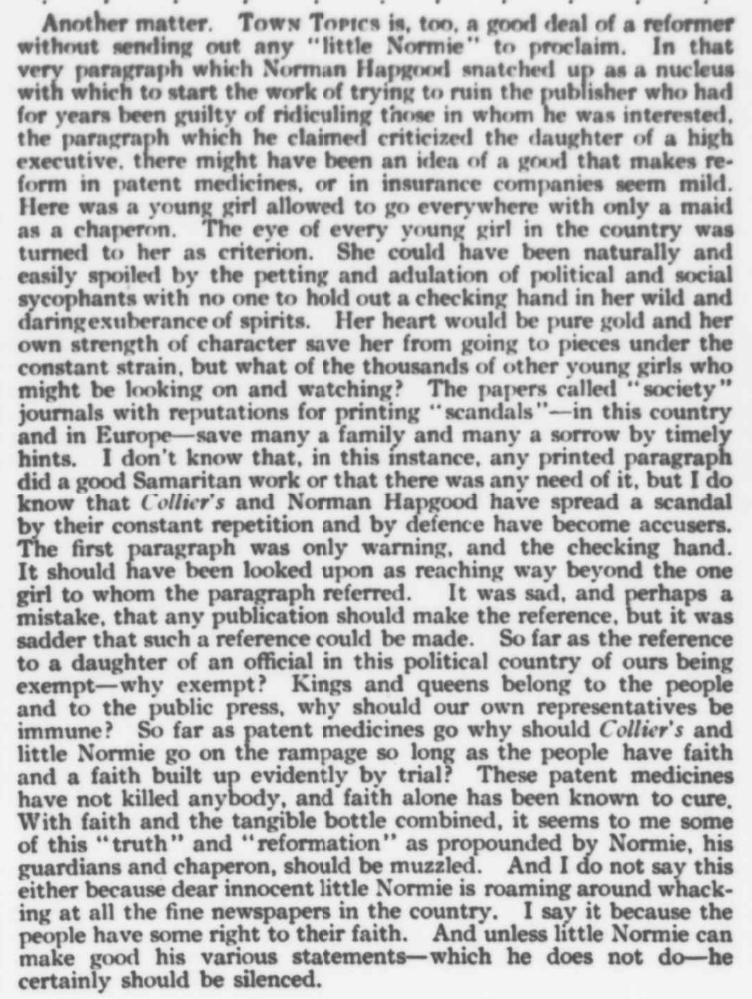
Town Topics also continued its personal attacks on Norman Hapgood after the trial. In the April 12th, 1906 issue, the magazine claimed that Hapgood “generally [makes] a stupendous ass of himself” (Town Topics, Vol. 55, No. 15, p. 13). The magazine renewed its criticism over the Alice Roosevelt affair, mocking him as “little Normie” and accusing him and Collier’s of having “spread a scandal by their constant repetition and by defense have become accusers” (p. 17). The article twisted the narrative by implying that the real scandal was that it was possible to refer to it, suggesting that Alice Roosevelt should not be immune from public scrutiny just because she was the daughter of a sitting president.
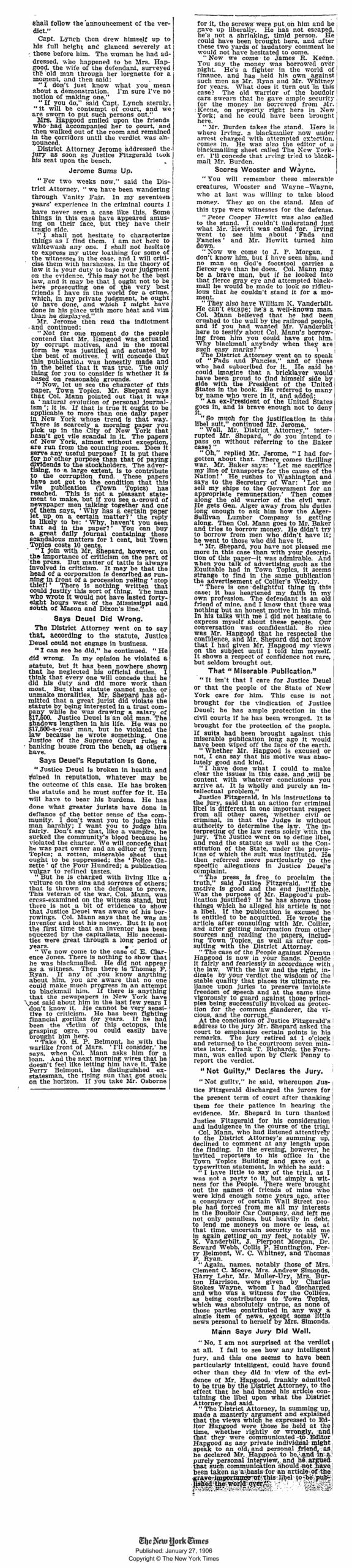
In the gallery below, you will find the New York Times articles covering the libel trial, published between January 16th and January 27th, 1906. I’ve included them here, as I couldn’t cover the full extent of their content in this blog, but you can read through them if you’re interested in a more detailed account.







The Remaining Stones Follow
The Hapgood trial may have ended with a not guilty verdict, but Colonel William d’Alton Mann’s legal troubles were not over. Just weeks later, the Colonel himself was indicted, not for blackmail or extortion, but for perjury. The charge arose from Mann’s sworn testimony in court, where he was accused of having “willfully, knowingly, corruptly, and feloniously” lied under oath by repeatedly denying that he had written or ever seen the notation “O.K. – W. D. M.” on the Ward letter (NYT, 28.01.1906, Part 1). On the day of his arrest, Mann offered only one statement:
“I deny the charges; that’s all I have to say.” (NYT, 28.01.1906, Part 2)
On February 27th, 1906, Mann’s new attorney, Martin W. Littleton, presented a three-hour speech before a magistrate to dismiss the case, and was granted a two-week recess to allow the District Attorney time to respond. However, rather than prepare a rebuttal, District Attorney William Travers Jerome made a tactical move. In that two-week window, he presented the evidence to a grand jury, which deliberated privately without any input from the defense. On March 12th, the grand jury returned a formal accusation for perjury, officially charging Mann. (Logan, Part 2, 86)
The case proceeded to the Court of General Sessions. The trial opened on December 17th, 1906. Mann once again entered the courtroom with his trademark elegance, but this time the confidence seemed thinner. He no longer controlled the narrative. The prosecution had clear documentation suggesting that Mann had lied under oath. Moses Ellis Wooster, former Town Topics employee and solicitor for Fads and Fancies, testified that he had seen Mann write the “O.K.” and sign with his initials (Logan, Part 2, 88; NYT, 28.01.1906, Part 1). Six handwriting experts even confirmed that “the notation was in Mann’s handwriting” (Logan, Part 2, 88).
Littleton attacked the indictment from multiple angles. He tried to undermine Wooster’s credibility (NYT, 08.02.1906) and claimed that the only proof of perjury “hung on the word of that ‘smooth, oily, subtle, sinister, slick fakir’ Wooster; as for the Colonel, he was widely known as an exemplary citizen and a brave soldier” (Logan, Part 2, 88). He also brought in his own witnesses to testify that the note was not written by Mann. All of them, incidentally, were employed by Town Topics at the time. Not that this detail was meant to matter, of course. In fact, “most of them thought the characters looked like Wayne’s handwriting”, as Wayne “frequently used these initials in passing on proofs for the paper when the Colonel was away”. Wayne had denied this accusation repeatedly. (NYT, 28.12.1906)
On December 28th, 1906, at 11PM, the jury agreed with Littleton. Mann was not guilty.
The verdict stunned many, but Assistant District Attorney Garvan admitted that the prosecution had “made the most of a slim case.” As he explained, the outcome rested “almost entirely upon whether the jury would believe the testimony of Moses Ellis Wooster”, a former Town Topics associate who, by the time of the Hapgood v. Deuel case, had already switched sides and was working with Collier’s. Another potential asset for the prosecution, Charles Stokes Wayne, had also defected to Collier’s Weekly, which further weakened the integrity of the state’s witnesses. (NYT, 29.12.1906)
Defense attorney Martin W. Littleton capitalized on this. He portrayed both men as opportunists and damaged their credibility in front of the jury. His final blow came in the form of a sharp remark that landed heavily:
“No one could conscientiously convict any one upon the word of two such men.” (NYT, 29.12.1906)
Peter Fenelon Collier later remarked that he was “reasonably satisfied with the results of the crusade against Town Topics.” His hope had been to end the blackmail by exposing the Colonel’s methods to the public. (Logan, Part 2, 89)
After Colonel Mann walked out of the Court of General Sessions with a not guilty verdict in his perjury case, Town Topics remained technically intact. The verdict may have cleared him in legal terms, but the public perception was shifting quickly. Mann’s carefully cultivated image had suffered irreparable damage. The aura of control and threat that had once defined the magazine no longer inspired the same fear or fascination. Even if Mann himself refused to acknowledge it, the foundation of his operation had begun to crumble.
Others began to come forward. Several members of New York’s elite who had once remained silent out of fear started to sue Mann. These lawsuits challenged both the contents of Town Topics and the methods behind Fads and Fancies, revealing that what had once been tolerated as sly social maneuvering was now seen more clearly as extortion. At the same time, public taste was shifting. The early twentieth century saw the rise of a different kind of reputation management. Instead of seeking inclusion in paid society books or fashionable gossip columns, the wealthy began investing their money in social organizations. The new standard of social respectability was no longer the glamour of a printed page but the permanence of a philanthropic institution. (Logan, Part 2, 90)
The introduction of the federal income tax in 1913 only accelerated this change. No longer able to hide wealth behind inherited charm or club membership, the upper class now had to justify their fortunes publicly. Philanthropy offered both moral cover and public praise. The glossy praise once sold by Colonel Mann could no longer compete with a wing at the Metropolitan Museum or a dormitory at Harvard. (Logan, Part 2, 91)
After Mann’s death in 1920, Town Topics drifted. His editorial successors lacked both his theatrical instincts and his ruthless coordination. The “Saunterer” continued, but its tone softened and its audience shrank. The magazine retained its weekly rhythm but lost its momentum. The items became vague and lifeless. What had once been a tightly guarded enterprise of power and persuasion had become a cultural leftover. By the early 1930s, few remembered Town Topics as a threat. It lingered on until its final collapse, but the heart of it had died with the Colonel. (Logan, Part 2, 91-98)
The final issue appeared in November 1937 (Logan, Part 2, 98). No announcement was made. There was no farewell edition. Just silence. Town Topics, once the most feared gossip paper in New York, had finally run out of things to say. Its power had come from secrets. And without them, it had nothing left.
In the gallery below, you will find the New York Times articles covering the libel trial, published between January 28th and December 29th, 1906. I’ve included them here, as I couldn’t cover the full extent of their content in this blog, but you can read through them if you’re interested in a more detailed account.





By Nadine Tran
I want to thank the anonymous reviewer for their helpful feedback, and Sophia Maria Hilgenroth for going over the final text with care.

All content for educational purposes only.
University of Greifswald
Seminar: Editing Scandal
(Summer Semester 2025)
Instructor: Prof. Dr. Katrin Horn