How to be a Proper Member of High Society
This section takes a deeper look at the representation of women and the development of social expectations revolving around the gender norms of the Gilded Age. It examines, for example, certain female archetypes, etiquette in public spaces, and discourse around scandal and divorce, thereby trying to determine Town Topics’ standpoints on questions of changing gender ideals and social roles.
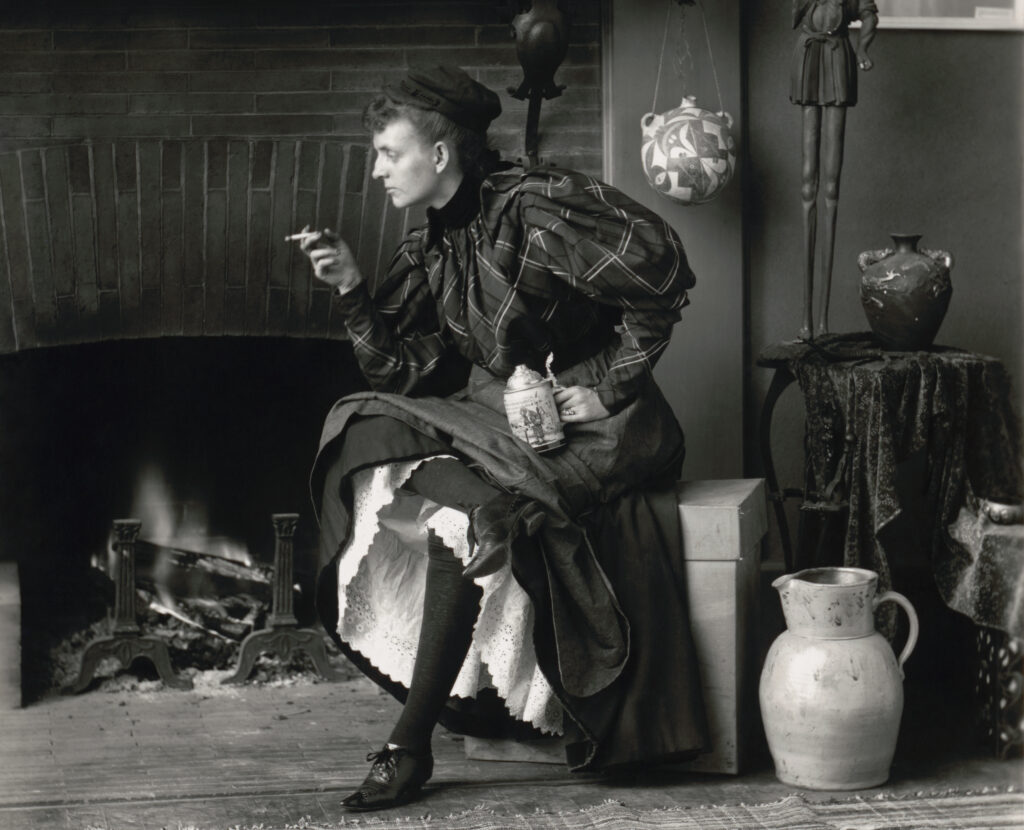
Library of Congress Prints and Photographs Division, Washington, D.C. Benjamin Johnston, Frances.
The Many Faces of Women in the Gilded Age — Gibson Girl, New Woman, Suffragette
In the United States of the late 19th and early 20th century, women became increasingly visible in public spaces through the appearance of new leisure activities and consumer culture, brought about by developments such as tremendous economic prosperity, industrial and technological progress, new social movements. These circumstances paved the way for the evolution of new female gender ideals which solidified themselves in the form of certain female archetypes. The Gibson Girl, the New Woman, and the Suffragette were an aesthetic, a socio-cultural, and a political phenomenon, respectively, and all described white, middle-class women from a younger age to roughly middle age. This projects studies the reception and portrayal of the three characters in Town Topics by analyzing the journal´s use of attributes, phrasing, tone, etc. when discussing them to answer the question whether being called a Gibson Girl, a New Woman, or a Suffragette was something to be aspired to or be avoided.
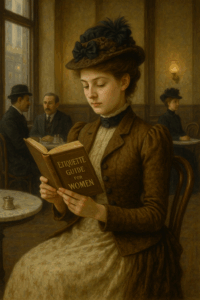
created with ChatGPT via the prompt: Could you create an image of a woman holding a book with “Etiquette Guide for Women” in the Gilded Age?
Women’s Etiquette in Public Spaces
The topic focuses on women engaging on etiquette guides in public spaces. In the Gilded Age, etiquette was a subject that could decide if someone was included in High Society. If well-behaved, invitations and strong connections could have followed.
The project is in form of a guideline that includes behavior rules for public spaces and a short quiz which allows the user to actively learn about the topic. The quiz consists of situations from Town Topics. Educational content and an active learning approach are the main aspects here. It provides a glimpse into women’s etiquette in High Society in New York between 1870 and 1900.
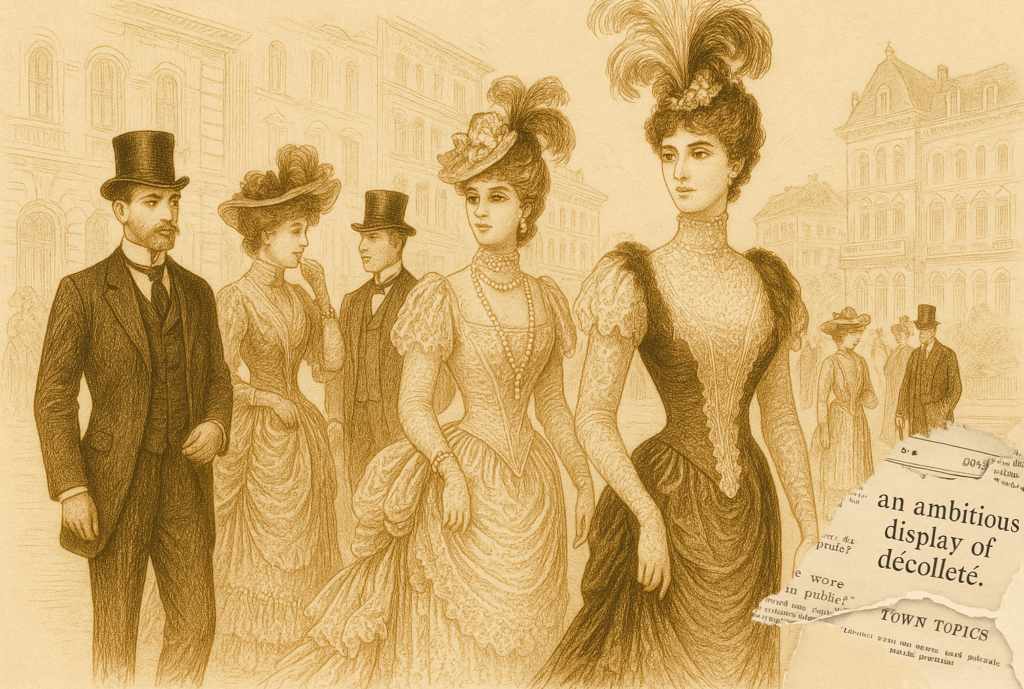
created with ChatGPT via the prompt Concept for homepage image of elite society late 1800s, landscape, light colors, Gilded Age style illustration (like old Harper‘s Bazaar fashion plates)
Hemlines & Headlines
Step into the stylish (and cutthroat) world of Town Topics, a New York society magazine that turned gossip into social regulation. Behind its witty tone and polished phrasing was a sharp eye for missteps, especially regarding how the wealthy dressed and broke unspoken rules. In the Gilded Age, fashion was used to signal status, and it quickly became a tool for policing society.
Using theories from Maureen E. Montgomery’s Displaying Women and Thorstein Veblen’s Conspicuous Consumption, the collection, in the style of an online tabloid or magazine, looks at how Town Topics both reflected and reinforced class expectations in the Gilded Age, especially for women. Because in this world, fashion could make or break someone.
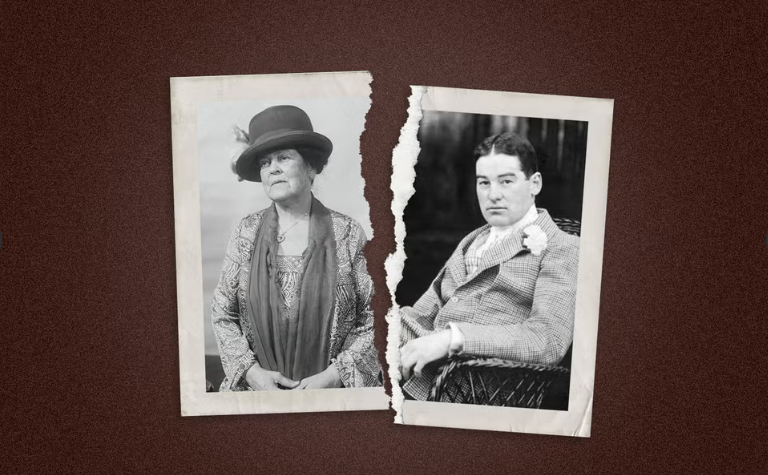
Getty Images. Courtesy newspapers.com. TownandCountryMag.com, https://www.townandcountrymag.com/society/ money-and-power/a64804460/gilded-age-divorce-scandal-alva-vanderbilt/
Scandal Coverage — Reputation in Town Topics
Broken engagements and divorces offer a unique perspective on how gender and morality were publicly debated during the Gilded Age. Town Topics didn’t just report on scandals, it also exposed how women were more vulnerable to reputational damage than men. While men often moved on with little consequence, women’s behavior, and visibility were constantly judged. Gossip acted as a kind of social control, reinforcing double standards around respectability, sexuality, reputation, as well as class. My blog explores these patterns through specific scandal cases, showing how Town Topics shaped public perceptions and also enforced social norms.
By Franziska Schnitzler
The Social Calendar
The idea of this project is to illustrate how the wealthiest of New York City’s elites mingled with each other. For the purposes of this, I have examined a time frame of ten years between 1890 and 1900 and created a representative calendar. The contents of the calendar are formatted in a way that attempts to capture the nature of Town Topics itself.
As the idea of social seasons is innately connected to debutante culture and the “business” of marriage, a brief section about this can also be found on this page. The central focus will be on the social events themselves and what might be important to know for a potential attendee.
The texts of this project are very consciously phrased to emulate the character of publications like Town Topics to give readers a glimpse into contemporary conduct literature and perhaps imagine themselves as a 19th century socialite for just a brief moment.

All content for educational purposes only.
University of Greifswald
Seminar: Editing Scandal
(Summer Semester 2025)
Instructor: Prof. Dr. Katrin Horn