Decadent Dresses. Cutting Remarks. Welcome to High Society.
Hemlines & Headlines
Published in New York City from 1885 to 1937, Town Topics was more than a high society magazine—it was gossip as gatekeeping. Covering the scandals and soirées of New York’s upper class week after week, the magazine named names and mocked missteps. If the Gilded Age had a fashion police, Town Topics was the badge and the bullhorn. This page explores the razor-edged world of social commentary, where no one was safe—especially women (and the occasional man) who dressed too boldly or reached too high. These excerpts show how elite femininity was curated, controlled, and often punished when it stepped out of line. Through the lens of Maureen E. Montgomery’s and Thorstein Veblen’s theories, these passages also reveal how Town Topics reinforced class distinctions, reflected elite societal values, and shaped the image of the ideal upper-class woman in the Gilded Age.
Fashion wasn’t just about looking good—it was about knowing your place.

when “Almost elderly” became the height of style
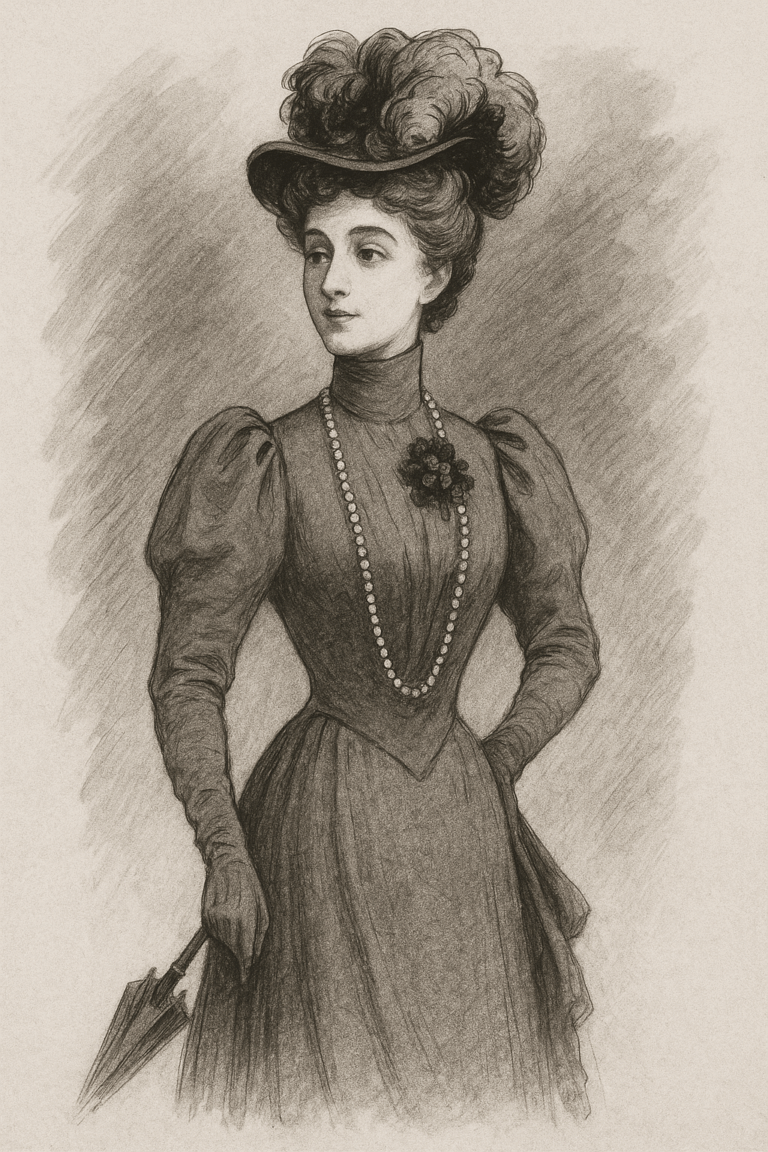
(OpenAI)
Miss May Handy proves dressing older than your years is the ultimate fashion move.
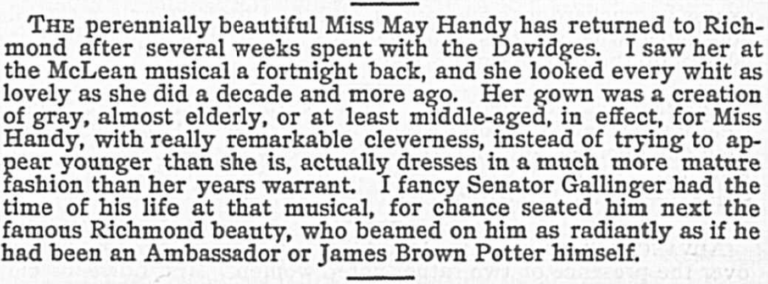
This Town Topics excerpt begins in praise—“perennially beautiful,” “every whit as lovely”—yet quickly pivots as the true compliment is not her looks but her strategy. Miss Handy’s success lies in performing age: selecting a gown “almost elderly” for a woman who is not. In the etiquette of 1890 high society, knowing how to age could matter more than resisting it.
Elite display often involves disciplined refusals—tasteful restraint rather than blatant showiness (Veblen 74, 96). By choosing middle-aged gray instead of youthful pastels, Miss Handy signals self-command, cultural capital, and immunity from fashion’s frantic chase. The gown is not just clothing but a tacit demonstration that she doesn’t need to compete on youthful allure.
Elite women’s visibility had to be “managed through carefully calibrated self-presentation” (Montgomery 12–13). Too vivid a display threatened gossip, and too little risked invisibility (as with Mrs. Gardner). Miss Handy’s gray compromise strikes the sweet spot of modest prominence. Montgomery further notes that aging posed special risks: successful social performers “embraced maturity as distinction, not decline” (56–57). Handy does exactly that, turning a potential liability into proof of refinement.
Thus, the observation is more than gossip. It is a performance review delivered by a society surveillance machine: Town Topics adjudicates whether a woman’s wardrobe aligns with class ideals. Miss Handy passes, not by feigning youth, but by modeling a maturity that flatters status and reassures observers she knows the unwritten rules.
Image Source:
OpenAI. A charcoal-style drawing of a lovely young woman in a refined gray 19th century gown with an elderly, overly mature silhouette, standing serenely at a society musical event, wearing her hair up in a modest style and exuding quiet elegance beyond her years. ChatGPT, 7 June 2025, https://chat.openai.com.
The Wardrobe Committee

Each week in Town Topics, these fashionable personas offered not just clothing commentary, but subtle instructions for living well—and being seen doing so.
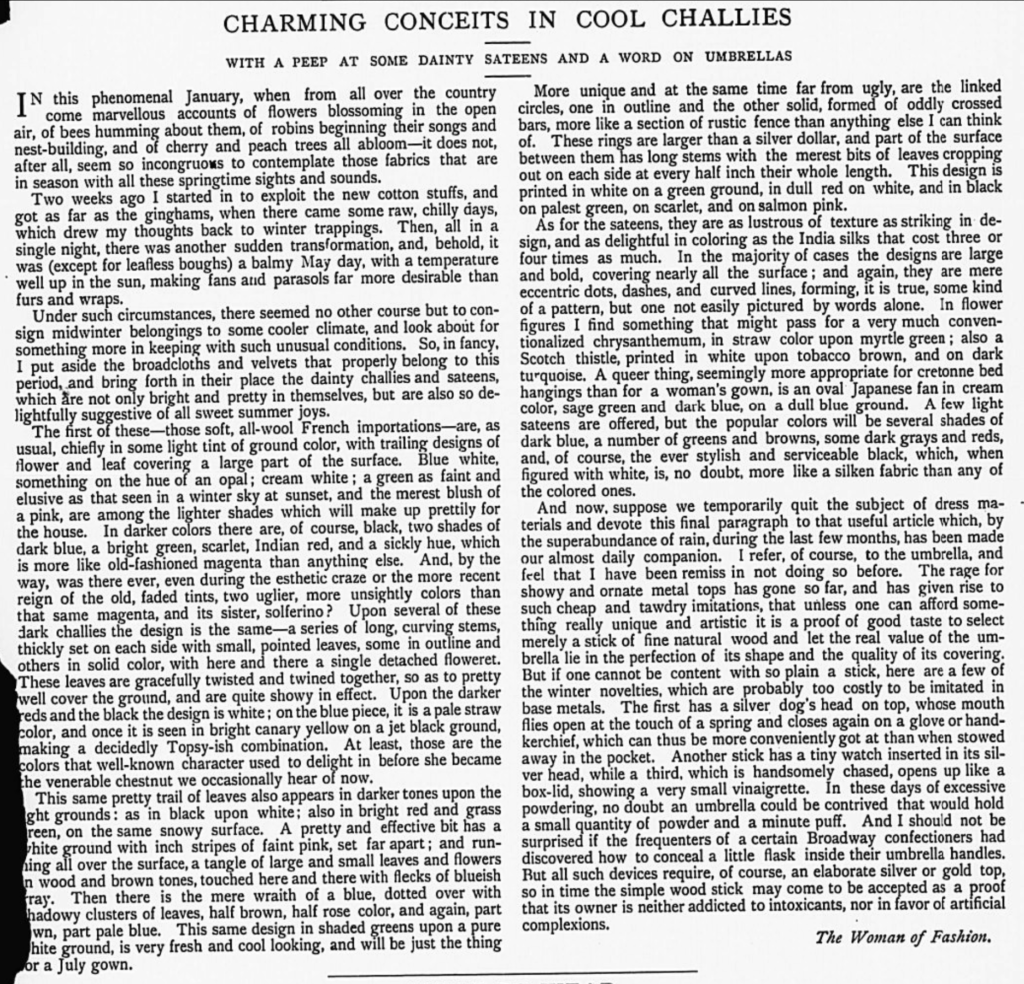
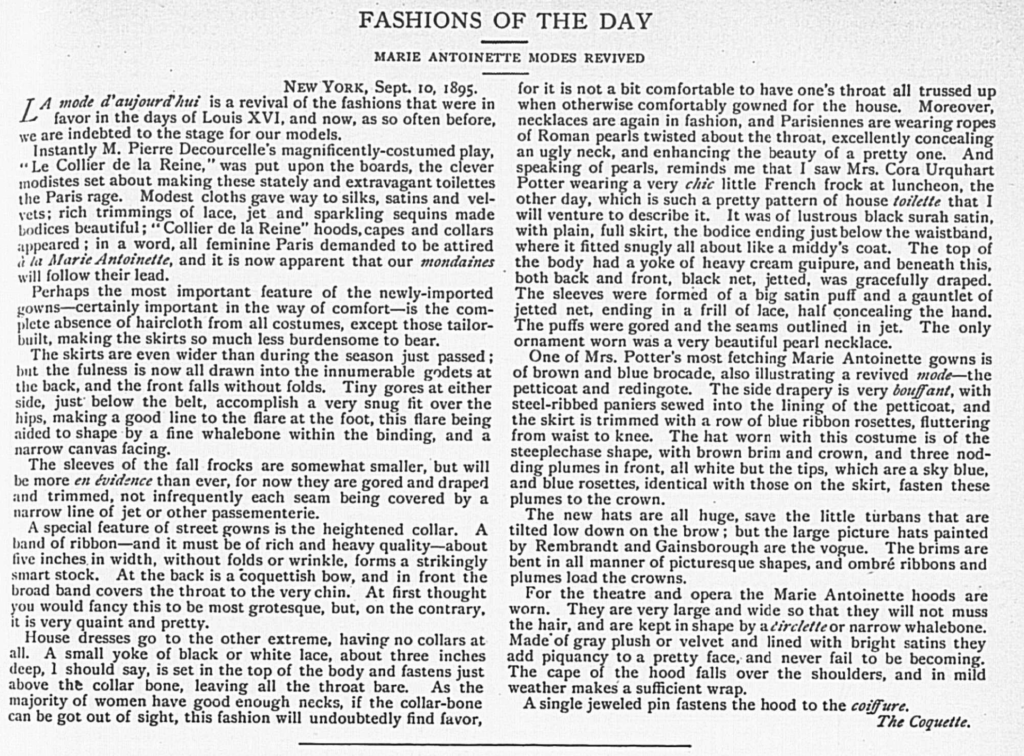
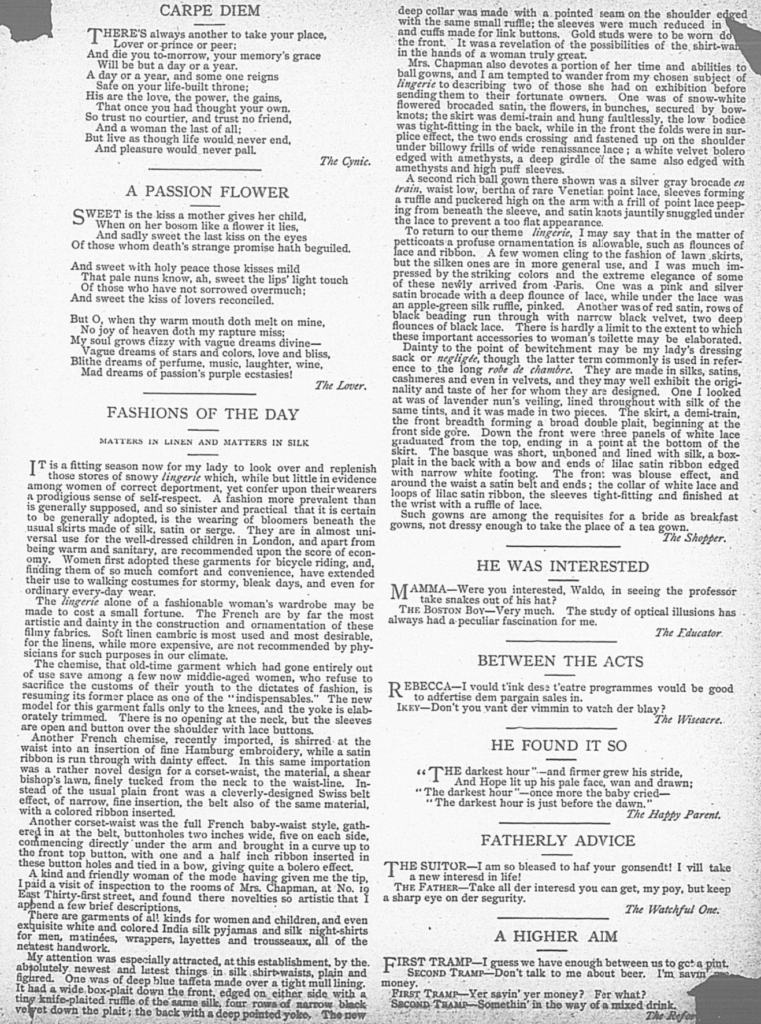
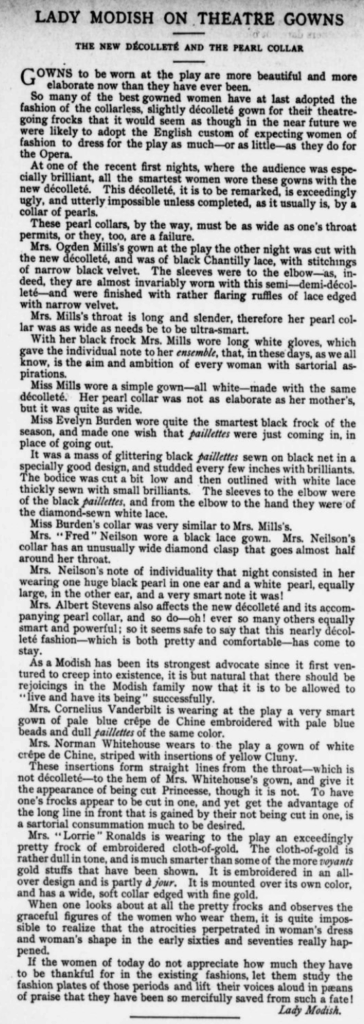
In the glittering world of Town Topics, fashion was very much curated. Meet the (unofficial) Wardrobe Committee: a rotating cast of columnists like The Coquette, Lady Modish, The Woman of Fashion, and The Shopper, who tracked, judged, and promoted the trends of the day. These weren’t only anonymous fashion blurbs—they were voices with flair, focus, and a sense of purpose. Together, they sketched out what it meant to dress and behave like a woman of style and status.
The Woman of Fashion
Town Topics, Vol. 23, Issue 4, p. 17. January 23, 1890.
A strategist for the season, the Woman of Fashion offered readers a vision of elegance rooted in foresight. She recommended cool challies, chill-proof accessories, and “woven cane” umbrellas—essentials that balanced style with practicality. Her tone was pragmatic yet polished, showing that true refinement required not just beauty but planning. In her careful blending of trend awareness and sensible restraint, she embodied what Montgomery describes as the elite woman’s responsibility to navigate between novelty and respectability—staying fashionable without seeming frivolous (115).
At the same time, her advice reveals a subtler layer of status performance. Though her suggestions appear practical, the materials and finish suggest quiet luxury. This understated elegance reflects Veblen’s idea of conspicuous leisure in disguise, where even functional items serve as signs of privilege when their refinement signals one’s place above necessity (53). The Woman of Fashion didn’t just dress well for the weather; she demonstrated how to master the season with decorum, subtlety, and social intelligence.
The Coquette
Town Topics, Vol. 34, Issue 11, p.21. September 12, 1895.
Playful and performative, the Coquette orchestrated fashion like a seasoned stage manager—always on top of the historic revivals and the spectacle of style. From “Marie Antoinette hoods” to pearls “thrown on in armfuls,” her column lent theatrical flair a respectable sheen.
She uses delicate, ornamental language that suggests an excessive, tactile beauty—not just what’s fashionable, but what seduces the eye. The word thrown, mainly, implies a casual, almost effortless luxury—a calculated nonchalance signaling someone who’s both aware of her charms and amused by them. Her fashion suggestions flirt with extravagance and rebellion, but always within safe, respectable bounds. For example, pearls “thrown on in armfuls” sound scandalously excessive, yet pearls remain a traditional, respectable accessory. She permits readers to push the line, not cross it.
Her reference to Marie Antoinette—the ultimate historical figure of opulent excess and tragic glamour—invites readers to see fashion as a performative act, a playful role to inhabit rather than mere practical dress. It’s a knowing wink: this is all a little over-the-top, but that’s part of the fun.
This aligns with Maureen Montgomery’s idea of “the performance of femininity as spectacle,” where women display taste, wealth, and beauty in a way that appears effortless but is carefully constructed (102). The Coquette’s flirtation with extravagance respects the “invisible fence” of propriety, embodying Montgomery’s concept of “managed visibility” and illustrating Veblen’s notion of conspicuous leisure—ornate, ornamental, and ultimately impractical fashion that signals status (34).
In the Coquette’s world, fashion was an elegant game of dazzling and seduction, inviting readers to flirt boldly with luxury without ever crossing into scandal.
The Shopper
Town Topics, Vol. 37, Issue 2, p.17. January 14, 1897.
With a domestic flair and a sharp eye for embroidered chemises and linen bloomers, the Shopper championed intimate luxury. Her attention to detail extended beyond fabric and finish—she even listed prices. But this wasn’t about thrift. Quoting prices served a different purpose, signaling her command of the high-end marketplace. She knew exactly what fine lingerie should cost and why, positioning herself as an authority on value within the world of elite consumption. In Veblen’s terms, this is not economy but conspicuous knowledge—a demonstration of taste and expertise through confident price awareness (65).
Even in the most private sphere of dress, she displayed tasteful consumption. Montgomery argues that elite women were expected to balance domestic refinement and visible social standing, even in garments never meant to be seen (121). The Shopper showed readers that luxury wasn’t only about display but also about knowing what to buy, where to find it, and how to subtly assert class through every layer of clothing.
Lady Modish
Town Topics, Vol. 45, Issue 6, p.15. February 1901.
Elegant and a touch strict, Lady Modish narrated fashion as it appeared on New York City’s grandest stage: the theatre. Décolleté gowns with pearl collars became her gold standard, so long as “individuality” remained within tasteful, socially approved limits. What makes her strict is her firm insistence on maintaining decorum and class, policing style to ensure it upheld the values of elite femininity rather than crossing into vulgarity or excess. She celebrated refinement and grace, but only when expressed through recognized symbols of status and good taste.
Her prescriptive and admiring gaze reflects the moral surveillance Montgomery identifies in elite women’s dress, where fashion becomes a form of social control (109). Lady Modish acted as both judge and guide, approving fashionable innovation only when it adhered to the invisible rules of propriety. This careful management of style demonstrates Veblen’s idea of useless luxury as a form of social power—ornate fashion was not merely decoration but a visible marker of status and hierarchy (41).
Mrs. Gardner: a paradox of visibility
(OpenAI)
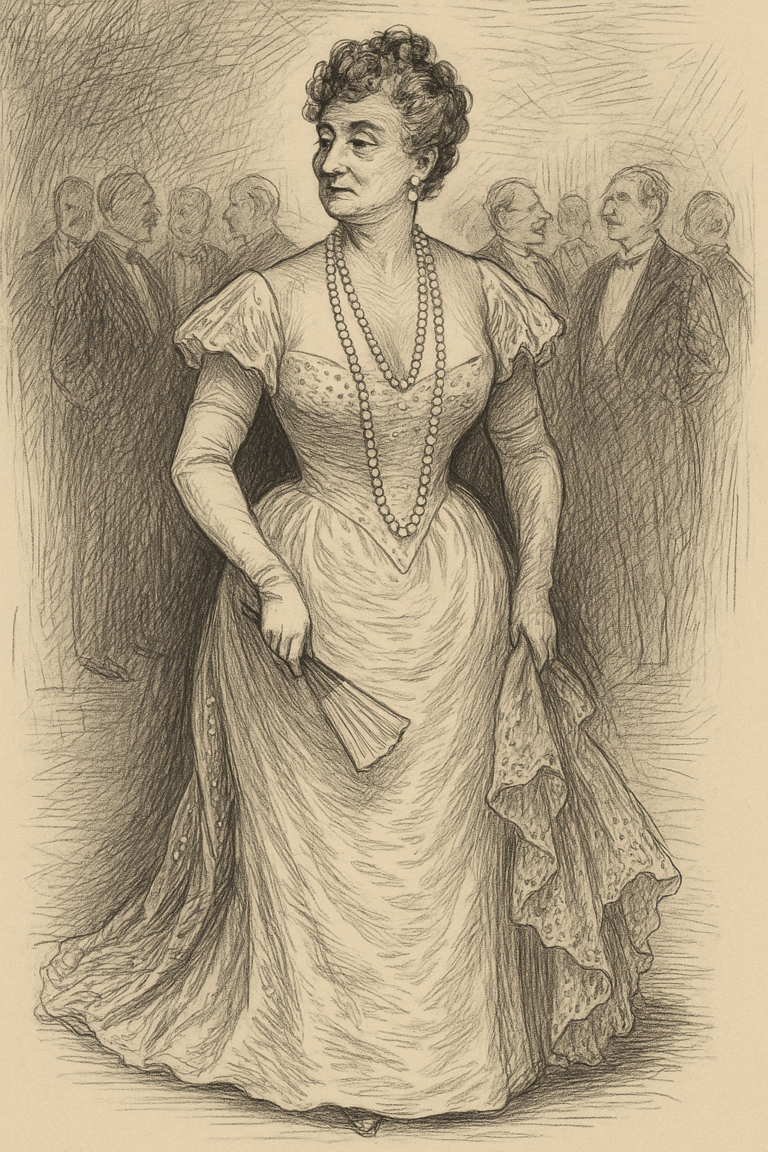
Every pearl she wore sparkled with elegance, and every glance with scrutiny.

Isabella Stewart Gardner was more than a society figure—she was a prominent Boston art collector, philanthropist, and founder of the Isabella Stewart Gardner Museum, which she opened in 1903. Known for her bold style and unconventional public persona, she became a fixture in elite circles and gossip columns alike (Isabella, bwht.org).
Mrs. Gardner was no stranger to attention in Town Topics, appearing in their “Saunterings” column multiple times. An 1894 mention noted her “late entree, in violet satin, with chiffon of a deeper shade, très décolleté, as usual” (Town Topics, January 18, 1894, p. 8).
This wasn’t just a one-off observation—it foreshadowed the sharper critique that followed three years later.
In 1897, Mrs. Gardner reappeared in the social spotlight, wearing “her white satin and silver spangled tulle of last year, and her long rope of pearls and diamonds.” But the commentary quickly shifted from admiration to censure: “It is needless to say that Mrs. ‘Jack’s’ corsage was low, sufficiently so to cause more than the customary comment. She is evidently going upon the principle that the older one gets, the less material is needed.”
This escalating scrutiny reveals how elite women’s bodies and fashion choices were repeatedly policed by society columns. As Maureen Montgomery argues in Displaying Women, visibility was both a privilege and a liability for upper-class women. Mrs. Gardner’s repeated appearance—and the increasingly sharp tone—illustrate the narrow boundaries of elite femininity: to be admired but not too bold, fashionable but age-appropriate (Montgomery 151).
By recycling last year’s dress—still luxurious, but not new—and embracing décolleté that defied ageist norms, she disrupted the expectations for elite women to consume fashion in a restrained and respectable way. Her outfit followed the aesthetics of high society but subverted its unwritten codes, particularly around aging and modesty.
This highlights the paradox of visibility for elite women: public attention offered status, but it also exposed them to ridicule, moral judgment, and potential exclusion from the inner circles they pursued. Mrs. Gardner’s bold style destabilized the safe meanings of elite femininity, challenging how women were expected to age gracefully, quietly, and without drawing notice. Her visibility became a double-edged sword: a display of independence and defiance that simultaneously risked her social standing (Montgomery 156).
In this way, Mrs. Gardner’s fashion choices revealed how easily a woman could fall out of favor simply by refusing to fade quietly into the background.
Image Source:
OpenAI. A satirical ink illustration of a mature Gilded Age woman wearing a white satin gown with silver spangled tulle, an exaggeratedly low corsage, and a long rope of pearls and diamonds, standing proudly at a society ball. ChatGPT, 6 June 2025, https://chat.openai.com.
THE ART OF GOSSIP: TOWN TOPICs’ SIGNATURE STYLE
Town Topics didn’t just report society news—it performed it. This section takes a closer look at how Town Topics used the magic of written language, ever so expertly and elegantly. Through both major and minor gossip, it brought the Gilded Age’s social scene vividly to life.
Town Topics is known for its unique style that blends light irony with quiet sharpness, making its gossip feel like a secret shared among an exclusive group. Its tone strikes a careful balance between familiarity and distance, creating a friendly yet polite voice that never feels too personal or harsh. This balance allows the magazine to pull readers into the private world of high society without being openly judgmental. Instead, it invites them to read between the lines and come to their own conclusions. According to anthropologist Sally Engle Merry, gossip like this acts as a subtle form of social control—it shapes reputations not through direct attacks but through carefully chosen words that hint at approval or disapproval (55-56).
The language of Town Topics is clean, clever, and polished. Rather than being loud or dramatic, it relies on understatement, euphemism, and double meanings. A fashion misstep might be called “a curious decision,” and a scandalous affair described as “most diverting.” These mild phrases let readers read between the lines and decide how serious the situation really is. Merry explains that gossip doesn’t just punish bad behavior—it also rewards good behavior (56). Town Topics does both: it gently mocks social mistakes while also giving quiet praise, using phrases like “gracefully gowned” or “most charming.”
The magazine’s overall voice and personal style are built on careful word choices, a smooth rhythm, and rhetorical tricks like irony or contrast. The writers rarely criticize anyone outright, but a slightly off or overly formal word can make a statement feel sharp. This quiet, elegant style keeps the magazine’s writing refined but still full of meaning. It doesn’t attack, but it also doesn’t flatter easily. Instead, it leaves room for readers to do the judging. This matches Merry’s view of gossip as something that both supports social rules and reminds people what happens if they step outside of them (57).
Reading Town Topics is just as much about what isn’t said as what is. Its tone, language, and signature style work together to create gossip that doesn’t just talk about scandal—it reflects the social rules, expectations, and power dynamics of the time. Merry’s theory helps explain how this works: by using hints instead of direct criticism, the magazine quietly keeps people in line (58). Readers are made to feel part of an exclusive circle, sharing in amusement and judgment. That’s what makes Town Topics so fascinating even today—it turns gossip into a kind of performance, full of elegance and quiet authority, and always impeccably dressed.
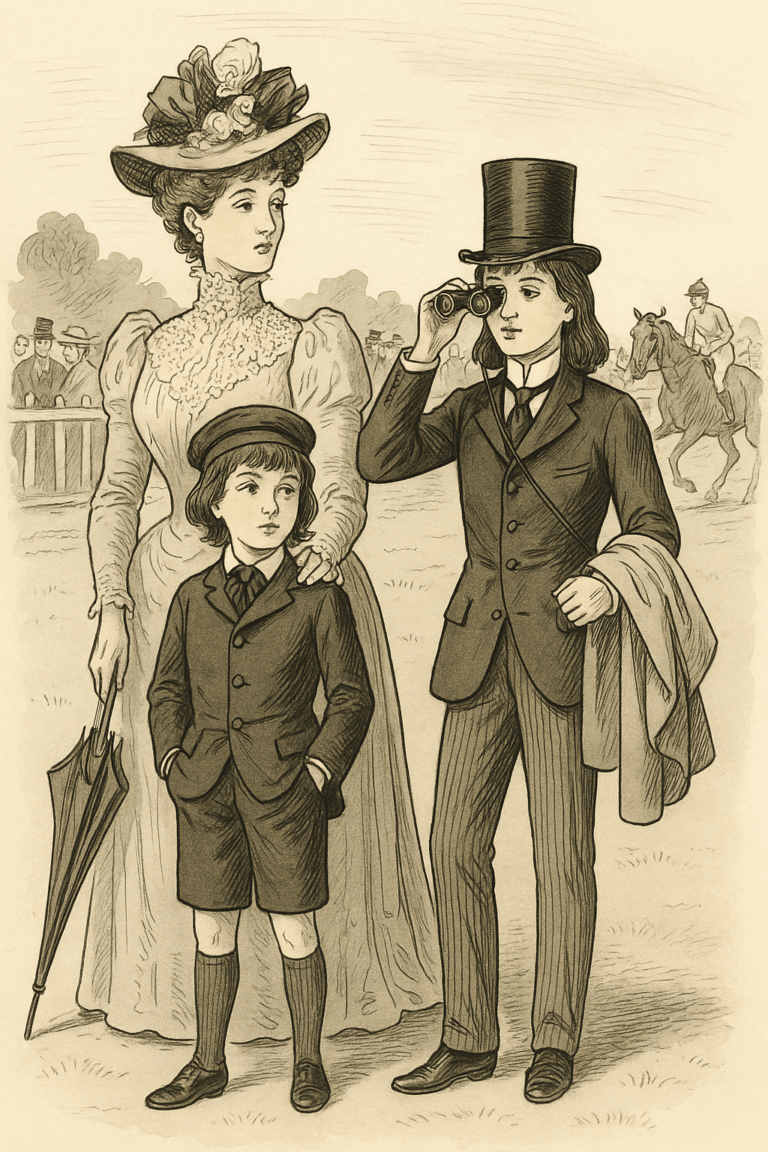
The Grand Prix, now a costume party?
(OpenAI)
Young ladies embodied the perfect gentleman overseas, and Town Topics is ready with the scoop.
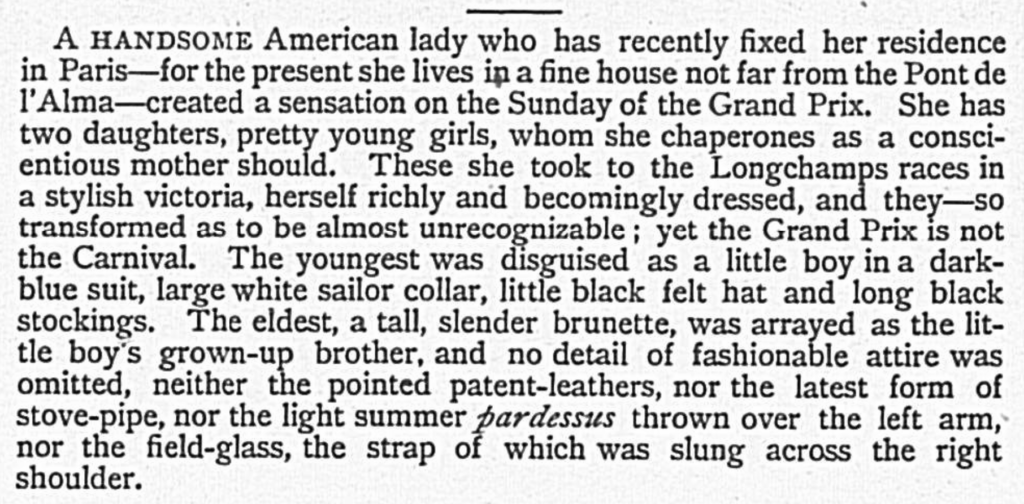
This passage from Town Topics is a wild ride. We’re not in Manhattan anymore, but New York City society was clearly tuned in. Gossip had wings, and when “a handsome American lady” and her daughters stirred the scene at the Grand Prix in Paris, France, the story landed across the Atlantic in Town Topics.
At first, the report seems harmless enough: a mother dutifully chaperoning her daughters to the Longchamps races, arriving in a stylish victoria (a fancy open-top carriage), dressed richly and appropriately. But the twist comes fast and sharp. Her daughters were “transformed as to be almost unrecognizable,” cross-dressing as fashionable young men, down to the stovepipe hat, patent-leather shoes, and casually slung field glass. This wasn’t the Carnival; this was a high-society event.
The commentary here is about more than fashion — it’s about gender, class, and decorum. The mother is initially praised for doing her maternal duty, but that approval sours into something more scandalous when the girls appear in male drag. This moment captures something Town Topics excelled at: delivering outrageous social happenings wrapped in winking prose and judgmental delight.
Maureen Montgomery’s concept of public femininity is useful here again, but flipped: instead of being too sexually visible (like Mrs. Tailer), these girls push boundaries by performing masculinity. Their fashion doesn’t suggest seduction but subversion. They play with power—borrowing the visual markers of young elite men—but in doing so, they rattle the performative scripts their class and gender were supposed to follow (Montgomery 11-12).
Montgomery emphasizes that elite women “worked at signifying leisure” through appearance and controlled self-presentation in public spaces. These performances were not spontaneous, but intentional, highly visible displays that affirmed class position and gender conformity (12, 121–122). The daughters’ drag parody did the opposite—it toyed with the seriousness of male display while pushing the boundaries of acceptable femininity.
Thorstein Veblen’s theory also offers a sharp lens. This display isn’t about utility—after all, dressing like men doesn’t make the race more enjoyable—it’s about spectacle. It’s conspicuous, performative, and intentionally transgressive (Veblen 42-44). The daughters’ parody of upper-class male fashion exaggerates its most superficial symbols: the hat, the shoes, and the summer coat over the arm. It’s mockery by mimicry, and Town Topics can’t resist broadcasting it.
At its core, this anecdote isn’t just about two girls in boys’ clothing. It’s about who has the right to play with fashion, to transgress, and to make a scene. And while the piece chuckles behind its fan, it also reminds us that stepping outside your sartorial lane—even playfully—could stir up whispers from Paris to Park Avenue.
Image Source:
OpenAI. A late 19th century ink and watercolor illustration of a fashionable woman at the Longchamps races with her two daughters cross-dressed as stylish boys: one in dark blue, the other as a tall, slender young man with patent-leather shoes, stovepipe hat, and a field glass strap. ChatGPT, 6 June 2025, https://chat.openai.com.
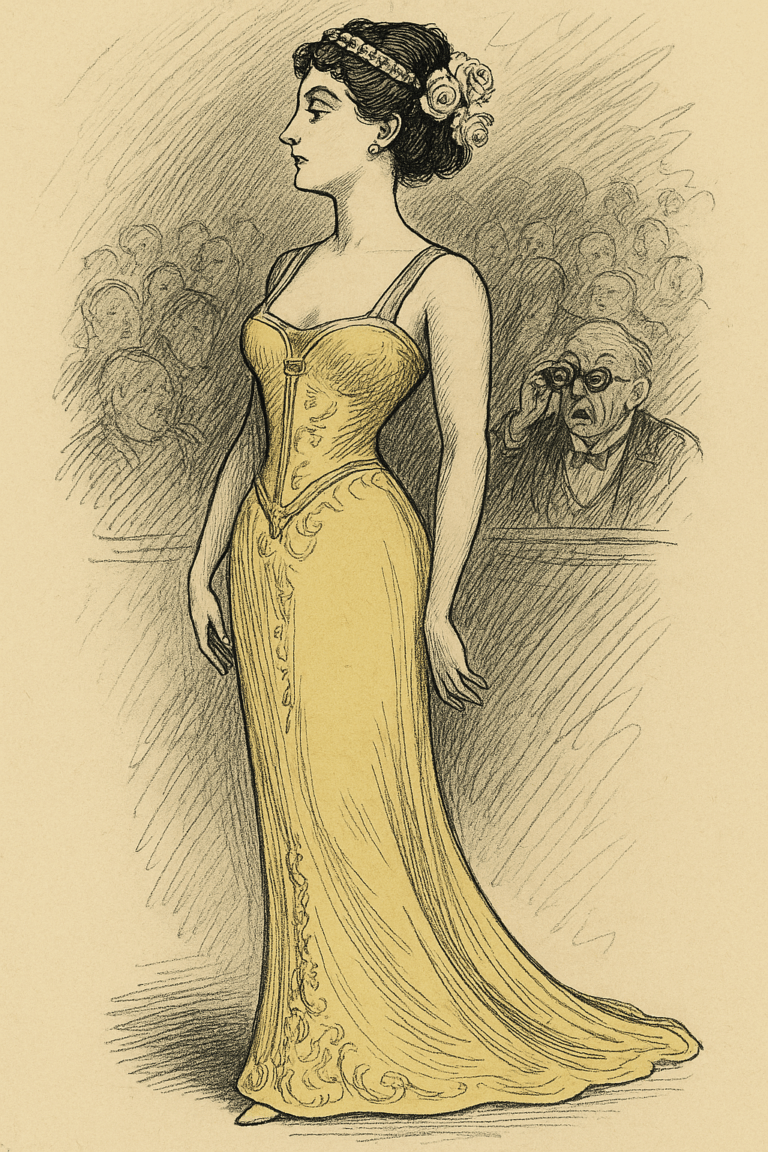
A Greek tragedy in Satin?
(OpenAI)
Mrs. Tailer wore a look too daring to be ignored yet too elegant to be dismissed.
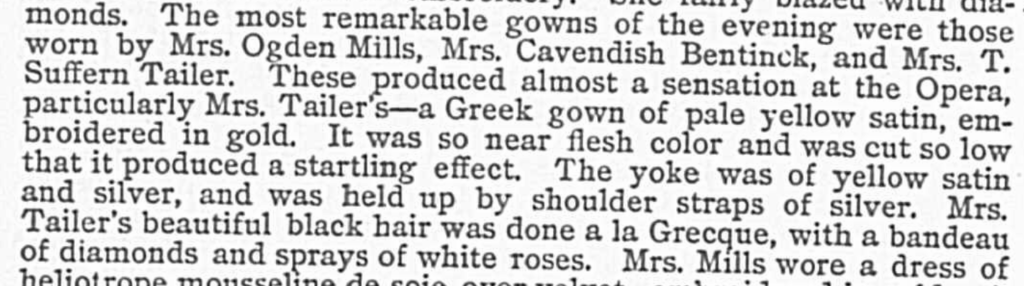
This brief remark packs a punch. It doesn’t just describe Mrs. Tailer’s gown—it passes judgment. This is fashion commentary turned surveillance, with Town Topics naming and shaming under the guise of chic reportage.
Mrs. Tailer’s appearance at the opera in January 1899 didn’t just turn heads—it sparked whispers loud enough to rattle the velvet seats. Dressed in pale yellow satin embroidered with gold, so close to her skin tone it was described as “startling,” she gave society more than enough to talk about. Her Grecian hairstyle, diamond bandeau, and sprays of white roses heightened the theatricality of her look—and the social tension it provoked.
The commentary on Mrs. Tailer’s dress goes beyond fashion critique; it is social policing masked as gossip—a reminder of the boundaries elite women were expected to uphold. Maureen Montgomery argues in Displaying Women that public femininity was a performance tightly governed by class, restraint, and carefully measured visibility. To deviate—even slightly—was to risk reputational backlash (Montgomery 10–11, 151).
Thorstein Veblen’s Theory of the Leisure Class offers further insight. The conspicuous elegance of Mrs. Tailer’s ensemble—and the wealth it signaled—placed her firmly within the leisure class. Yet her “startling effect” breached the unspoken etiquette for women who were meant to be adorned, not provocative. For Veblen, fashion signals class but exposes its contradictions: presentation invites both admiration and disapproval (75, 96).
This moment is about more than a gown. It’s about what a woman’s body, wealth, and self-presentation are allowed to say publicly, and who gets to decide when it says too much.
Yet even as the column clutches its pearls over the gown’s neckline, it softens when describing her accessories. The “beautiful black hair done à la Grecque,” the “bandeau of diamonds,” and “sprays of white roses” are described with clear admiration—a return to the familiar script of aristocratic femininity. These details are not merely decorative. As Montgomery notes, accessories were crucial in crafting the image of a socially successful woman—ornate yet restrained, lavish yet tasteful (117-118).
The praise for her coiffure (or hairstyle) and jewels works as a social readjustment, steering readers back toward the acceptable narrative: Mrs. Tailer is, after all, one of them. Her boldness may have startled many, but her diamonds redeemed her. This balancing act was the tightrope elite women walked to be both exceptional and conforming. For one night at the opera, Mrs. Tailer walked it in satin—and scandal.
Image Source:
OpenAI. A pen-and-ink illustration of a glamorous woman in a Greek-inspired pale yellow satin gown with gold embroidery, worn low and close to the flesh tone, with silver shoulder straps, a diamond bandeau, and white rose accents in her black hair; late 19th century high society style. ChatGPT, 5 June 2025, https://chat.openai.com.
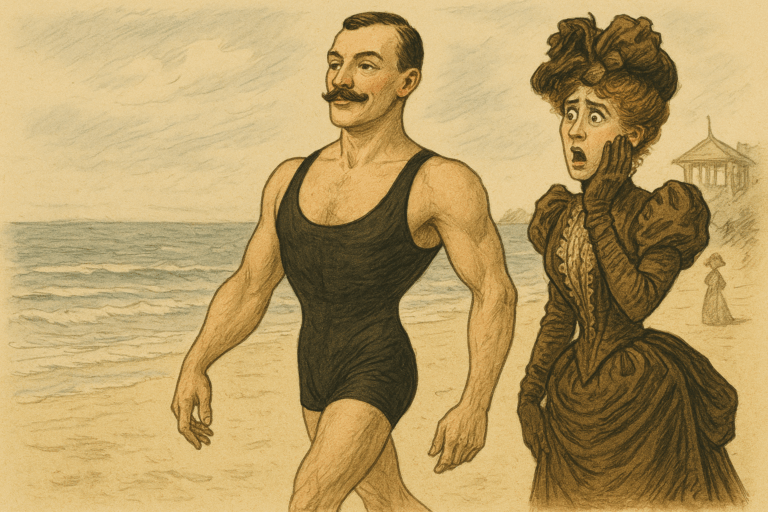
One Man. One Bathing Suit. Multiple offenses.
(OpenAI)
Mr. Beatty has the figure—and the flair. But Newport is still not ready for this much décolleté.
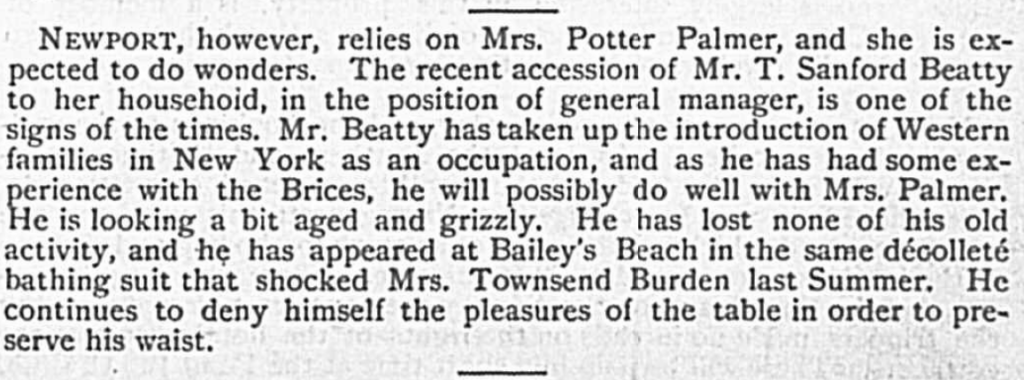
Mr. Beatty’s summer fashion statement was less about fabric and more about form. Town Topics remarked that he had “appeared at Bailey’s Beach in the same décolleté bathing suit that shocked Mrs. Townsend Burden last summer”—a garment that, for a man, was risqué enough to earn a mention in the notoriously snide “Saunterings” column. At Bailey’s Beach, a private club in Newport, RI, known for hosting the Gilded Age elite, fashion was as much about being seen as what one wore (Clem).
This commentary stands out not only for its rare focus on a male body but also for how closely it mirrors the tone usually reserved for women. Mr. Beatty becomes a spectacle, judged for what he wears, how he maintains his figure, and how he presents himself to the social gaze.
As Veblen clarifies in The Theory of the Leisure Class, conspicuous leisure wasn’t just about visible wealth but also about the visible absence of labor. Mr. Beatty’s carefully managed physique and beachside display signal a life of refinement, control, and class distinction. But by stepping into the realm of spectacle typically occupied by women, he unsettles the gendered boundaries of fashionable visibility (Veblen 82).
The line between admiration and mockery is thin. Town Topics’s jabs—particularly about his diet—reveal an undercurrent of unease: a man dressing with intentional flair for effect and perhaps for attention. His theatrical self-presentation risked looking too self-aware in a setting where men were expected to exude effortless authority (Veblen 96).
As Maureen Montgomery argues in Displaying Women, the social world of elites was governed by visibility, surface, and performance. Mr. Beatty, in his scandalous swimsuit, wasn’t just enjoying the sun—he was treading the same turbulent waters of fashion, class, and gender roles as his female peers (Montgomery 10, 151). Even though Montgomery focuses primarily on elite women, Mr. Beatty’s case fits neatly within her framework. His public presentation—primarily through fashion—was judged just as sharply as that of his female counterparts, revealing how the social performance of visibility could extend beyond gendered expectations (Montgomery 47).
And the cost of such performance was real: too much flair, too much vanity, and a man risked being mocked, feminized, or dismissed—not merely as unfashionable but as unserious. For Mr. Beatty, the line between charm and caricature was perilously thin.
Image Source:
OpenAI. A satirical ink and watercolor illustration from the late 19th century, depicting a slim Gilded Age gentleman in a scandalously low-cut vintage bathing suit, standing confidently on a beach, with exaggerated posture and period-appropriate beachgoers in the background. ChatGPT, 5 June 2025, https://chat.openai.com.
The Man of fashion
Your Fashionscope is here:
What’s trending for Gentlemen this week?
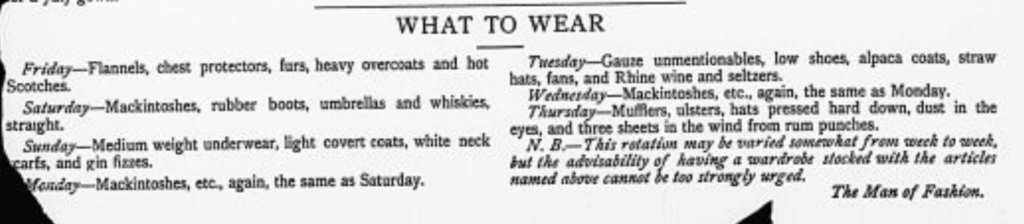
Though the Man of Fashion appeared nearly a decade before Lady Modish or the Shopper, his presence fits more as a parody than a prototype. Unlike the women of the “Wardrobe Committee,” who earnestly discussed hemlines, pearl collars, and fashionable theatre gowns, the Man of Fashion offered a deliberately absurd week-long rotation of outfits—from flannels and furs to gauze unmentionables—punctuated by weather shifts and cocktails of choice.
His wardrobe guide is less fashion advice than social commentary, mocking how style columns, particularly those in Town Topics, treat dress as both performance and necessity. His final note—”the advisability of having a wardrobe stocked with the articles named above cannot be too strongly urged”—mirrors the prescriptive tone of his female counterparts, only pushed into farce.
In contrast to the sincere—even aspirational—voices of fashion columnists, the Man of Fashion feels like Town Topics winking at its own audience. This may be a reminder that beneath all the glitter and gossip, the magazine was perfectly aware of the absurdity it helped perpetuate.
What on Earth Is a Mackintosh? And Other Stylish Mysteries:
Chest protectors – Garment accessories (often quilted or padded) worn under jackets or coats to protect the chest from cold drafts, common in late 19th-century menswear (Gentlemen’s Gazette).
Gauze unmentionables – “Unmentionables” is a Victorian euphemism for underwear; “gauze” refers to lightweight, sheer fabric. This phrase mocks the delicacy or absurdity of summer undergarments for men (Dictionary.com).
Mackintoshes – Waterproof rubberized raincoats, very common in late 19th-century Britain and the U.S. for wet weather (Sansom).
Mufflers – Thick scarves or neckwraps, typically wool, worn for warmth (Dictionary.com).
Three sheets in the wind – A nautical idiom meaning very drunk; humorously inserted to match the day’s drink, rum punch (Dictionary.com).
Ulsters – Long, loose, heavy overcoat, originally of Irish frieze, now also of any of various other woolen cloths (Dictionary.com).
Fashion Scandal in the Suburbs
(OpenAI)
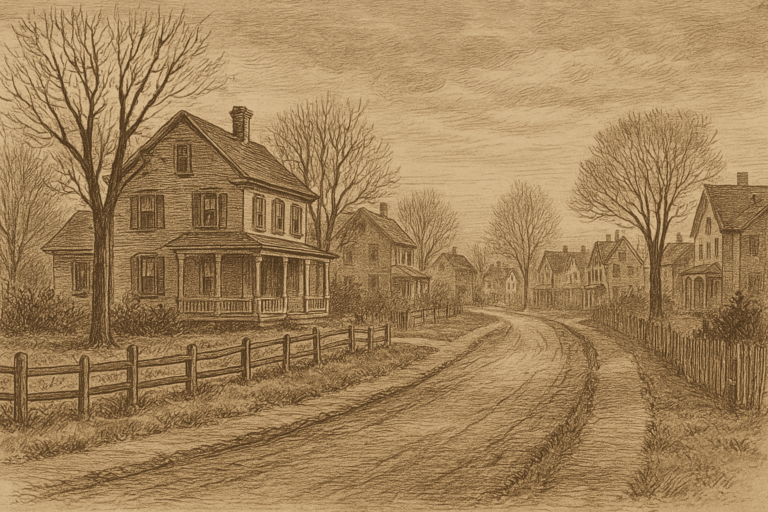
Nutley woman startles suburbia (and Town Topics) with bold metropolitan style.
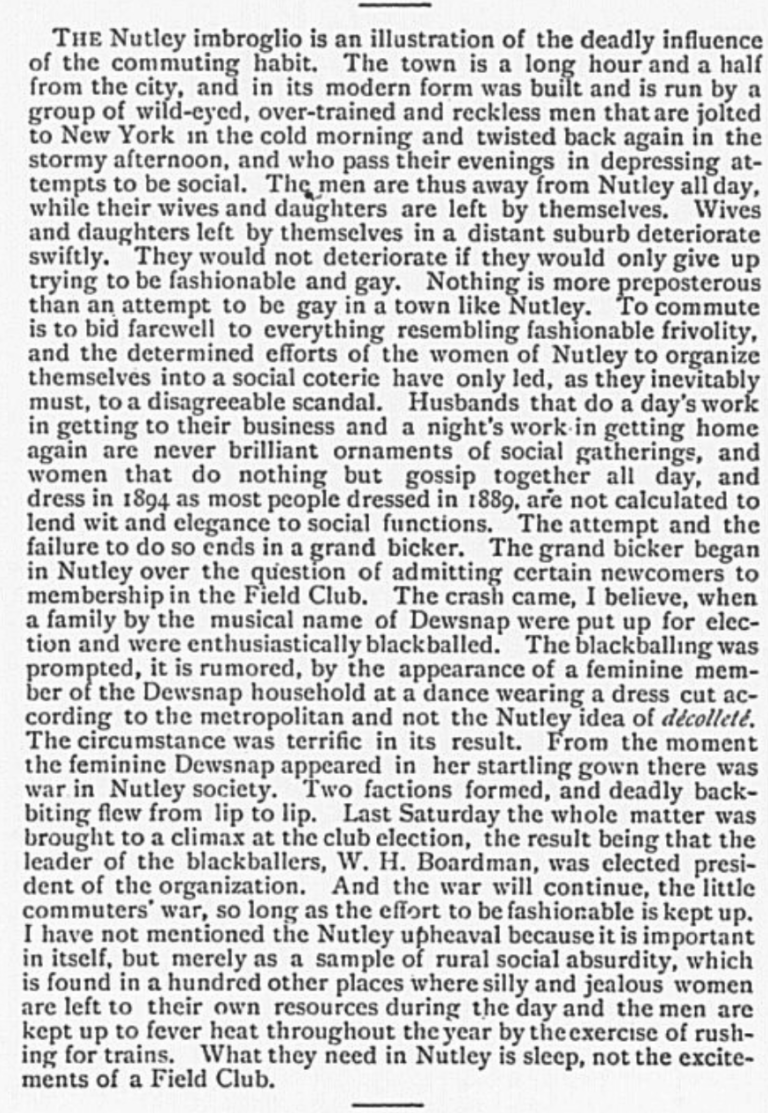
In Town Topics’s biting coverage of the “Nutley Imbroglio,” suburbia emerges as both a setting and a character—a symbol of feminine idleness, thwarted ambition, and unruly fashion aspirations. Nutley, a New Jersey town about an hour and a half from New York City, was governed by train schedules and social exhaustion. The scandal was not merely about fabric or cut but about etiquette and the constrained role of women in a suburban community.
This passage drips with scorn for the “commuting habit” and, more pointedly, for the women left behind. Framed as physically remote from culture and alienated from good taste, suburban women’s attempts at socializing and dressing fashionably are portrayed as tragicomic (a mix of sadness and unintended comedy) failures. The infamous “feminine Dewsnap,” whose metropolitan décolleté gown sparks an ongoing “war,” embodies this anxiety. Her fashion choice does not merely violate Nutley’s norms—it threatens the social fabric of the entire community.
As Maureen Montgomery outlines in Displaying Women, public femininity in elite spaces is tightly choreographed. To step outside that choreography—even slightly—is très risqué for social life. The Dewsnap woman’s gown may be cut “according to the metropolitan” taste, but in suburban Nutley, such flair becomes a symbol of moral decay. This reveals how fashion operated not only as self-expression but as a mechanism of distinction, one that reinforced both class boundaries and regional codes of conduct. As Montgomery explains, women of the leisure class “worked at signifying leisure” through highly intentional acts of self-presentation involving appearance, behavior, and performance in public space (12-13). This conscious “performance,” she argues, was a means of expressing one’s social position and femininity in ways that were class-specific and rigorously policed by cultural norms.
Enter Thorstein Veblen, who would have found the whole episode depressingly predictable. In The Theory of the Leisure Class, Veblen argues that fashion is a form of conspicuous consumption, meant not for utility, but for showing off one’s exemption from labor (82). Nutley women, left in their large homes while husbands commuted to New York, embodied Veblen’s idea of vicarious leisure, a term used to describe the leisure enjoyed by one person as a result of the labor of another. Their role was to be beautiful, refined, and a quiet proof of their husbands’ success (Veblen 80-82).
What Veblen calls conspicuous leisure also applies here: the public display of idleness becomes a status marker, where even attempts at “purposeful” domestic activity are ultimately performative. Veblen describes how the leisure class engages in make-believe duties—charity boards, social events—meant to simulate productivity while signaling status (96). In Nutley, these social performances are met with ridicule rather than admiration, revealing the fragile boundary between tasteful refinement and failed mimicry. Suburban women may have dressed the part, but in the eyes of Town Topics, they lacked the social legitimacy to pull it off.
Through ridicule masquerading as reportage, Town Topics enforces strict norms: elegance belongs to the city, décolleté belongs to the young or metropolitan, and failed mimicry is a source of social shame. Nutley was undoubtedly not New York City, and these suburban fashion efforts were met with suspicion rather than admiration.
Image Source:
OpenAI. A late 19th century ink and watercolor illustration depicting a suburban town. ChatGPT, 5 June 2025, https://chat.openai.com.
Page authored by Bruna Santos.
Special thanks to Lisa Magdeburg and an anonymous reviewer for their helpful feedback, and to Josefin Hagen for her technical support.

All content for educational purposes only.
University of Greifswald
Seminar: Editing Scandal
(Summer Semester 2025)
Instructor: Prof. Dr. Katrin Horn