
How the Saunterer Gossips
Comparing Contemporary Discourses on Privacy and Gossip.
This project offers an insight into the discourse around gossip as a social concept and specifically within the sphere of the society journal Town Topics. Considerations of privacy versus public interest will be outlined and discussed. To introduce the topic and lay the scholarly framework, perspectives by different authors and throughout different time periods will be provided first. Succeeding, a deeper insight into contemporary perspectives of the privacy discourse, which came up as a reaction to the developing technologies and increasing spread of information through publicly accessible media, will lay the groundwork for an accurate understanding of Town Topics within its historical and social context. Finally, some excerpts from “Saunterings” are displayed. These can be critically contemplated through the lens of the different stances held by authorities on the topic. The excerpts have been chosen to display the full timeframe of publication, so that potential changes in perspective would not be lost. Additionally, it may be valuable to consider how the Saunterer viewed his own work and whether he was aware of the moral implications of his work. To prompt further individual considerations, the excerpts are each shown with my personal thoughts and contemplations.
The Scholarly Discourse on Gossip: 1963 – 2024
Gossip has historically had a bad reputation. Particularly during the time when Town Topics was being published, new debates regarding the priority of spreading information versus preserving and protecting privacy were flourishing. These legal debates started to take a turn during the middle of the 20th century. The negative connotations started to dissipate slightly within the context of the social sciences. 1963 the ethnosociologist Max Gluckman published a paper on “Gossip and Scandal” where he mentions the public disproval of gossip, but argues for the social function of enhancing inter personal connection: “gossiping is a duty of membership of the group” (Gluckman, 313). Although he does demonstrate some ambivalence toward the moral implications of gossiping, thereby showcasing the significance of the social and historical context. “When a group, even one with a united history, begins to fail in its objective, gossip and scandal accelerate the process of disintegration” (Gluckman, 314). Soon authors like Roger Abrahams, who was an American folklorist, examined gossip through new lenses. He investigated the correlations between the act of gossiping and other forms of performance. Abrahams argues that gossip “provides an active way of guaranteeing a certain level of homogeneity of ideals and even of social practices” (Abrahams, 297). In effect, this means that gossip may strengthen social norms and thereby help stabilise a community and bring it together. During the late 20th century, the social value of gossip was widely accepted within the sociological community. In 1996 scholar Margaret Holland writes: gossip “feeds curiosity about the lives of other persons, allows one (implicitly) to compare oneself favorably with others, provides the opportunity to display wit and humor, creates an intimate atmosphere, and fills time in a manner that is undemanding” (Holland, 1996). Most recently, a new development lies in the feminist reclamation of gossip, which is discussed in a 2024 paper by Katherine Batchelor an associate Professor at Miami University. She concedes that gossip “can also be harmful based on how it is wielded in hierarchical structures of power” (Batchelor, 68). This paper emphasizes in which ways the patriarchal system is relevant context within this discussion. Gossip thereby exists within its social structures and environment and not only in a personal vacuum, which means there is a reciprocal effect. Batchelor’s central approach is the use of “gossip as an analytical tool to reframe and promote gender equity, [for the] critical analysis of the innumerable ways systems and institutions of power and privilege—such as race, eth-nicity, religion, and sexuality—intersect in the fight for gender equality” (Batchelor, 68). In her core opinion of gossip, she does agree with the previously mentioned authors, basing her paper on previous scientific research and sociological discourses. This is shown through statements like: “gossip connects us to others in our most primitive sense as a way to learn the social and psychological reactions to our shared human experience” (Batchelor, 75). Evidently, the advantages of gossiping have become more visible and accepted since the time when the Saunterer published his columns. Although, it is important to keep in mind that these views are found within the framework of the sociological field of study, which means that people as a whole may still connote gossip negatively.
Contemporary Discourse

1890:
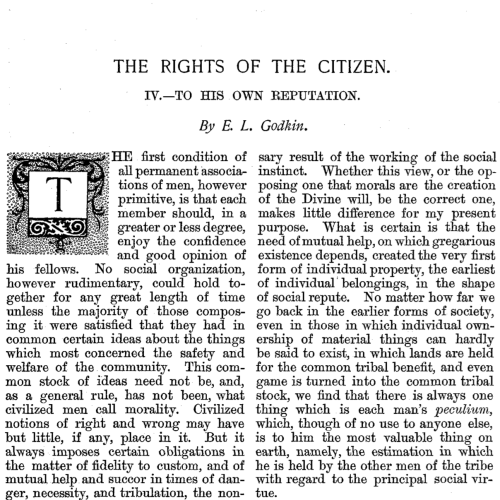
During the period of the late 19th century, gossip was a common practice, which was yet to be seriously considered in the social sciences. The perspective Edwin L. Godkin, who was himself a journalist and editor, offers must be understood in the context of the contemporary debate around law. He states that “the very first form of individual property, the earliest of individual belongings, [is] the shape of social repute” (Godkin, 58). Godkin’s perspective is embedded in the capitalist system. He views privacy as a belonging, which can be damaged and which therefore must be legally protected. Godkin theorises that there is less community gossip due to decreasing focus being laid on personal relationships and small communities as appose to the “outer world” and “large external events” (Godkin, 62). He is concerned with the rising significance of Newspapers remarking they have “converted curiosity into what economists call an effectual demand, and gossip into a marketable commod-ity” (Godkin, 66). From this statement we can identify the responsibility, which Godkin places on media, potentially blaming certain papers and journals for developments of society as a whole, as well as ramifications of capitalism as a system. His critique of commodification of social capital is interesting, since he does not seem to apply it to the capitalist system, but is instead more willing to hold the press accountable. To Godkin, reputation is of utmost importance, and since media has the capacity to negatively impact it, there must be restrictions.

1890:
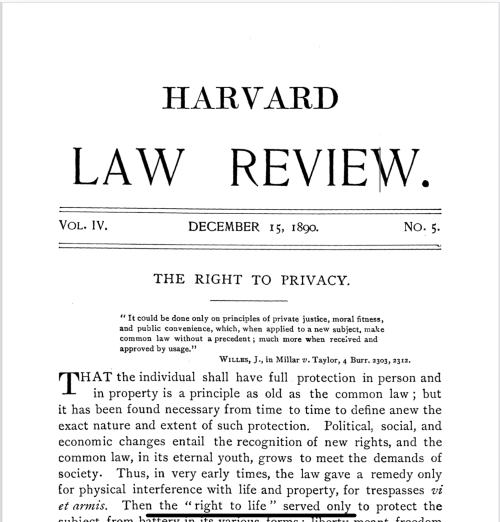
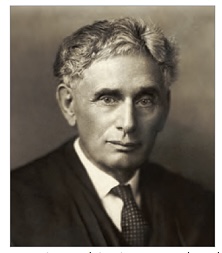
Similarly to Godkin, Samuel D. Warren and Louis Brandeis examined the developments of laws regarding privacy, stating that privacy must be safeguarded institutionally. Both Warren, an American lawyer and businessman, and Brandeis, who served as an associate justice on the Supreme Court, sharply scrutinised gossip, especially in the public domain. “Instantaneous photographs and news-paper enterprise have invaded the sacred precincts of private and domestic life;” (Warren & Brandeis, 195). They express their worry of contemporary developments and a modernising society through phrases such as “the evil of the invasion of privacy by the newspapers,” (Warren & Brandeis, 195). Warren and Brandeis do make an exception in the case of a person with special public relevance. A such person must relinquish their right to privacy to the extent which public interest determines. For example a politician potentially being voted into office must accept that information concerning his character will be published to ensure the public are aware of what kind of person they may vote. Apart from this, their stance on gossip and its dissemination is clearly condemning. Primarily, the objective of this paper from the Harvard Law Review, is to elevate the legal status of a person’s right to privacy. This would increase the degree of possible legal action, which could benefit the protection of personal privacy or the penalisation of those whom disobey other’s rights. Neither the societal value of freedom of speech, nor that of the freedom of the press are prioritized by Warren and Brandeis. Therefore this perspective should not be taken lightly, a critical analysis is significant.

1912:
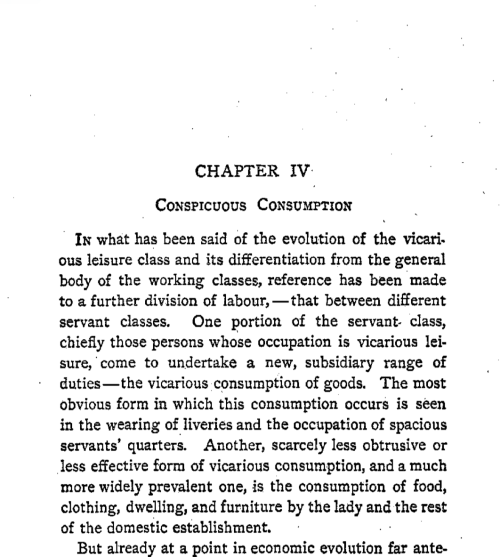
The sociologist and economist Thorstein Veblen offers a different perspective to his predecessors. His focus does not lie on the legal developments, but rather on the observation of social structures. He speaks mainly on the value of consuming in a capitalist environment. He claims for instance that: “decency still requires the wife to consume some goods conspicuously for the reputability of the household and its head” (Veblen, 83). He illustrates the importance of how one is viewed by their social circles and beyond. The comparison of urban and rural structures is made obvious with the following statement: “Among the country population its place is to some extent taken by savings and home comforts known through the medium of neighbourhood gossip sufficiently to serve the like general purpose of pecuniary repute” (Veblen, 88). The juxtaposition of tonality between this and other contemporary works is clear. Veblen sees gossip as inevitable and even concedes that it serves a social purpose. He views gossip as a method to acquire social status, which does not demand any justification. Essentially, he does not comment on the moral implications, nor does he allow himself a judgement over others for indulging in the act of gossiping. In this context, it is essential to consider that Veblen’s work does not take the public media landscape or its developments into account, meaning that his views only apply to more personal environments. This makes a direct comparison to the other two works difficult, but his views are nonetheless valuable in the analysis of “Saunterings”.
Town Topics Excerpts
Town Topics v. 20 (July-Dec 1888)
"Still, society will gossip, and when it commences there is no telling where its license may terminate," (3)
The Saunterer depicts gossip as an inevitability. He admits that clear boundaries are impossible to identify or rely on, Morally, he is taking himmself out of the situation, as though he was not, by writing and publishing this, explicitly accerating the spread of the gossip and extending its reach.
Town Topics v. 20 (July-Dec 1888)
“while gossip lies dead in the deserted town.” (Unpaginated)
This personification of gossip offers a vivid visualisation, which effectuates the responsibility of both the gossipees and the readers to keep gossip alive and well.
Town Topics v. 42 (1899)
“fanned by the gossip of scandal-mongers.” (7)
The use of the word scandal-mongers is very interesting, since the term has a negative, potentially offensive, connotation. Nonetheless, the Saunterer sharply criticises behaviour similar to his own. He purposefully dissociates with from this to appeal to the reader.
Town Topics v. 42 (1899)
“ people of her set were entitled to the same kind of privacy as was enjoyed by the common people.” (12)
This was a call to respect privacy, of people regardless of their social standing. The Saunterer simply reports this without considering the role his own work plays. He does not attempt to justify or reflect, but instead leaves the situation uncommented.
Town Topics v. 62 (July-Dec 1909)
“Without defending the veracity of the gossip,” (4)
There seems to be a self-awareness of the possible effects of gossip. He conveys his sense of limitation, that gossip should have boundaries.
Town Topics v. 62 (July-Dec 1909)
“Considering the gossip that has followed these young people for several years, they exhibited a rare bit of nerve to be thus snapped.” (7)
The Saunterer seems to be aware of the power he yields, implying the threat of which consequences could await these young people by his hand.
Town Topics v. 76 (1916)
“some idle gossip questioned“ (11)
Using the term “idle” to describe what he is reporting on is interesting, since it devalues the information. Whatever follows is framed in this light, which may affect the reader.
Town Topics v. 76 (1916)
“There has been a lot of nonsensical gossip” (4)
Placing judgement on other gossip, produces a hierarchy of what may be trustworthy and by devaluing other sources he is singling out his input as the standard/ trustworthy/ truthful one.
Town Topics v. 84 (July-Dec 1920)
“Gossip is a perverted in-terest in other people's affairs." (5)
A direct quote found in “Saunterings” by Rev. Henry Tinkaus, which is left uncommented, as though the Saunterer isn’t openly aware that it is a gossip column, in which he is reciting the statement,
Town Topics v. 84 (July-Dec 1920)
“According to gossip in North Shore circles,” (9)
This is a representation of how the Saunterer ‘quotes’ or details his sources. If he mentions the origin of his information at all, his sources are kept anonymous and therefore protected.
Town Topics v. 84 (July-Dec 1920)
“I merely present this gossip for what it is worth.” (24)
Here the use of honesty brings the Saunterer and the reader closer together, as though everyone is in the same boat and he has shared all he can offer. As appose to taking responsibility of what information he is publishing.
Town Topics v. 105 (Feb 1936-Nov 1937)
“some unfortunate newspaper frightened him off.“ (6)
This comment showcases that media like Town Topics may have real life consequences for those reported on or gossiped about. The Saunterer implicitly admits that his work can negatively affect people and may therefore not be harmless.
Concluding…
Overall the term gossip is used ambivalently by the Saunterer. He does not suggest a moral implication of the term itself, nor the indulgence in the act. The Saunterer does not explicitly comment on his role in the publication of certain information or the scope of its spread. He seems to be aware of his power to a certain extent and knows of potential consequences which are associated with his work. Although these consequences concern mostly the gossipees, since he is sure to hide him and his informants within the scope of anonymity.
Additionally, the Saunterer does not seem awfully concerned with the privacy debates, which were taking place during his publishing. He rarely mentions the term privacy at all, whereas his identification with the term gossip is evident. Assumably, the legal and sociological discources had little overlap with the “Saunterings”, which may have been the most advantageous manner of handling the controversial topic for the Saunterer. This way his readers were kept blissfully unaware and the evolution of gossip in the press continued on without hinderance.
The popularity of gossip in media has only continued to exponentially rise since Town Topics was last published. The social significance and advantages of gossiping have been explored in depth and are unquestioned in modern sociological circles. Although gossip may still carry a somewhat negative connotation, the (re-) production and consumption of gossip and news is mainstream. The world of media and press have come to fully engage with scandalous information, since it continues to be of interest to the public and most importantly it continues to be highly profitable.
By Johanna Bogendörfer
Thank you to the anonymous reviewer, and to Josefin Hagen and Ana-Lena Richter for the technical help.

All content for educational purposes only.
University of Greifswald
Seminar: Editing Scandal
(Summer Semester 2025)
Instructor: Prof. Dr. Katrin Horn