
The Princess of the White House
Alice Roosevelt’s Rise to Celebrity

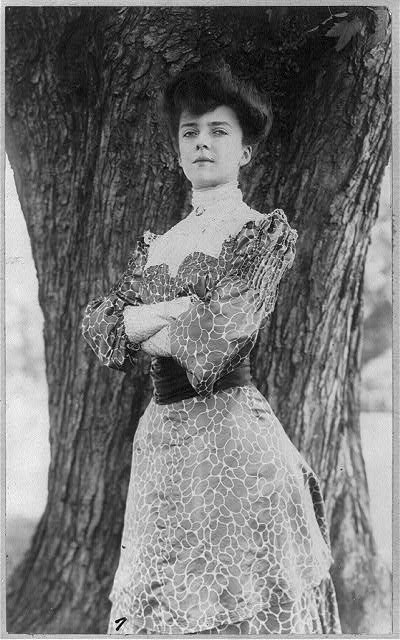
Alice Roosevelt was known for her wits, her defiance of social expectations for women and simply for being well-known. The eldest daughter of Theodore Roosevelt became a figure of great public interest at just 17 years old after her father took over the presidency in 1901. As a young woman, Alice gained unprecedented fame during her time as the First Daughter of the land, in the United States of America (USA) as well as internationally. With my project, I want to trace the key moments in Alice’s surge to celebrity status and compare how the contemporary newspapers reported about her since the newspaper coverage of Alice during her famous years was exceptional. The focus is on the journal Town Topics that was infamous for its gossip and scandal accounts. It played a role in Alice Roosevelt’s public image insofar as it once published condemning paragraphs about her behavior that even were the catalyst for a legal case against the editors of the journal. The New York Times serves as a more reputable newspaper for the comparison.
A Brief Digression into the Evolution of Celebrity Beforehand:
The concept of celebrity is based on extensive reputation, meaning to be known by people outside of the personal social circles (Lilti 6). This was enhanced with a transformation towards “a public” as defined “by sharing the same curiosity and the same beliefs, by being interested in the same things at the same time and by being aware of this simultaneity” (Lilti 9). The public thus began to be the new unified agent who creates reputations. In celebrity, the public curiosity is directed at unique individuals, and their private lives become subject to common interest (Lilti 254). These social developments were the first steps for why individuals like Alice Roosevelt could be celebrated by such large crowds as they were.
There were a few historical evolvements in the 19th century as well that accelerated a change in the celebrity system: on the one hand, there were technical innovations such as the printing press or the steam engine that allowed information to be spread notably faster and therefore also extended the circle of reputation and enabled a more widespread notoriety. Altogether with the appearance of photography and the telegraph for transmission, Europe and the USA entered a new era of mass communication (Lilti 258). On the other hand, there were shifts in the print media: fueled by a growing literacy rate, print runs skyrocketed, and daily newspapers were sold for much cheaper so that they became an object of everyday consumption and an integral part of city life (Ohmann 20). As such, dailies “had a decisive influence on shaping the public consciousness of the urban middle class, those who constituted the public sphere” (Lilti 52). Members of the middle class weren’t hereditarily rich or noble but had enough money and ambition to climb the social ladder, and they were interested in all the information they could find about the wealthy upper class in order to imitate them and try to become part of their social circles (Ohmann 25). Consequently, newspapers devoted more space to the lives of celebrities and the elite (Lilti 258). In Town Topics, it’s the society column “Saunterings” that serves this target, and it’s the place where most mentions concerning Alice Roosevelt can be found.
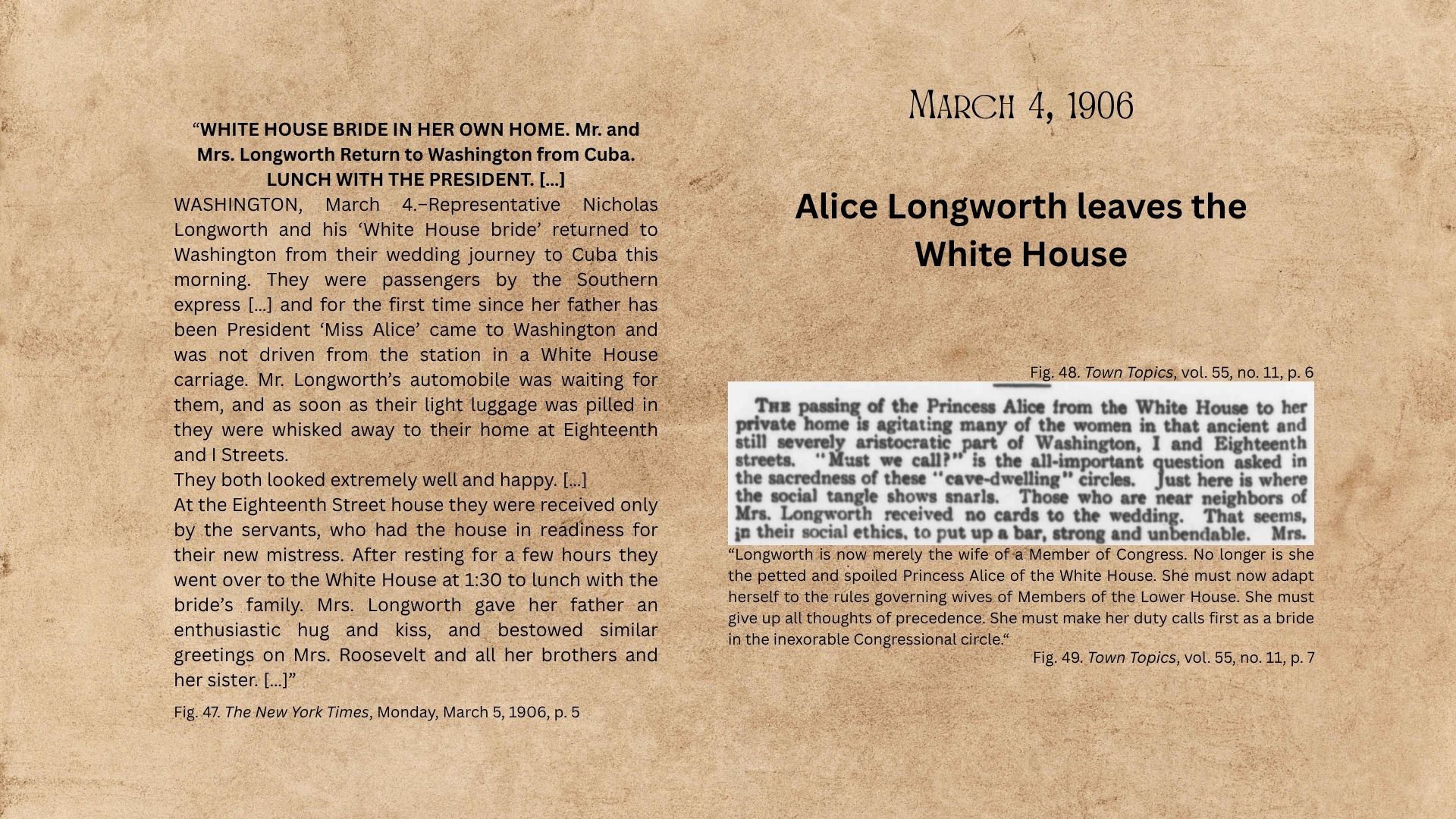
The slide show displays the news coverage of the major events that took place in Alice’s life during the years 1902 to 1906, beginning with her introduction into society and ending after her marriage that involved changes to Alice’s role in society. On one side, there are extracts from The New York Times (The New York Times. Issues from 1902-1906. In: The New York Times Archive. TimesMachine), and the other side displays fragments from Town Topics (Town Topics, The Journal of Society. Volumes from 1902-1906. In: Everyday Life & Women in America c.1800-1920).


Creating the Celebrity Alice Roosevelt: Her Fame in Context
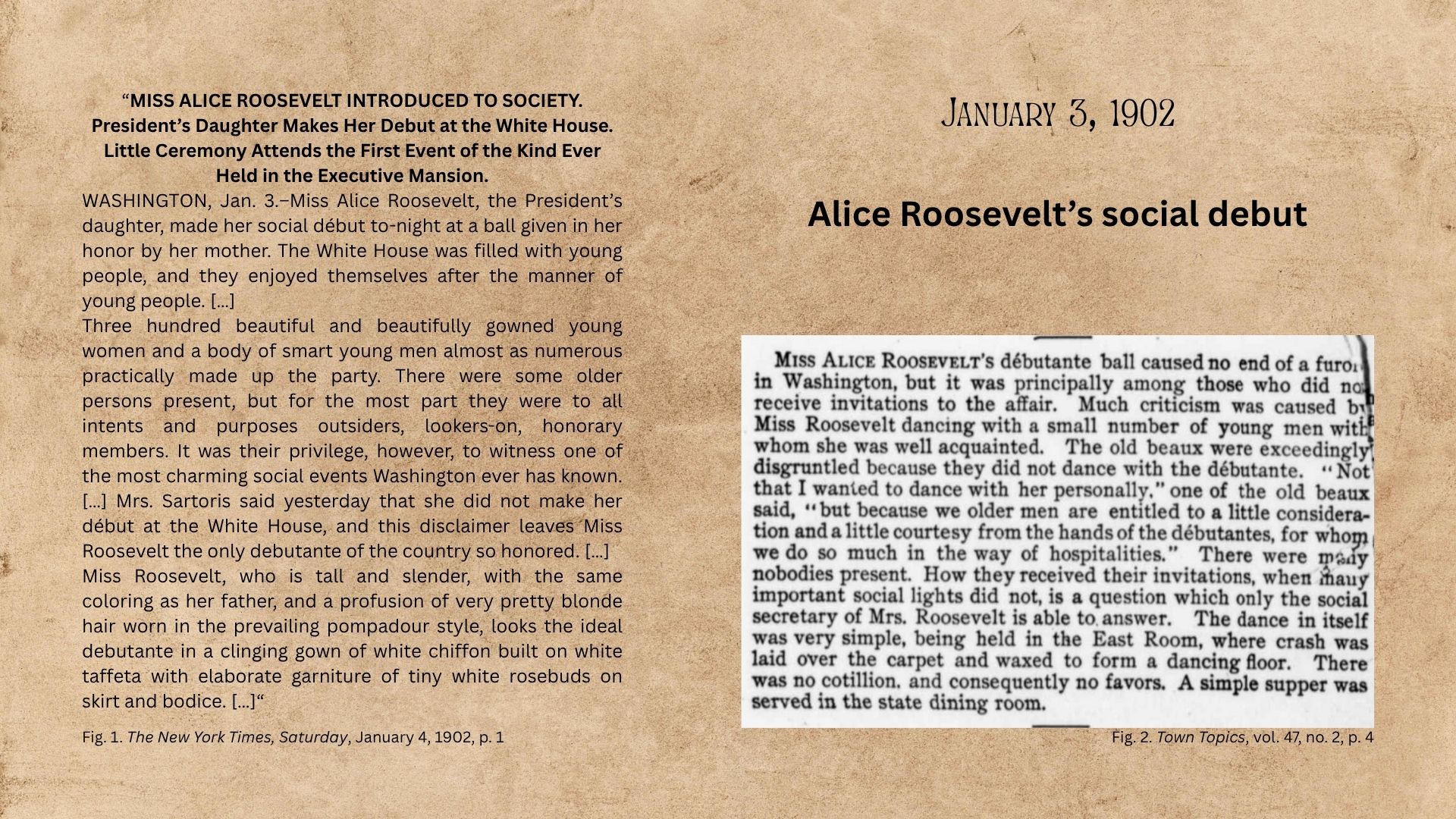
The press coverage of Alice Roosevelt’s life began earnestly with her debutante ball in the White House (see fig. 1, 2). She had been mentioned in the papers before at times since she was a member of the Knickerbocker Roosevelt family that circulated amongst New York City’s high society, and her father was the vice-president of the USA. But when Theodore Roosevelt assumed the presidential chair, Alice’s reputation grew, and the public interest in her life as well as her appearance in the media reached new heights.
The person who held the office of the President of the USA had always captured the special attention of the people, being the Head of State and—especially in earlier times—somewhat of a substitute figure for that of a king (Lilti 194). In monarchies, the king was always known simply because he was the king, regardless of his popularity (Lilti 161). The president in the USA and his family were the closest thing Americans had to royalty and therefore, they were in the public eye by default. Yet, Alice Roosevelt’s celebrity remained a special case that no other society woman at her time came close to. So, what was the secret to her notoriety?
Celebrated people fascinate others because of their personality, their unique actions that spark curiosity, and their capacity “to arouse feelings of infatuation and fascination”, in short: a person’s charisma (Lilti 185). The scholar Stacy A. Rozek writes that Alice managed to “capture the prevailing progressive, conquering spirit” (60) that marked the process of modernization in American society at the turn of the century. Her often unconventional behavior mirrored the changes in gender roles and the shift away from “Victorian moral standards and formality” (Montgomery 6). Additionally, Alice’s debut put her—alongside Mrs. Roosevelt—in the position of displaying her family’s status as members of high society to the public because in the Gilded Age, it was the women’s responsibility to display rank and wealth. “Some of these women became celebrities, the minute details of their daily lives reported in the society columns of newspapers and in magazine articles. They were held up as leaders—leaders of society, of fashion, of taste, of gentility” (Montgomery 9). Alice’s special role as the President’s daughter helped her entice the curiosity of the nation, and, on top of it all, she enjoyed being in the spotlight and pursued the attention (Rozek 53). Alice herself concludes the following in her autobiography:
“The curiosity that was aroused by my father’s daughter was really rather amazing. The great popular feeling for him was reflected in an interest in the activities of his entire family, a good deal of which attached itself to me. I was the daughter of an enormously popular President, the first girl in the White House since the days of Nellie Grant, and I looked upon the world as my oyster. I think people are apt to be amused by and interested in those who are themselves amused by and interested. Probably this accounts for the degree of publicity I had” (Roosevelt Longworth 59).
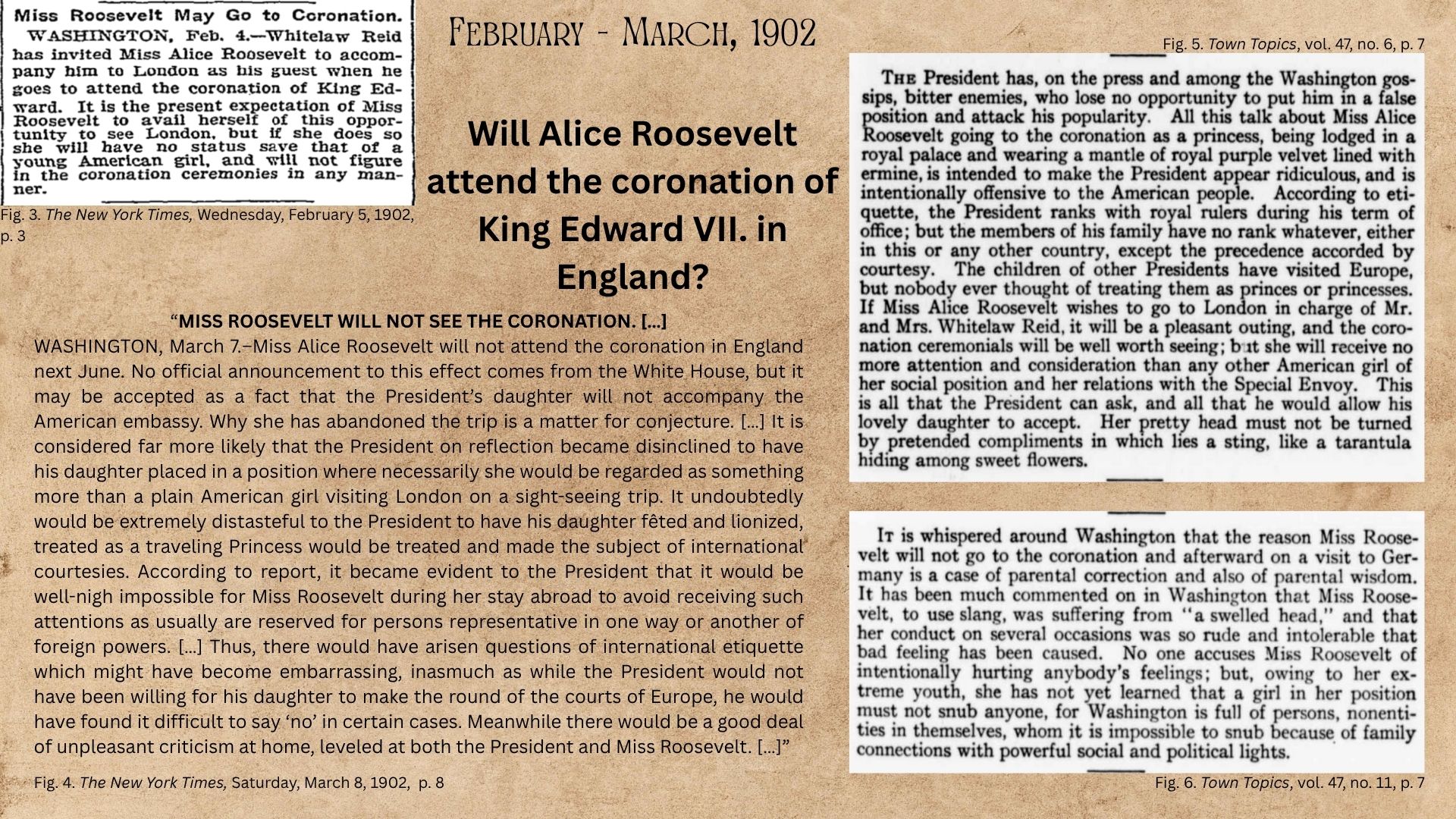
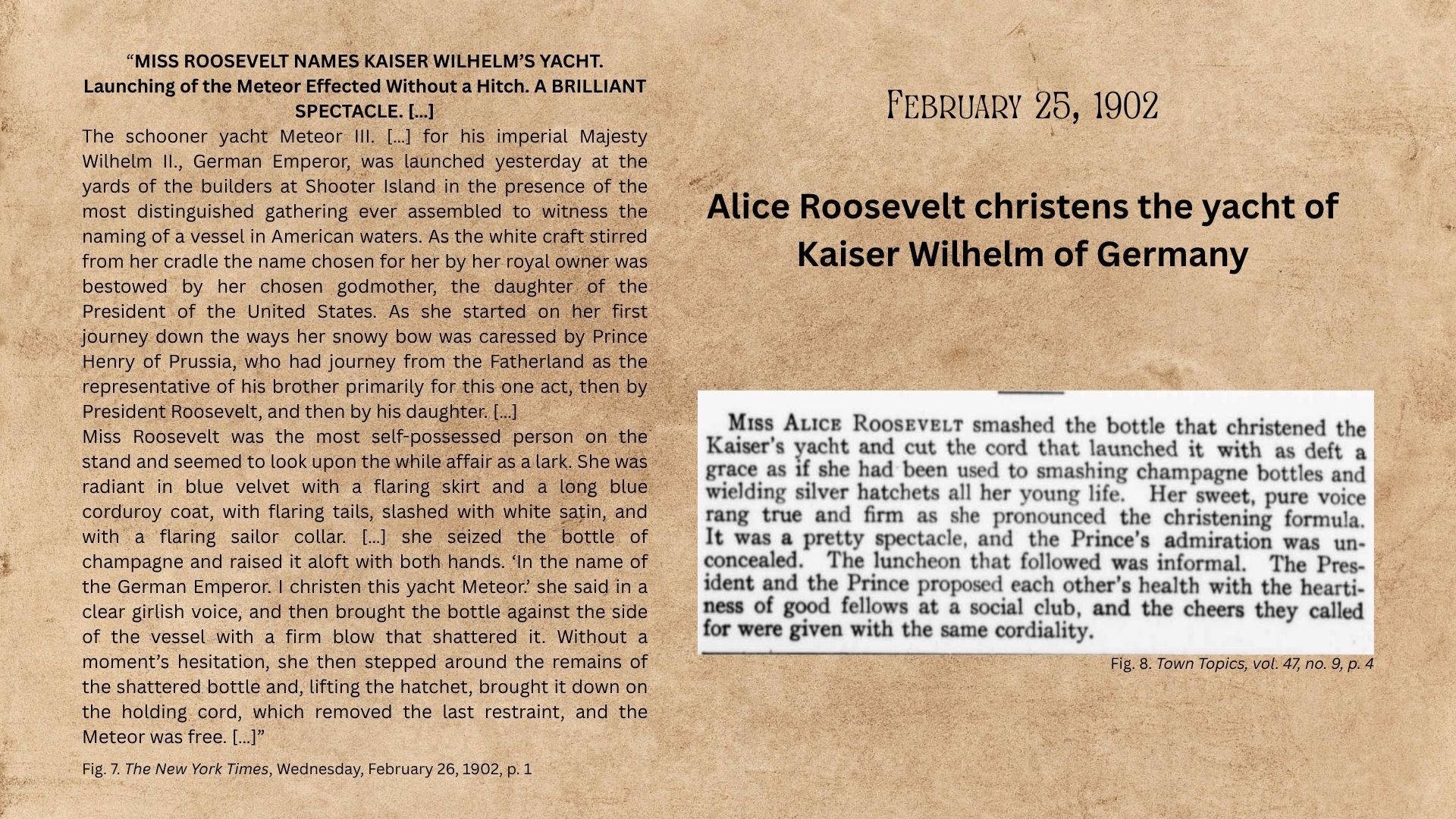
Alice Roosevelt’s favorable reputation expanded to the international stage when the German Kaiser asked for her to christen his new sailboat that was being built in the USA (see fig. 7, 8). The event was recounted in-depth by the newspapers at home and abroad. Alice’s celebrity took another big leap forwards after she was invited to attend the coronation of King Edward VII. in England, and the English wanted to treat her like royalty (Rozek 57; see fig. 3-6). The large-scale discussion that followed about what role and rank she in fact held was to be a reoccurring theme throughout the coming years, and it earned her the nickname “Princess”. Alice comments on this incident:
“I had been promised a trip to England to the coronation of King Edward, but so much absurd discussion was aroused as to what my exact ‘rank’ would be that the family asked me if I would mind much not going. It seemed too complicated, there was too much newspaper publicity about it” (Roosevelt Longworth 50).
Thereby she presumes that “had the press corps not been so profuse in their coverage an equitable solution could have been found” (Rozek 57).
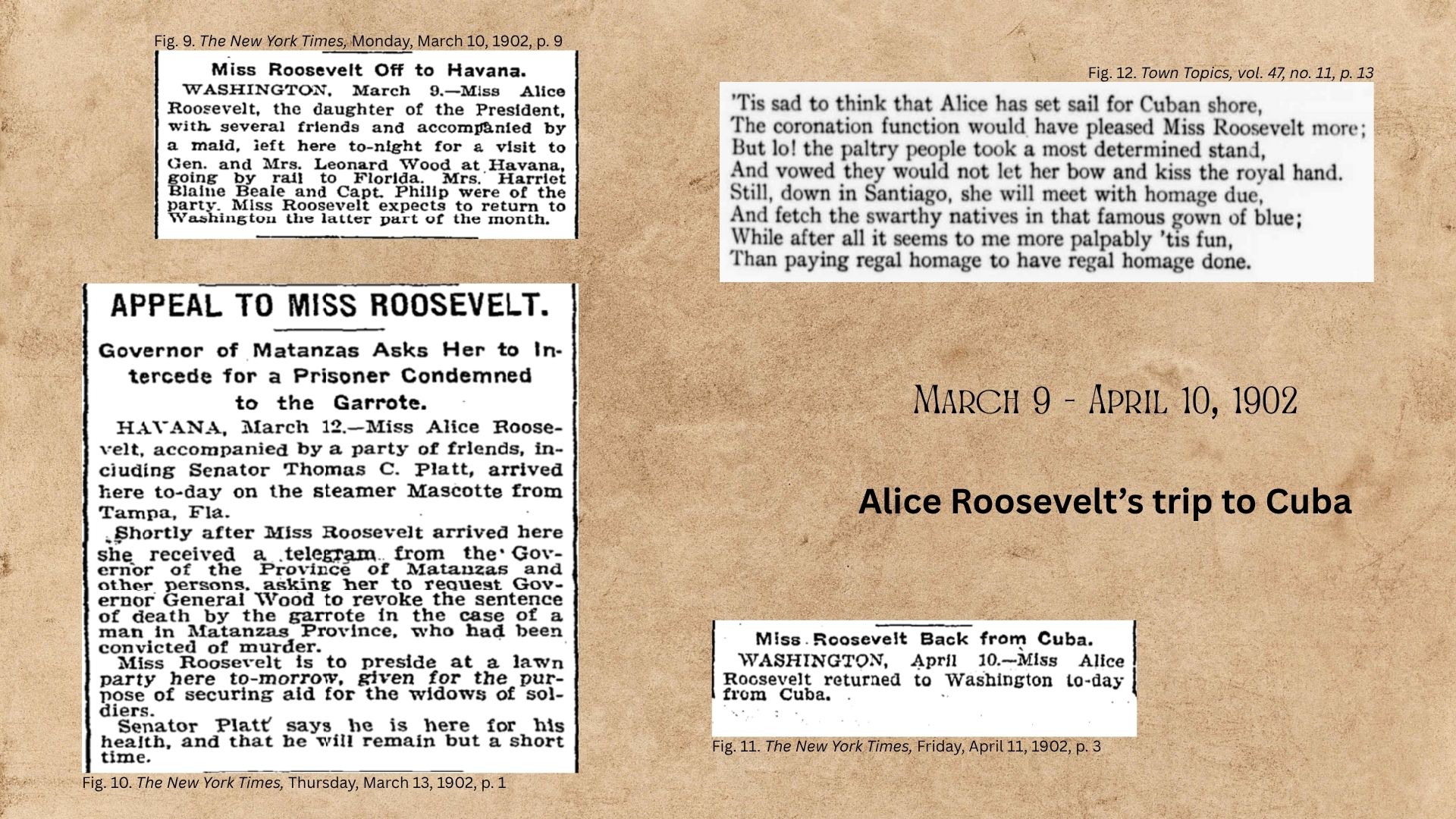
Although not having any official status, Alice was always received by foreign governments as if she were more than only the daughter of a president, a position that includes no legitimate rank because the President of the USA is a temporary title with no inheritable rights. But still, as the President’s daughter, Alice was expected to be interested in political affairs and compelled to attend official entertainments (Roosevelt Longworth 52, 65). This ambiguous semi-official position combined with her popularity culminated in cases where people thought that “Alice’s advocacy might aid their case before a favorable public” (Rozek 58), for example during her travels to Cuba when she was asked to intercede for the pardon of a convicted man (see fig. 10).
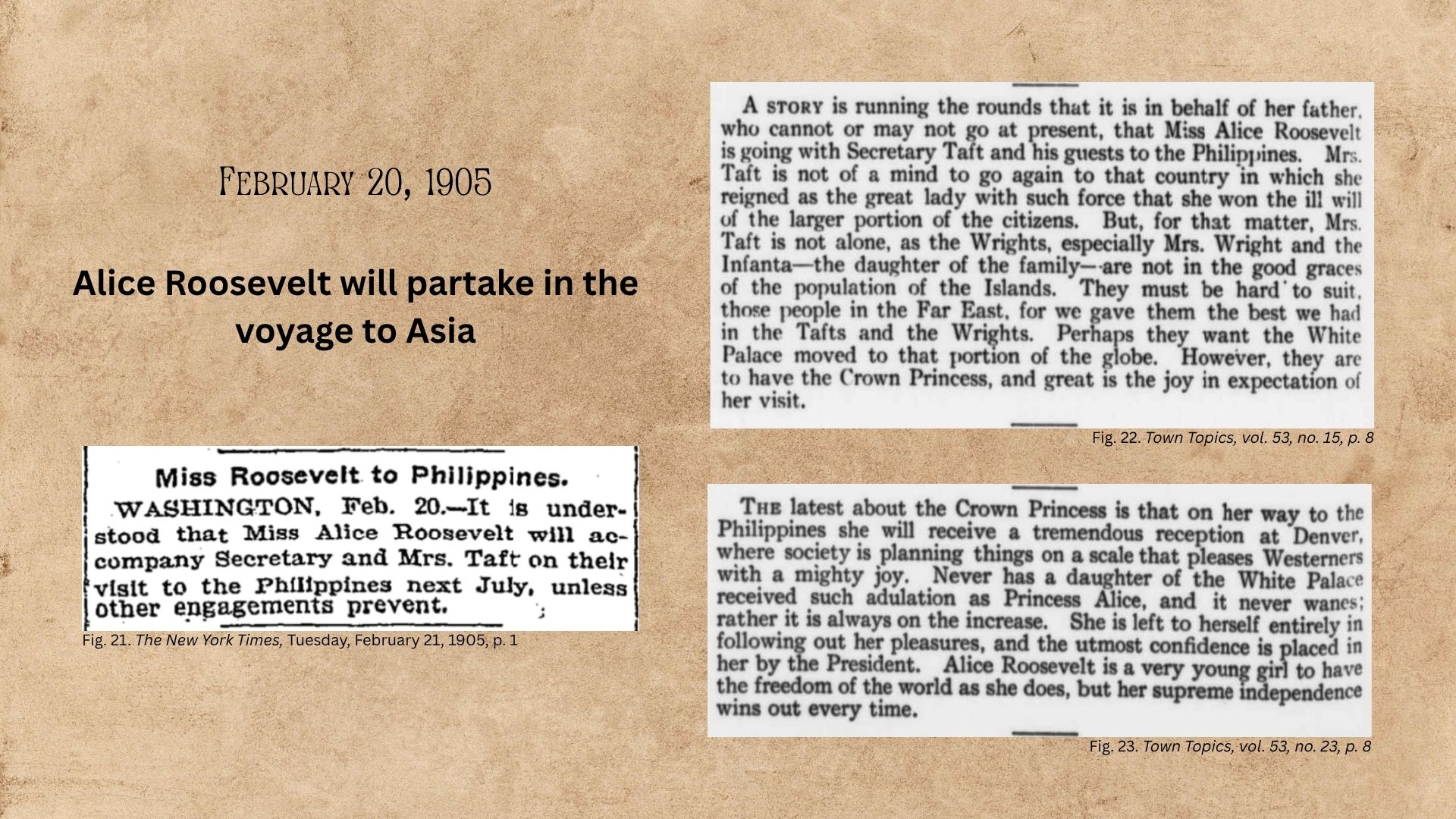
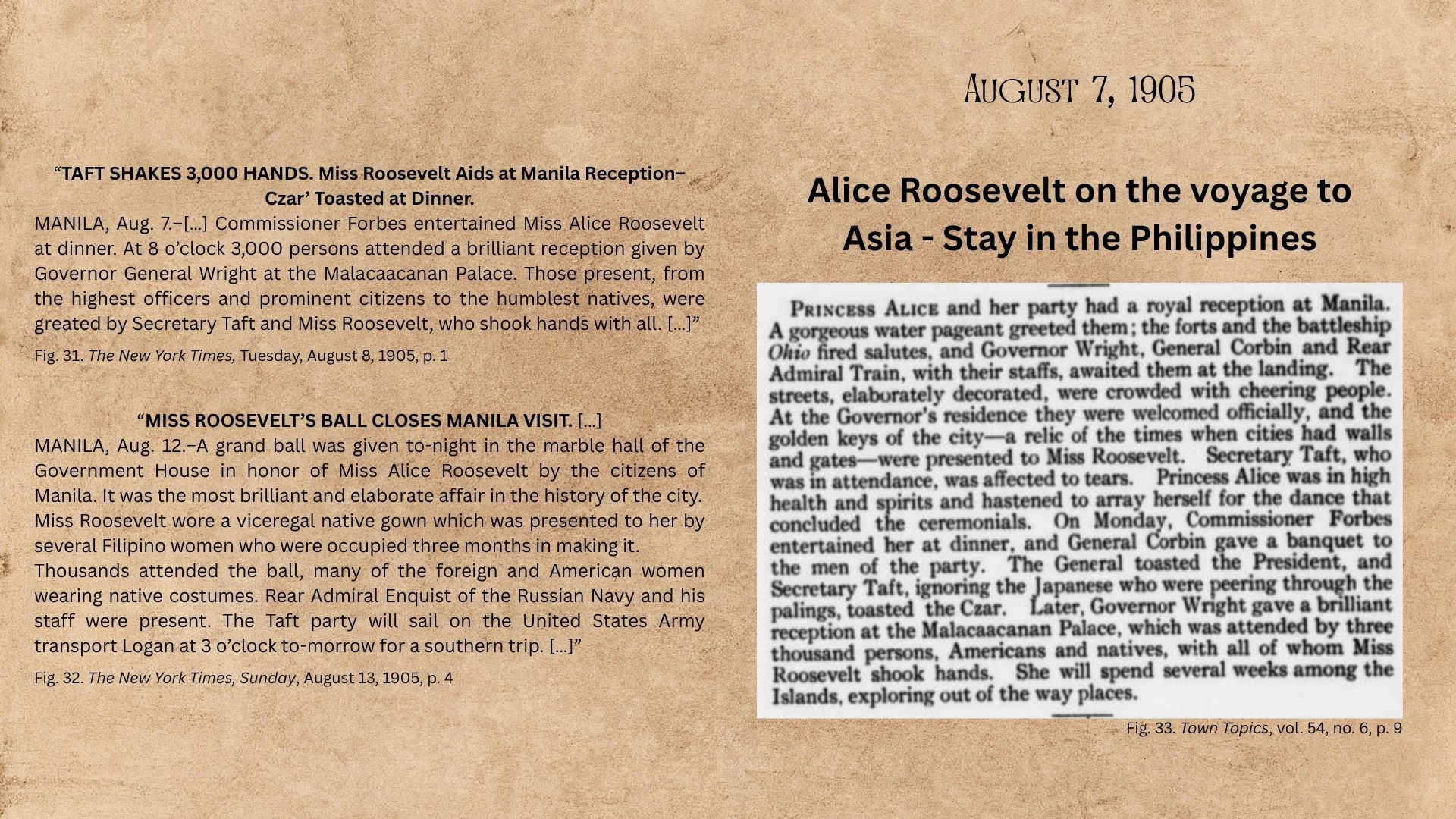
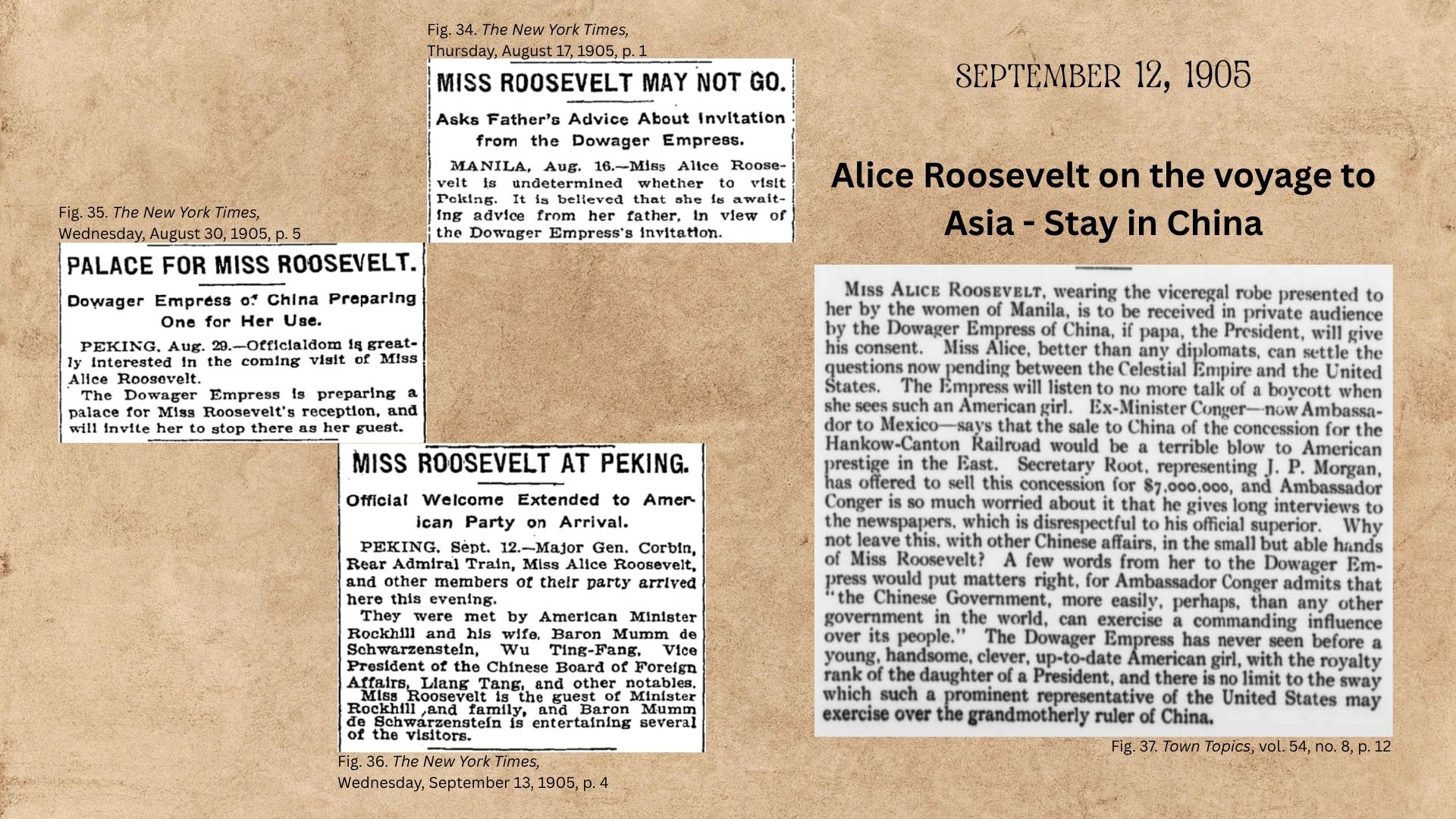
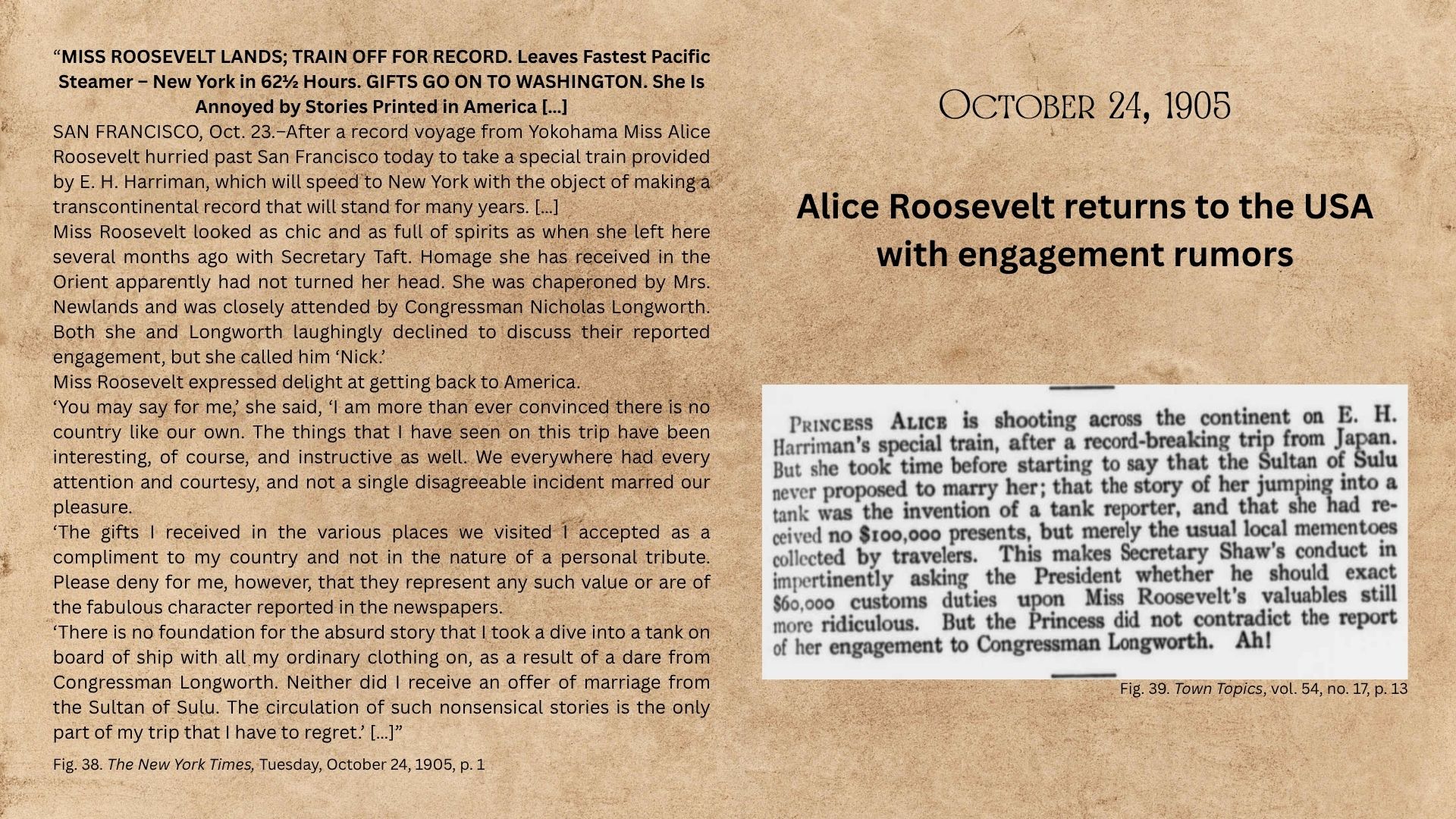
The topic became especially evident once more during Alice’s journey to Asia alongside Secretary Taft’s diplomatic mission. The receptions and honors that were bestowed upon her (for example in the Philippines, see fig. 31-33) clearly exceeded the attentions given to any other accompanying member of the travel party. “Because of the preferential treatment given them by foreign hosts, Alice and Taft came to be called ‘our royalty’ by the other members of the party” (Rozek 62). This once more illustrates Alice’s immense popularity and lionization, even internationally, as well as the unique role that she held: that of having no legitimate status but still representing the USA because she was the President’s daughter. Thus, her position of presidential daughter threw her into the political game where her celebrity was valuable since “entertaining Alice was a pleasant way for a foreign country to flatter America” (Rozek 62). Alice really managed to capture the hearts of the people wherever she went with her carefree and cheerful nature, and she drew crowds at every tour stop, within the national borders and far beyond while the newspapers followed her every step. At the pinnacle of her fame, Alice Roosevelt returned to the USA from her trip to Asia, and crowds of Americans lined her way of passage to catch a glimpse of “their” princess (Rozek 62-63).
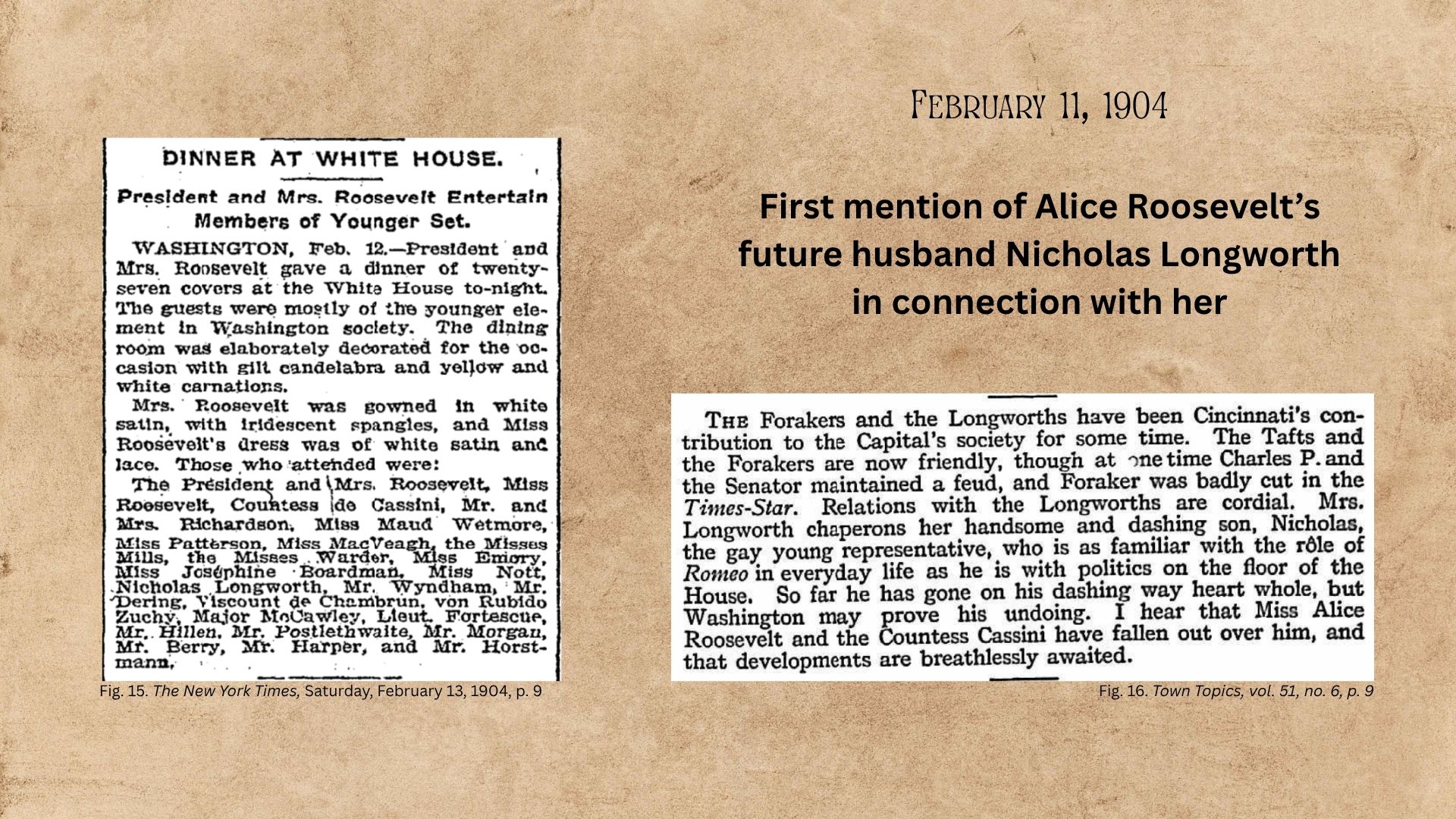
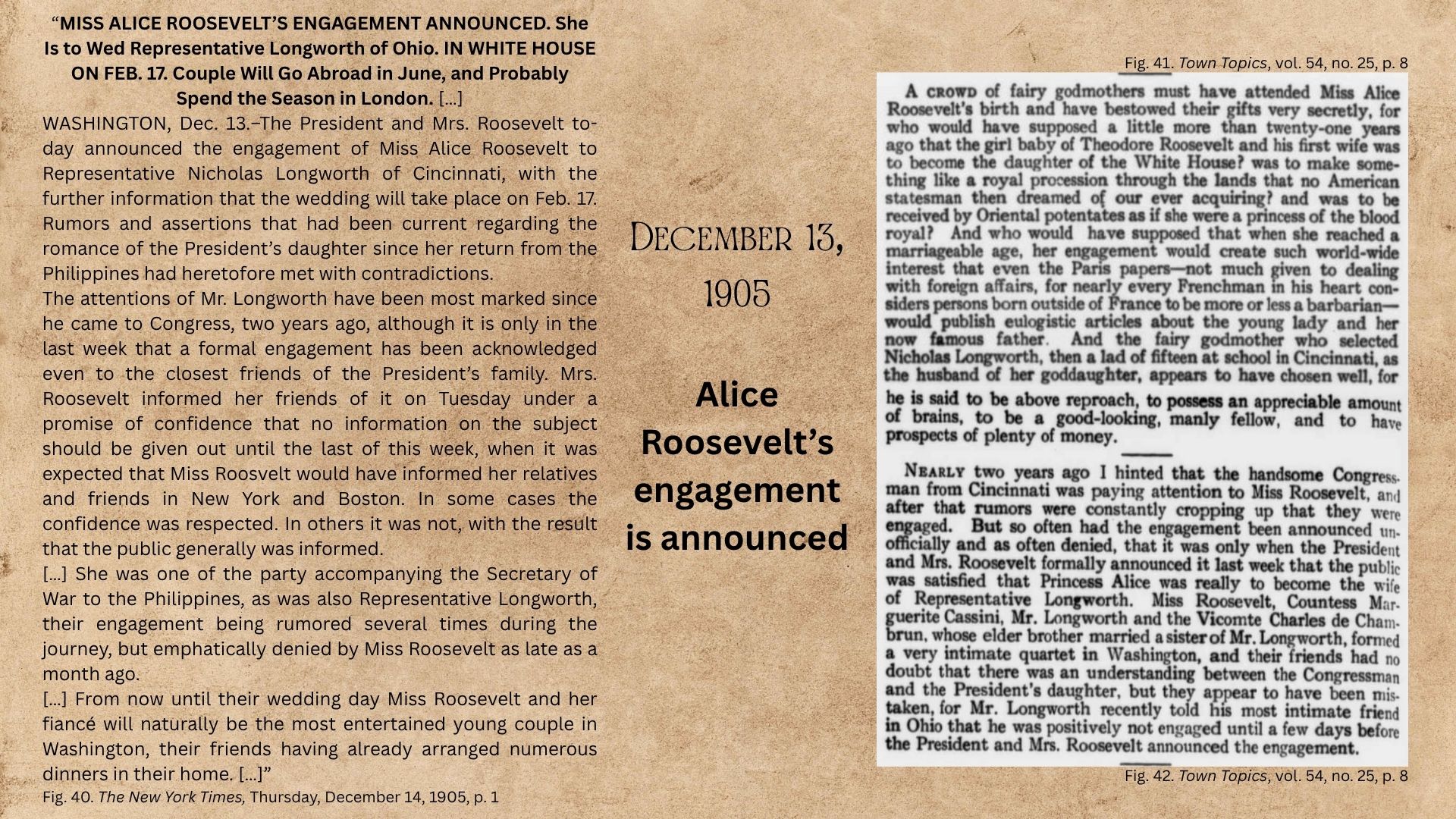
The trip was the talk of the town in another respect because Nicholas Longworth too was a member of the travel group, and rumors of an engagement circulated quickly. Just a few months before the trip, Alice had been visiting the Longworth home in Cincinnati which revived stories of a connection between the two. Accounts of alleged marriage arrangements were not new to Alice; they had been part of her public image in the newspapers ever since all eyes were on her when she smashed the champagne bottle on the Kaiser’s yacht, “but in society page fashion, the engagement rumors made much bigger front page headlines than the denials which inevitably followed” (Rozek 59). The gossip about an engagement between Alice Roosevelt and Nicholas Longworth, however, turned out to be true after it was officially announced by the White House several weeks after the return (see fig. 40-42). Alice states: “I had not been back long before Nick and I decided that we were engaged and that we might as well announce our engagement, as the papers were daily doing it for us” (Roosevelt Longworth 108).
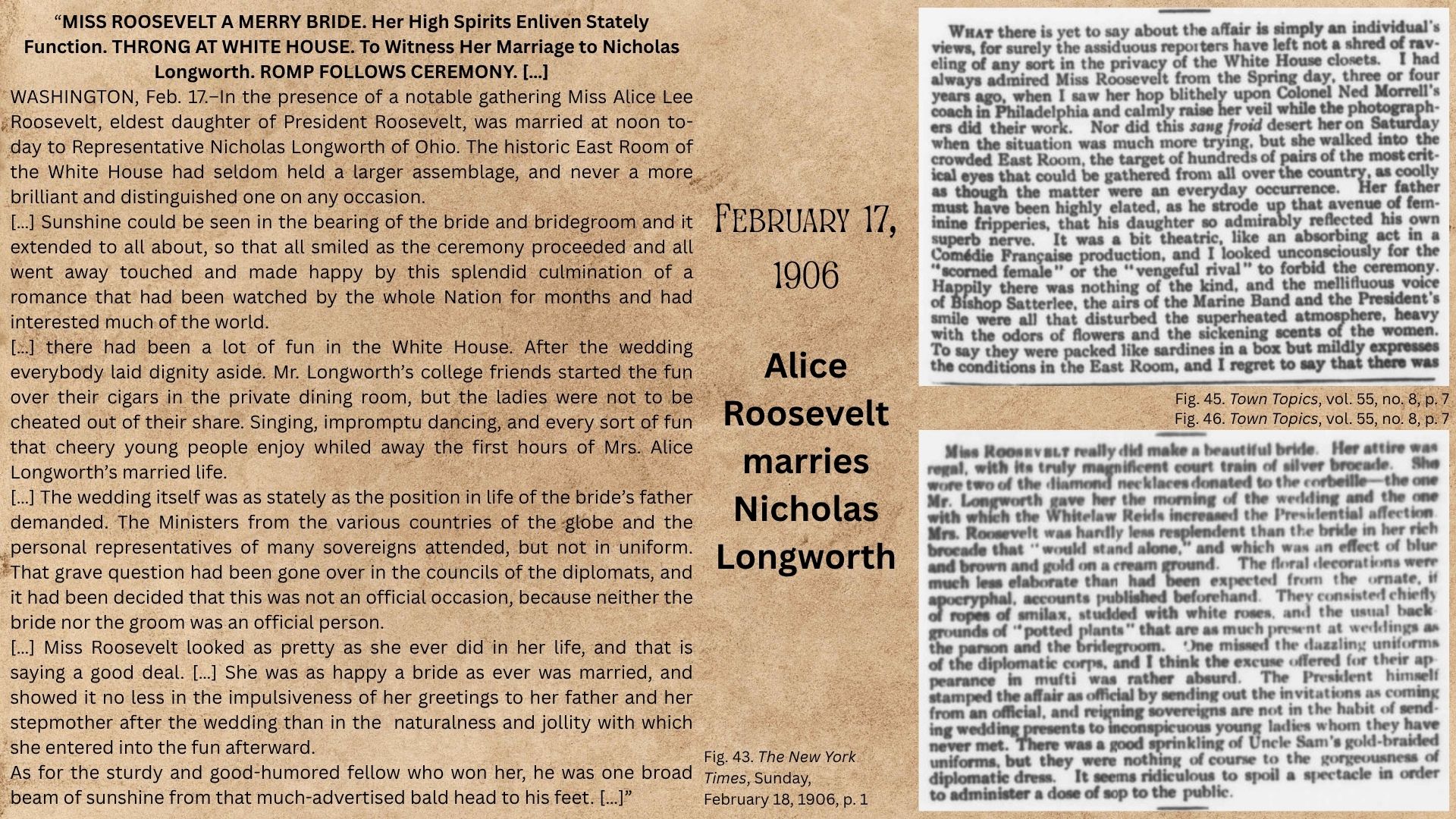
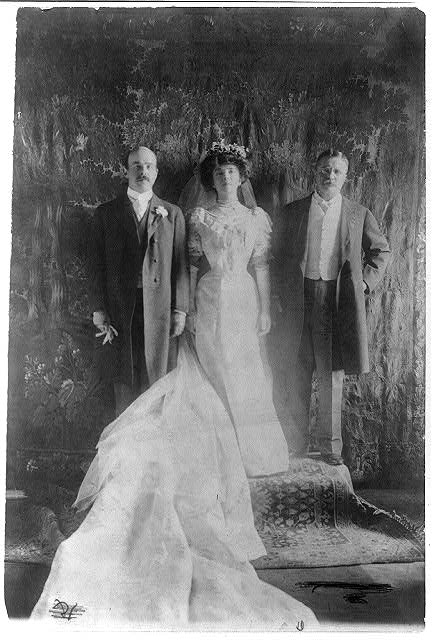
The forthcoming wedding occupied the entire nation: Alice—titled the “White House bride” (see fig. 47)—was the center of all attention, and speculations about her dress and every other detail of the ceremony flooded the newspapers while Nicholas Longworth was brushed aside by the idolization of his fiancée. Alice remembers the turmoil during the wedding preparations: “There were trips to New York to stay with friends and shop, dogged by reporters, inquisitive crowds following when I went shopping; to some extent the sort of thing a royalty or a movie star endures, or enjoys” (Roosevelt Longworth 109). The wedding was the event of the year, and the press covered it meticulously. Nevertheless, the altered role of Alice Longworth henceforward as the wife of a congressman brought about some changes. Alice continued to appear in the papers, and she was still popular as she reflects herself:
“Settling down seems a contradictory term for those exceedingly gay months. Before one is married, one is entertained because one is going to be married; afterwards, one is given still more parties because one has been married; so, I should say, there was even more than usual “going out”. […] For a while I tried to have ‘days at home’, but soon had to give them up, as they amounted to keeping open house for the passers-by. Sightseeing stages actually used to stop and let off their passengers, who would come in, wander around, have tea, and occasionally depart with a souvenir such as a doily or a small spoon” (Roosevelt Longworth 116).
But even so, the life of a married woman at the time made different demands on Alice. Her husband’s political career ranked first, and she supported him strongly while taking up her role as “Mrs. Nicholas Longworth” (see fig. 48-49). Ultimately, “with the exchange of vows Alice’s limelight dimmed as she withdrew to the relative domesticity of a congressman’s wife, at least until after Nick’s death in 1936” (Rozek 65).
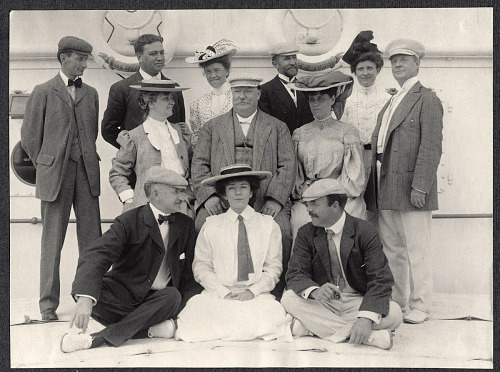
McIntosh, Burr. William Taft’s shipboard table companions aboard the SS Manchuria. 1905. “The Alice Roosevelt Longworth Collection of Photographs from the 1905 Taft Mission to Asia.“ National Museum of Asian Art Archives. Smithsonian Institution, no. FSA A2009.02, https://sova.si.edu/search/ark:/65665/dc341502a29676643f988bf65e18fb56dc3.
Writing about Alice Roosevelt: Town Topics vs. The New York Times
Celebrity and newspaper coverage are interdependent. Magazines featured the latest news about famous people because there was a common interest in their lives that increased sales. At the same time, individuals gained more publicity and a broader reputation when they appeared in the papers because more people got to know them. The way a newspaper reports about a celebrity has an impact on their public image. “Publicity could therefore have, and still can have, both favorable and unfavorable consequences for those caught in its beam” (Montgomery 155). When Alice recounts looking through some old newspaper articles, she is astonished by how much her public appearance was interpreted by the press: “Most of the accounts were kindly, many delightfully humorous. The vulgarity and inaccuracy of others is goose-flesh raising. Some in the foreign papers were worse, if possible, than our ‘yellow journals.’ [sensational journalism] But I suppose we were fair game for the press of the day” (Roosevelt Longworth 128). This comes to show that newspapers don’t necessarily represent a person accurately, and that their narratives shape different conceptions among the consumers. It also pinpoints the dependence on and duality of media interest for celebrities. The advantages include “a degree of prestige and influence […]. But press attention also had its negative side: the lack of privacy, unwanted surveillance, the risk of exposure, or misrepresentation” (Montgomery 151). In the following, we will take a look at how Town Topics and The New York Times each report about Alice Roosevelt in the above presented time period, how their manners differ, and what we can draw from this about the newspapers and Alice’s published reputation.
A strongly indicative difference in the way The New York Times and Town Topics respectively write about Alice Roosevelt can be seen in the names and terms they use to refer to her. While The New York Times sticks to mostly her full name or her last name, they always combine it with the polite form of address that was proper at the time, so it’s either “Miss Alice Roosevelt” or “Miss Roosevelt”, and “Mrs. Alice Longworth” or “Mrs. Longworth” after Alice’s marriage. This corresponds to the overall style that the newspaper is composed of. Not for nothing does The New York Times serve as a reputable comparison to Town Topics: their manner of reporting is rather neutral and descriptive, they stick to the facts and figures, and they keep a professional and respectful distance toward the subject of their writing. They don’t report rumors in a sensational manner much like Town Topics does, whose main medium of exchange was “information, gossip, rumor, and innuendo” (Montgomery 1). Town Topics already chatters of flirtation between Alice Roosevelt and Nicholas Longworth from their earliest involvements on (see fig. 16, 39) and prides itself on these speculations later on when they turn out to be true (see fig. 42) while The New York Times doesn’t mention any particular connection early on (see fig. 15) but reports matter-of-factly about the engagement rumors when they’re up to date (see fig. 38). And yet, The New York Times can—like all newspapers—sometimes be faulty in their reports, for example when they rely on hearsay about events during Alice’s journey to Asia so that she has to set the record straight upon her return to the USA (see fig. 38).
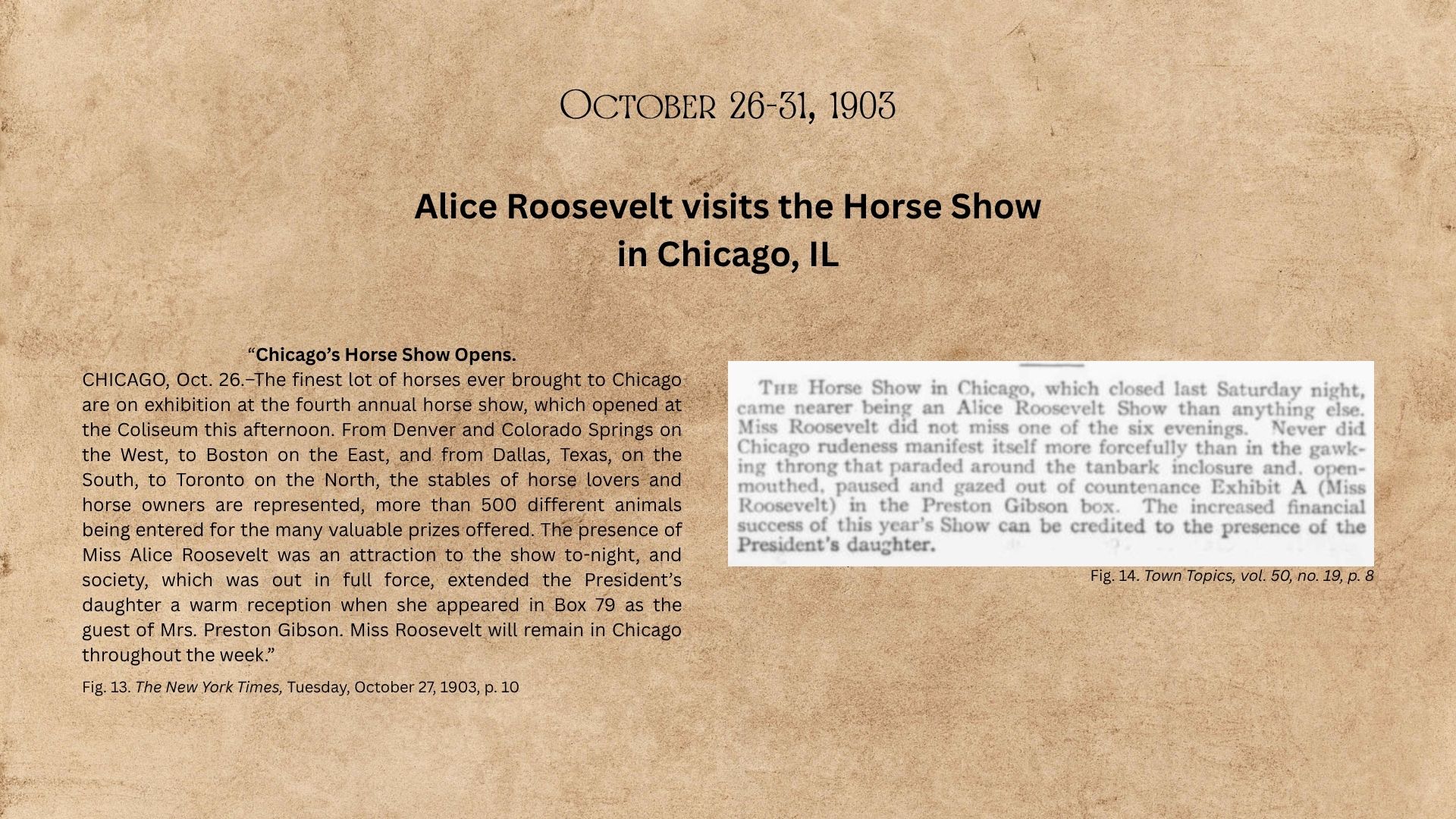
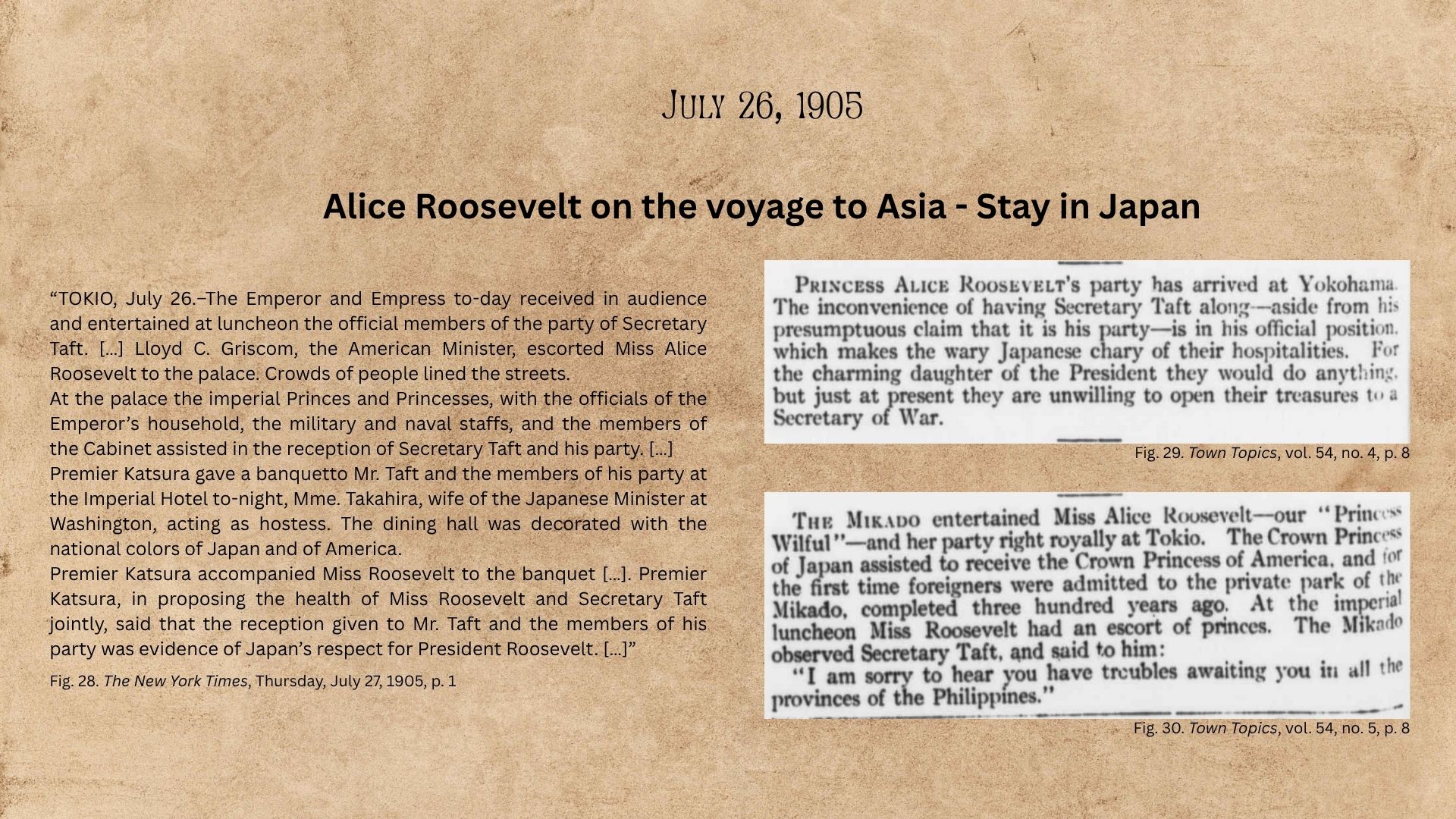
In terms of referencing Alice, Town Topics also states her address and full or last name, especially in the earlier years of her celebrity. The label “President’s daughter” or “daughter of the President” is something that both papers frequently use. It communicates Alice’s rank and has recognition value for the public. Even if somebody hasn’t heard the name Alice Roosevelt, the mention of the relation to the President would be sure to ring a bell with almost everyone. However, the Saunterer—the author of Town Topics’ society column “Saunterings”—gets more creative with his referring to Alice over time as her popularity increases. He comes up with names such as “Exhibit A” (see fig. 14) to satirize the Horse Show where Alice was the main attraction or uses a casual first name reference of ”Alice” (see fig. 12) that makes it seem as though the magazine is close and personal with her. The references are also in line with the overall attitude of a respective article, so they depend on whether a paragraph is written slightly mockingly—of Alice or of society—or if it’s supportive of her actions and praises her looks. In addition, the Saunterer takes up the nickname “Princess” that the public gave Alice Roosevelt and uses it in all kinds of variations. He especially elaborates the royalty metaphor in the coverage of Alice’s travels to Asia when he refers to the White House as the “White Palace” (see fig. 22), contrasts the Crown Princess of Japan and the “Crown Princes of America” (see fig. 30), writes about a royal reception (see fig. 33) and “the royalty rank of the daughter of a President” (see fig. 37) to caricature the great extent that Alice’s celebrity had assumed at this point.
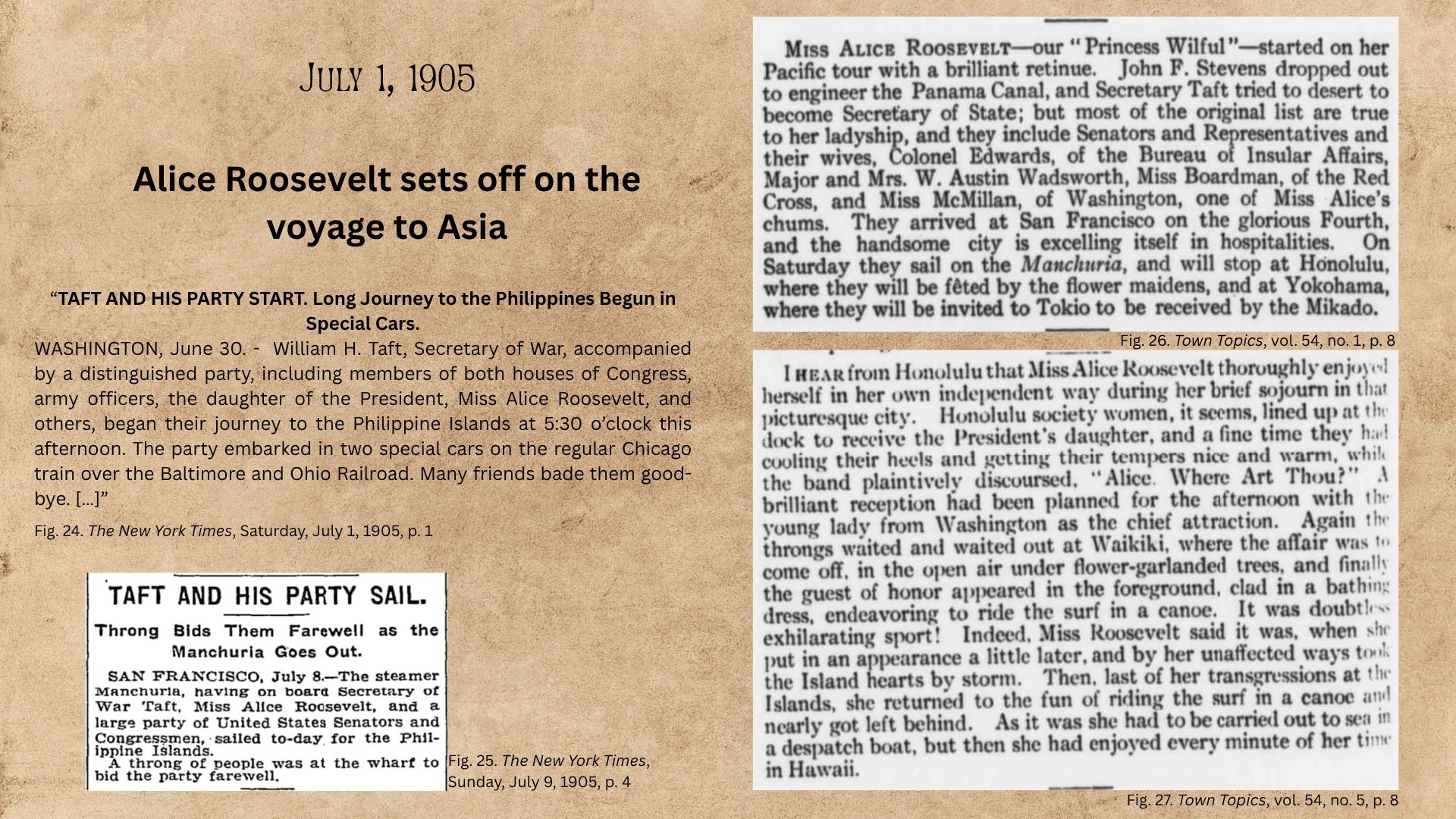
Interestingly, The New York Times’ coverage of the trip to the Philippines and beyond is written in a different manner that emphasizes key differences in the two newspapers. For The New York Times, the main person of the trip is Secretary Taft, the official leader of the diplomatic mission and the one holding an official position, being the Secretary of War. This highlights the political interest of the newspaper with regards to content. The news headings of articles regarding the tour stops talk about “Taft and his party” (see fig. 24, 25), reinforcing his important role on the journey. Articles name Alice Roosevelt in the headlines only if she is specifically involved in an event (see fig. 31, 32). This only changes after the party splits up and Alice travels on to China with a few companions while Secretary Taft returns to the USA. From then on, Alice is the center of attention in the travel reports in The New York Times (see fig. 34-36). On the contrary, Alice is the main attraction in Town Topics from the very start of the journey, and the magazine reports almost exclusively about her actions and her special treatment. The Saunterer reports about “Princess Alice Roosevelt’s party”, wryly shifting the importance to her, and even makes a snarky remark about Taft presumptuously claiming that it would be his party (see fig. 29). In that context, the Saunterer also calls Alice “our ‘Princess Wilful’” (see fig. 26, 30), thereby positioning himself amongst his readership and at the same time expressing his cynical opinion about her past behavior, winkingly masked in a pet name.
On the whole, the Town Topics columns are rarely purely informative; they usually contain the judgement of the Saunterer toward the person and situation at hand, be it in a positive or in a negative light. For instance, his remarks about Alice at the christening ceremony are complaisant but his comments on the coronation affair and discussion about Alice’s rank include rebuke and advise for better behavior on her part (see fig. 5, 6, 8). The New York Times’ accounts in both these cases, and generally, are more objective and good-natured towards Alice (see fig. 3, 4, 7). This subjective style of writing in Town Topics results from the Saunterer having established himself as an authority of society’s moral standards. He “acted as a censor of the behavior of those who set the fashion for the rest of society” (Montgomery 5), namely society women in the public eye such as Alice Roosevelt. His aim was to give a social commentary, not neutral coverage of events. The Saunterer’s tone in doing so tends to be sarcastic and “much of what the Saunterer said was done with tongue in cheek” (Montgomery 150).
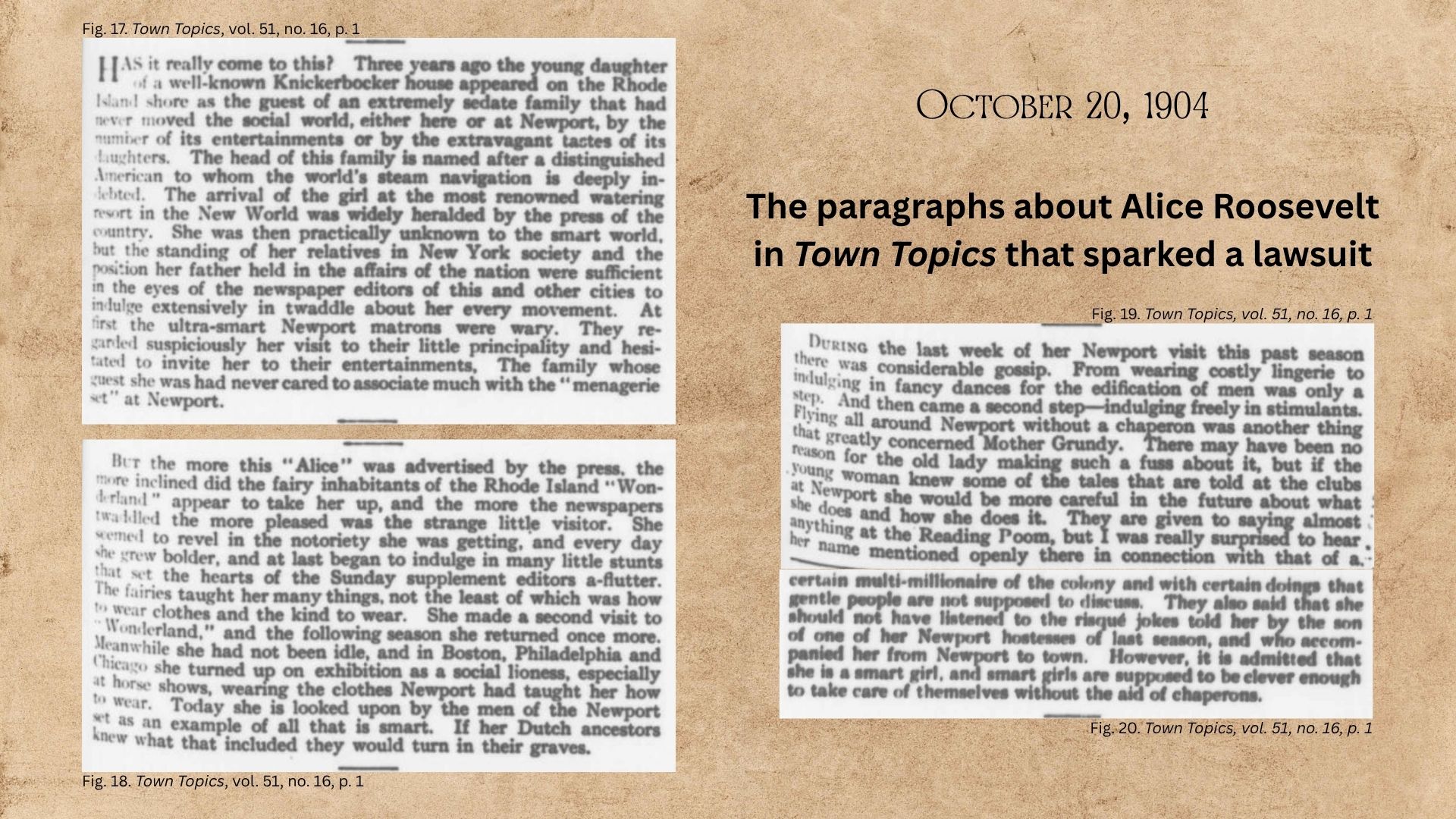
The Saunterer really got to work as the “censor of society” in regard to Alice Roosevelt when he published three scathingly condemning paragraphs about her—in his opinion—abominable moral behavior (see fig. 17-20). For writing such libelous passages in general, the Saunterer used a sly method of pairing paragraphs where “the first one, the ‘blind paragraph,’ would refer to the infelicities of a member of society and the paragraph immediately succeeding it, the ‘key,’ would contain the name of the person in question” (Montgomery 146). That way, he could avoid being sued for defamation as he didn’t openly name the person in the same breath but still gave away their identity. Nonetheless, these paragraphs about Alice did indirectly lead to a lawsuit, because the vicious implications about the President’s daughter drove the publisher of another paper to take on the editors of Town Topics in an editorial battle that resulted in a court case (Montgomery 145; for more information on the libel suits see also project Town Topics’ Downfall – Significant Libel Cases). By being subject to such an affront in the papers, Alice experienced another side of publicity: “All celebrities live in fear that their public approbation will fade, only to be supplanted with disapproval—harbinger of the ultimately fatal inattention. For Alice, this came in part in 1904” (Rozek 61) with the ruthless remarks in Town Topics. Although this situation must have had unfavorable consequences for Alice’s public image, this is not so much reflected in either Town Topics or The New York Times. The reports about Alice in Town Topics just continue in their usual fashion as if nothing bad was ever written about her, and there is also no specific mention of the incident in The New York Times. They report about the legal cases that follow for Town Topics’ editors but there is no connection drawn to the paragraphs written about Alice in Town Topics. Potentially, a bigger public uproar was prevented because at the time, nobody who deemed themselves respectable would have liked to publicly admit that they read a scandal sheet like Town Topics (Rozek 61). Alice herself doesn’t write anything about this specific occurrence, but as reports of her eccentricities increasingly appeared in the papers, her father wrote her a scorching letter with reproaches to her behavior (Roosevelt Longworth 60-61).
Apart from differences in style and content, the two newspapers also vary in their layout. After Alice Roosevelt becomes a public figure, the articles that concern her in The New York Times are printed amongst the more striking news located at the front of the paper. She isn’t just mentioned in the specified society columns on the rear pages but gets her own designated articles with headlines, often on the front page itself. This speaks for Alice’s prominent public value because “unusual or sensational items of news about particular families or individuals […] were often brought forward to the front page” (Montgomery 144) in order to set them apart from the regular social activities of high society and entice potential readers to buy the paper. Not only does The New York Times chronicle even the smallest of Alice’s movements (see fig. 9, 11), when it comes to the grand events, the articles are also very in-depth and elaborate at length on detailed descriptions of fashion, decoration and procedure, as well as giving background information and statements of the people involved (see fig. 1, 7, 43). The New York Times can dedicate this much publishing space to extensive reports because they are a daily newspaper and therefore have a full paper worth of space to report about the news of a single day. For the sake of this project, I had to cut down the related articles to the most relevant points to enable a direct comparison.
Town Topics, on the contrary, is issued in a weekly cycle and has thus the same space to cover the happenings of the entire past week. This can be seen in the lengths of the paragraphs written about Alice. They are shorter and less detailed overall but compared to the other accounts in Town Topics they usually occupy a larger space and often grace the front page here as well. Especially in the later stage of Alice’s celebrity when she has become a household name, there are multiple paragraphs written about her tidings such as the journey to Asia and her engagement along with the wedding (see fig. 26, 27, 41, 42, 45, 46). Moreover, during the years 1902-1906, Alice is featured in almost every issue of Town Topics in “Saunterings” and often additionally in one of the other columns hence further underlining her prominence in the public.
For Town Topics, Alice’s wedding to Nicholas Longworth marks the end of an era. While The New York Times continues to report about her in a similar fashion as in the years before—potentially slightly less prominent and adopting to her new role and standing as the wife of a congressman—Town Topics dramatically titles this stage in her life “the passing of the Princess” (see fig. 48, 49) and predicts a decline in her fame due to her altered standing in society. The magazine continues to report less frequently about her in the following year, heeding its own announcement and perhaps moving on to more promising gossip prospects since the pastimes of a wedded Alice Longworth weren’t of much interest to a journal that sought to cover the sensational, and the Saunterer’s beloved royalty metaphor had likewise become obsolete from then on.
Towards the End of This Chapter: Final Thoughts
The years of 1902 to 1906 in Alice Roosevelt’s life involve her rapid ascent to celebrity, starting out as a debutante in the White House all the way to her international renown, and being cherished and honored like a princess. Alice lived through both the favorable and unfavorable sides of this popularity and experienced what it meant to have the press make public every detail of her life. The immense hype around her came to a temporary end after she got married. Alice ceases to represent the picture of the flamboyant President’s daughter and rather takes on the position of a “regular” society woman, leaving behind her princess image and the center of attention.
The press has become an integral part of creating and nurturing celebrities like Alice Roosevelt. The newspapers for this comparison are merely two examples of the broad variety of press coverage that awaits a public person, and they showcase that the manner of reporting influences the created public image. The events recounted of Alice’s life may be the same but through Town Topics’ subjective style of writing the magazine presents its readers with a prefabricated opinion of Alice Roosevelt and depicts her in a certain light, thus having a greater influence on shaping the public’s impressions of her. The New York Times creates a more unfiltered picture of Alice through their factual reports which might be slightly positively biased by her parental relations since the articles are throughout affirmative. The paper overall aims to provide the public with up-to-date information.
Interestingly, we can still see parallels to today’s celebrity culture in Alice Roosevelt’s rise to fame: news outlets that seek to chronicle every movement of a famous person, scandal sheets that strive to dish the dirt to create the most exciting headlines. Paparazzi that invade personal space have increasingly come into the picture, and nowadays celebrities themselves share deep insights into their lives on social media. Debates about privacy are still up to date just as well as questions about the influence of the media on shaping the public’s opinion. Because the following is still true: Publicity can make or break you.
By Lisa Magdeburg.
I want to thank the anonymous reviewer for their helpful feedback, and Bruna Santos for her technical support.

All content for educational purposes only.
University of Greifswald
Seminar: Editing Scandal
(Summer Semester 2025)
Instructor: Prof. Dr. Katrin Horn