
The Socialite’s Map
Ads and Travel Reports at the Onset of WWI
I’d figure that the First World War needs no introduction. The monumental, devastating war that was fought out on a global scale was by far not the first war of the 20th century, yet it stands out as an armed conflict arising out of seemingly nothing but affecting virtually everything. How this war relates to a weekly periodical from New York City, NY, that concerned itself with gossip about—predominantly—East Coast high society, however, may require an introduction.
Introduction: the “Foreign Hotel Directory”
In September of 1913, Town Topics debuted a new, irregularly recurring segment: the “Foreign Hotel Directory.” This segment only concerned advertisements, comprising a block of densely formatted ads (2’’ by ⅔’’ max.) regarding hotels in Europe and North Africa. On its first appearance, the “Foreign Hotel Directory” carried seven ads for hotels—four French, one German, one Italian, one Swiss (TT, 70/13, 23). Placed on the penultimate page, it was followed by ads for US-American hotels and railways on the back cover. Hotels, inns, and resorts within the USA had been advertising in Town Topics for some time, but ads from European hotels had been sparse.
This would change with the “Foreign Hotel Directory”: two months after first appearing, the November-27th number would contain 19 hotels advertising in the “Directory” on the back cover, made up of three Algerian, one Tunisian, five French, two German, four Italian, and four Swiss hotels (TT, 70/22, 24). The first “Directory” of 1914 only held ten hotels (TT, 71/10, 28); meanwhile the following week’s segment showed 37 ads occupying half of the back cover (TT, 71/11, 26), together with additional European hotel ads pushing US-American ones onto pages 20 and 22. For the next three months, whenever the “Directory” was printed, it contained more than 30 ads; it was not until June that the amount fell to 25 ads placed on the second-to-last page (TT, 71/24, 22). From there numbers kept declining until July 30th, showing 15 ads (TT, 72/5, 20).
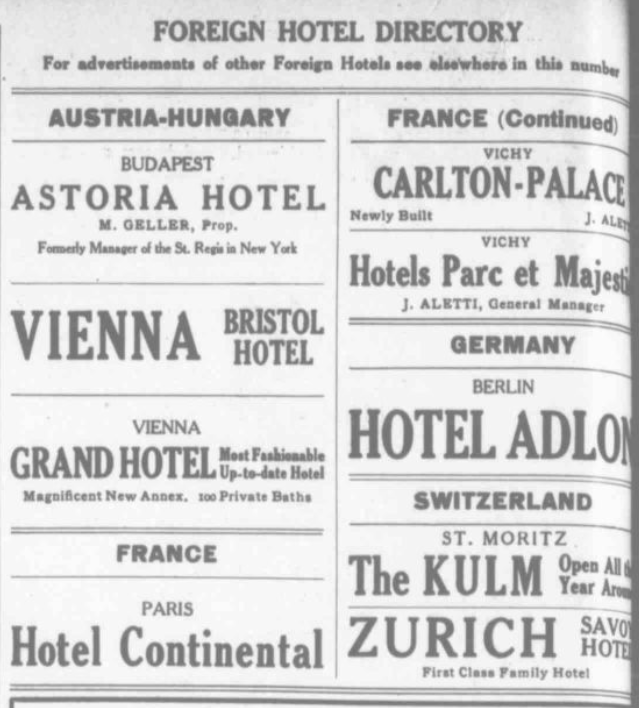
The number on August 6th, after war had broken out amongst a multitude of European nations, carried no Directory, but had on the back cover a full-page advert for Pall Mall cigarettes (TT, 72/6, 20). Since Town Topics received news until 4 p.m. on the Tuesday before publication, they could have received notice of events as late as the German invasion of Belgium at dawn of August 4th (Schafer 116), but the British declaration of war on Germany did not occur until 6 p.m. EST (Supplement 6161). The following number was published into a world where virtually all large European powers were at war (Becker and Krumeich 39) and presented a “Directory” of nine advertisements (TT, 72/7, 20; see fig. 1). The “Directory” ended with the November-19th number, showing three ads (TT, 72/21, 24). As a segment, it would only be resurrected near the end of 1919 (TT, 82/24, 48), but the ELWA search tool suggests it died down for good about a year later in September 1920 (TT, 84/13, 22).
This means we can track the impact of the First World War on Town Topics quantitatively by looking at travel-related advertisements contained within the journal. The “Foreign Hotel Directory” is not the only source here, as free-standing US-American and European hotel advertisements were prevalent around the same time that the “Directory” ran—with a similarly rapid demise.
Of course, advertisements are not the only tool: the gossip column “Saunterings”, the irregularly recurring segment “Americans Abroad”, and the stage gossip segment “Broadway Banter” mention travels frequently. I’ll take a closer look at some of these instances and provide a few maps that will visualize the changes the first year of WWI brought about in the realm of travel.
Early 1914: what is it about travel?
As much as balls and dinner parties were a staple of high-society living in the early 1910s, so was travel. Taking from one’s winter place to the family-owned summer residence was reported upon as much as staying with relatives in a nearby city for a few days. This focus on the movement of high society members allows for an overview of where those who could afford to travel took to. The winter of 1914 saw socialites visiting acquaintances or family, staying at resorts or in cities like New York City, NY (abbr.: NYC), or travelling overseas to Europe, Africa, and the Caribbean. In the case of actor Donald Brian and his first wife Florence Meagher Gleason, splitting up, gossip, and travel are directly connected. The Night Owl writes: “I HAVE it on good authority that this time the Donald Brians have parted for good. Mrs. Brian is said to have gone to Virginia Hot Springs, Donald remains on his job. . .” (TT, 71/2, 17).
In the same vein, Parisian tenor Lucien Muratore and opera singer Lina Cavalieri had to reveal their marriage while in a hotel in Chicago, IL: “Recently when they engaged a suite together at the Congress Hotel in Chicago the management of that hostelry showed some perturbation, but his virtuous qualms were laid when the couple promptly produced their marriage certificate” (TT, 71/2, 17).
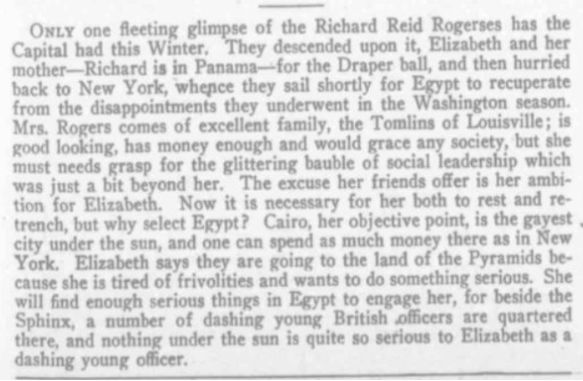
The Saunterer at times provided full travel itineraries, such as in the case of the Rogers family of Washington, DC. While Richard Reid Rogers resides in Panama, his wife Eunice Rogers (née Tomlins) and their daughter Elizabeth attended the Draper Ball in Washington, DC, only to hurry to NYC, where they will catch a boat to Egypt. Elizabeth is rumored to keep her eyes open for British officers when staying in Cairo (TT, 71/2, 9; see fig. 2). I’ll get back to that once we’re in May 1915.
April 1914: attitudes toward Europe and the year of 1914
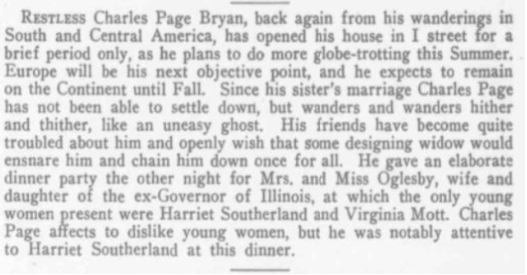
The first issue of 1914 has the Saunterer proclaiming: “HAPPY NEW YEAR to all! Whether it is going to be happy the Lord only knows, but no harm can come and some good may result from wishing unanimously for what we all want. With Saturn and Mars in the ascendant, the astrologers of France, England and America agree in predicting a year of disasters, especially in the United States and Great Britain” (TT, 71/1, 11). This anticipation, however, does not seem to have deterred travel in any meaningful way and the April-30th number is filled to the brim with travel inside and outside the USA. US-American diplomat Charles Page Bryan is reported to have returned to Washington, DC, “from his wanderings in South and Central America.” If the Saunterer is to be believed, Bryan held plans to sail over to Europe in the summer for further wanderings which should keep him preoccupied until fall that year (TT, 71/18, 7; see fig. 3).
In world news, the Saunterer and other contributors were in early January pre-occupied with the Panama Canal (TT, 71/1, 12) and the Mexican Revolution (TT, 71/2, 14), which by April had turned into a conflict with US interference (TT, 71/18, 14). Still, while European, South American, and Asian nations were subject to political and military commentary in Town Topics, and while warfare was part of the reported news, this did not affect the periodical at large. As I’ve stated in the introduction, foreign advertisement was at its peak, and travel reports frequently mentioned Europe. The April-30th issue carried a new installment of “Americans Abroad”, mentioning US-Americans in Wiesbaden, Munich (both Germany), Naples (Italy), and Paris (France) as well as recommending Abtenau in Austria (TT, 71/18, 19). Coincidentally, the Hotel Rose in Wiesbaden, the Continental in Munich and Abtenau are all mentioned in the segment and advertised throughout the number. The same goes for a physician by the name of Dr. Gara who reportedly prescribed Mrs. Mosler of NYC mud baths in Piešťany (Slovakia) to great effect (TT, 71/18, 19). The same doctor and baths are advertised four pages later (TT, 71/18, 23).
As you can see on the map, European resorts and hotels were advertised disproportionally more than US-American ones when compared to travel reports. Nonetheless, there are ten paragraphs in “Saunterings” and elsewhere mentioning socialites in Europe—either staying there already or just having set sail aboard the Mauretania (TT, 71/18, 1).
Summer 1914: first reactions to the war
On July 30th, Town Topics was published under the impression of a run-out ultimatum posed by Austria-Hungary to Serbia and consequent Serbian mobilization (Gilbert fig. 14). The issue of the following week came out after Austria-Hungary had invaded Serbia (Gilbert fig. 14), as a consequence of which Germany declared war on Russia (Gilbert fig. 14; Becker and Krumeich 56) only to then open the Western Front with invasions of Luxemburg and Belgium, as well as a declaration of war against France (Becker and Krumeich 39; Gilbert fig. 14).
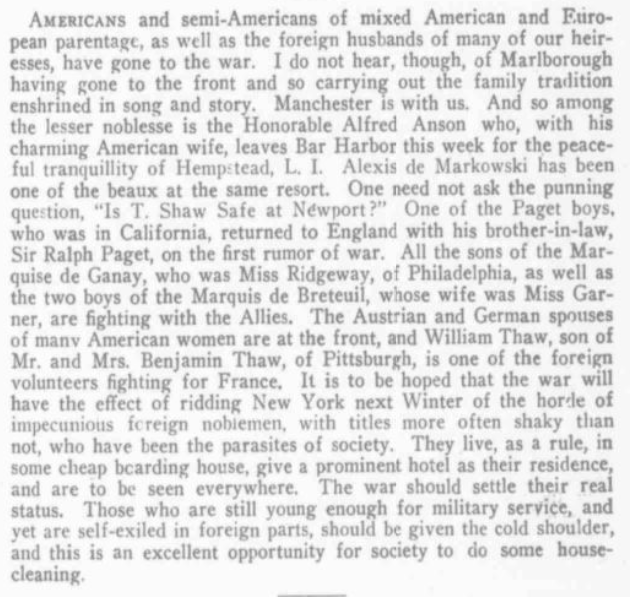
By the August-13th issue, most of the great European powers had entered into the war (Becker and Krumeich 39)—a war that within a few weeks had already reached across central Europe into Africa (Morrow 58), the Arab Peninsula (Gilbert fig. 43), and Asia (Gilbert fig. 24; Morrow 56). On August 19th, US-American President Woodrow Wilson urged neutrality under the impression of the ongoing US-American involvement in the Mexican revolution and the high number of European immigrants living in the USA (Morrow 40). Wilson’s plea for neutrality was not well-received in Town Topics, but mostly for its style, not its substance (TT, 72/8, 12). While the journal does not appear a particularly pacifist one, it seems to have accepted US-American neutrality at first. Regarding immigrants, specifically, the Saunterer talks of war as an “opportunity for society to do some house-cleaning,” hoping that “war will have the effect of ridding New York . . . of impecunious foreign noblemen” (TT, 72/11, 5; see fig. 4).
Shortly after President Wilson’s plea, Japan declared war on Germany (Gilbert fig. 24), Germany and Great Britain fought at sea (Gilbert fig. 75), and Germany advanced significantly into France. The German forces on the Western Front had, in just about a month, invaded Luxemburg, Belgium, and the northwest of France and were moving quickly towards Paris.
September 1914: taking position
When the German army had arrived at the Marne (France), some 20 miles from Paris, their advance was halted by the French and British forces fighting to contain German aggression (Gilbert fig. 16). Just about a month after Germany had invaded Belgium, this battle would prove decisive to the war on the Western Front, presenting a heavy blow to German war aims (Gilbert fig. 16; Morrow 44). The outcome would prove to be a year-long deadlock with only slight changes along the front line. The September-10th issue of Town Topics was published right in the middle of the First Battle of the Marne and reported on several US-Americans affected by the war. The issue opens with a report on the last event of the season in Newport, RI. That event—a horse show—was attended sparsely, but among those watching were both Reggie and Alfred Vanderbilt who had previously fled Europe, their return to the USA producing a great amount of talk and coverage (TT, 72/11, 1).
London (United Kingdom, abbr.: UK) appears prominently in this issue, as many US-Americans are reported there—either passing through, staying, or just arriving. NYC lawyer De Lancey Nicoll reportedly fled to the British capital “packed in like a sardine in a common carriage on the trip from Paris” (TT, 72/11, 5); business man Colgate Hoyt and his wife Katherine Hoyt (née Sharp) escaped St Petersburg (Russia) via Scandinavia and London to NYC (TT, 72/11, 6). Former US Senator Chauncey Depew will stay in London to “see the war” (TT, 72/11, 6) while several Baltimoreans are reported as feeling “comparatively safe” there (TT, 72/11, 8).
Some US-Americans are sailing over, such as Mrs. Dudley who plans to join the Red Cross in France as a nurse (TT, 72/11, 9). In a manner described as that of a “typical American,” former U.S. Steel president William Ellis Corey has gone for Paris to meet his wife Mabelle Gilman Corey there, proclaiming “‘Certainly I expect trouble, but I shall get there.’” (TT, 72/11, 11)
May 1915: transatlantic relations
The issue of May 13th, 1915 carried just ten advertisements for hotels—all of which US-American. Europe was no longer marketable as a destination for leisure, seeing as the war had reached over most of the continent. The Western Front was mostly frozen but brought about thousands of fatalities nonetheless. Germany used chlorine gas on April 22nd at Ypres, opening the door to chemical warfare (Gilbert fig. 50; Morrow 78; Audoin-Rouzeau 67). The Eastern Front had been subject to a significant pushback by German and Austo-Hungarian forces against the Russian military (Audoin-Rouzeau 72, 85). Outside Central Europe, the UK had opened hostilities against the Ottoman Empire in late October of 1914 (Morrow 53), then targeted the Arab Peninsula (Gilbert fig. 42), occupied the area around Ahvaz (Iran) (Morrow 53–54), and landed in the colony of German East Africa (Morrow 60) in November 1914. The formerly German-occupied Qingdao (China) fell to Japan that month (Morrow 56). In December 1914, the UK and Germany were engaged in naval battle at the Falkland Islands (Gilbert fig. 25).
Clashes at sea happened regularly in European waters and the North Atlantic. Especially after February 4th, 1915, when Germany declared the waters around the UK a war zone, the seas had become a battle field. Germany launched into “unrestricted submarine warfare” (Morrow 100–101) which would eventually lead to the sinking of the ocean liner Lusitania on May 7th by a German submarine just off the Irish coast (Morrow 101), causing roughly 1,200 civilian fatalities—about 10% of which US-American (Audoin-Rouzeau 74, 80). The May-13th number of Town Topics was written under the impression of this sinking. In “Saunterings,” 15 paragraphs address the event; the Widow’s contribution to this issue is an entire page covering the sinking; the number carries a poem entitled “The Lusitania;” the repercussions for the stock market are discussed (TT, 73/19). While some socialites are reported to have survived, many did not: “THE death-roll includes a long list of other names distinguished in commerce, art, and what not pursuit,” among those the multi-millionaire Alfred Vanderbilt (TT, 73/19, 11).
The German embassy had issued a warning by means of advertisement in several newspapers concerning transatlantic travel a few weeks before the sinking. I couldn’t find such an advertisement in Town Topics, but the Saunterer did mention the affair as a German “alibi” for the sinking (TT, 73/19, 13). As for US-American reaction, the Saunterer called for sending the United States Navy to the English Channel to protect US-American civilian ships but is skeptical of whether President Wilson would even consider such a measure—the only adequate measure in the Saunterer’s eyes (TT, 73/19, 13).
Dupont et al. find in their study of US-American overseas travel from 1820 to 2000 that the First World War did significantly cut into the number of US-American tourists overseas (see: Dupont et al. 146, 164). We can trace the early stages of this development in Town Topics, by means of looking at both advertisements and travel reports. But while casual US-American travel to Europe was heavily impacted by the first year of WWI, it didn’t cease: socialites continued to visit Europe, even as it became a battle field. Remember the Rogers family of Washington, DC, from the section on early 1914? While, in January of 1914, the Saunterer presumed the Rogers’ daughter Elizabeth to be on the lookout for British officers in Cairo (see: TT, 71/2, p. 9), she was now, in May of 1915, living at a estate in Rotenburg a.d. Fulda (Germany) belonging to the House of Hesse. She, now Elizabeth Freifrau von Barchfeld, had since married Prince Christian of Hesse-Philippstal-Barchfeld. Her mother, Eunice Rogers (née Tomlins), had stayed a while in Europe, most likely visiting her daughter, then returned some weeks ago to Washington, DC, and has now left for NYC (see: TT, 73/19, p. 8).
Addendum
Figures (click to enlarge):


Data (coming soon):
Click to download the CVS files of my map data:
By Philipp Rehbock. I want to thank the anonymous reviewer for their helpful feedback, Johanna Bogendörfer for her editorial support, and Paula Gillmann for their technical support.

All content for educational purposes only.
University of Greifswald
Seminar: Editing Scandal
(Summer Semester 2025)
Instructor: Prof. Dr. Katrin Horn