Selling Status — The Evolution of Advertising in Town Topics, 1887-1906

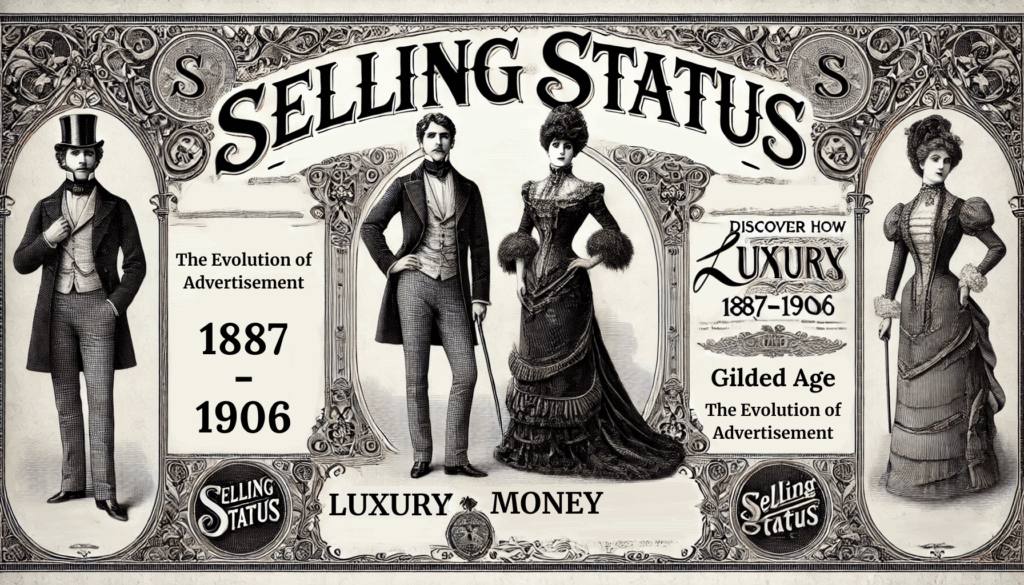
Around 1900, advertising developed into more than informing about products and their potential uses and effects—it was a display of identity, class, and power. In Town Topics, ads reflected and shaped ideals of luxury, gender, and status. This project explores how these advertisements changed between 1887 and 1906 in content, placement, and volume. Drawing on Veblen’s concept of conspicuous consumption, it analyzes how wealth was performed on the page. By digitizing one issue per year, the project makes visible how advertising mirrored and reinforced the social order of the Gilded Age.

By Franziska Schnitzler

The Social Calendar

The idea of this project is to illustrate how the wealthiest of New York City’s elites mingled with each other. For the purposes of this, I have examined a time frame of ten years between 1890 and 1900 and created a representative calendar. The contents of the calendar are formatted in a way that attempts to capture the nature of Town Topics itself. 

As the idea of social seasons is innately connected to debutante culture and the “business” of marriage, a brief section about this can also be found on this page. The central focus will be on the social events themselves and what might be important to know for a potential attendee.

The texts of this project are very consciously phrased to emulate the character of publications like Town Topics to give readers a glimpse into contemporary conduct literature and perhaps imagine themselves as a 19th century socialite for just a brief moment. 

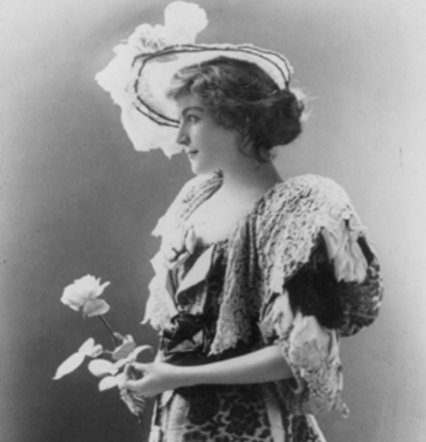
Library of Congress Prints and Photographs Division. B. J. Falk, photographer. Cora (Urquhart) Potter. https://www.loc.gov/item/2002698427/

Early forms of celebrity culture and parasocial relationships: The Case of Cora Potter


Parasocial relationships and celebrity culture are now an integral part of our media consumption society. But how did it come to be that, as a society, we developed such a fascination with media figures and public personalities—and beyond that, one-sided relationships with them, to the point where people feel as though they have a kind of friendship with individuals they don’t actually know?

This development began in the late 19th century, when people of public interest started to be featured in print media. The following project explores the concepts of parasocial interaction and parasocial relationships, as well as the origins of celebrity culture. To connect these ideas and build a bridge to the 21st century, you are invited to explore a fan account for Cora Potter, an 18th-century celebrity.
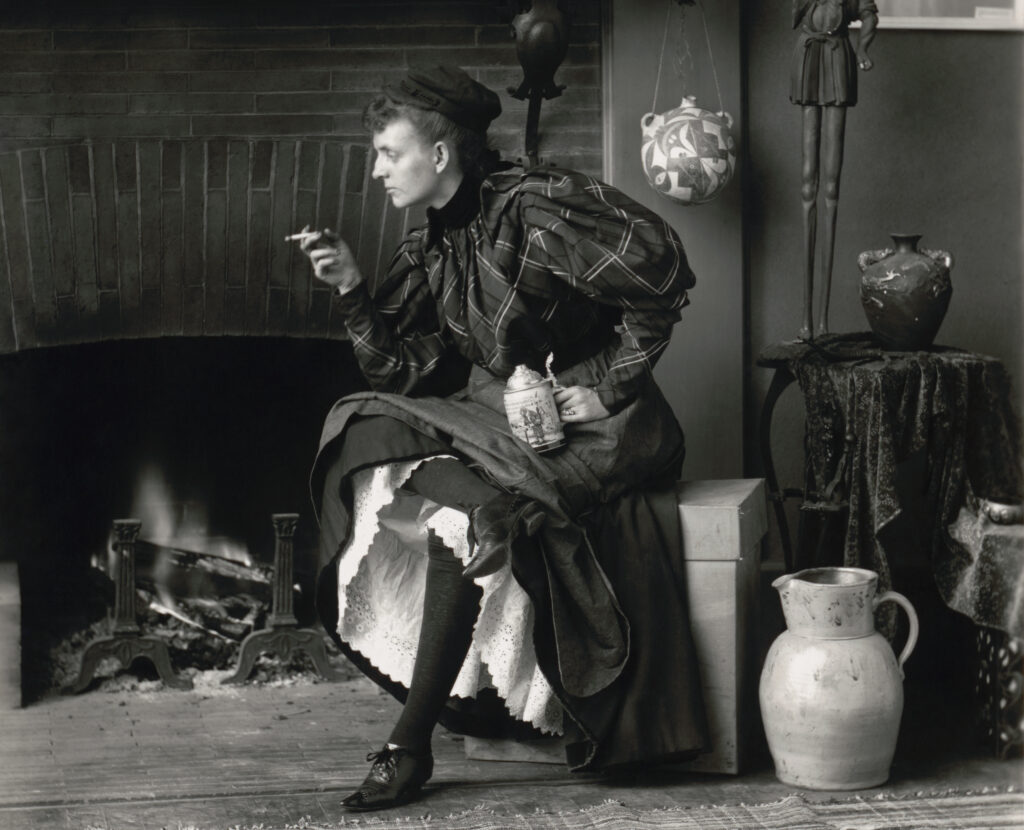
 

Library of Congress Prints and Photographs Division, Washington, D.C. Benjamin Johnston, Frances.

The Many Faces of Women in the Gilded Age — Gibson Girl, New Woman, Suffragette

In the United States of the late 19th and early 20th century, women became increasingly visible in public spaces through the appearance of new leisure activities and consumer culture, brought about by developments such as tremendous economic prosperity, industrial and technological progress, new social movements. These circumstances paved the way for the evolution of new female gender ideals which solidified themselves in the form of certain female archetypes. The Gibson Girl, the New Woman, and the Suffragette were an aesthetic, a socio-cultural, and a political phenomenon, respectively, and all described white, middle-class women from a younger age to roughly middle age. This projects studies the reception and portrayal of the three characters in Town Topics by analyzing the journal´s use of attributes, phrasing, tone, etc. when discussing them to answer the question whether being called a Gibson Girl, a New Woman, or a Suffragette was something to be aspired to or be avoided. 

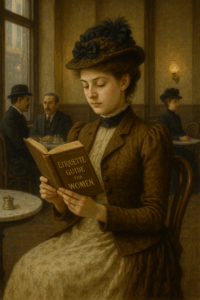
created with ChatGPT via the prompt: Could you create an image of a woman holding a book with “Etiquette Guide for Women” in the Gilded Age?

Women’s Etiquette in Public Spaces

The topic focuses on women engaging on etiquette guides in public spaces. In the Gilded Age, etiquette was a subject that could decide if someone was included in High Society. If well-behaved, invitations and strong connections could have followed.

The project is in form of a guideline that includes behavior rules for public spaces and a short quiz which allows the user to actively learn about the topic. The quiz consists of situations from Town Topics. Educational content and an active learning approach are the main aspects here. It provides a glimpse into women’s etiquette in High Society in New York between 1870 and 1900.

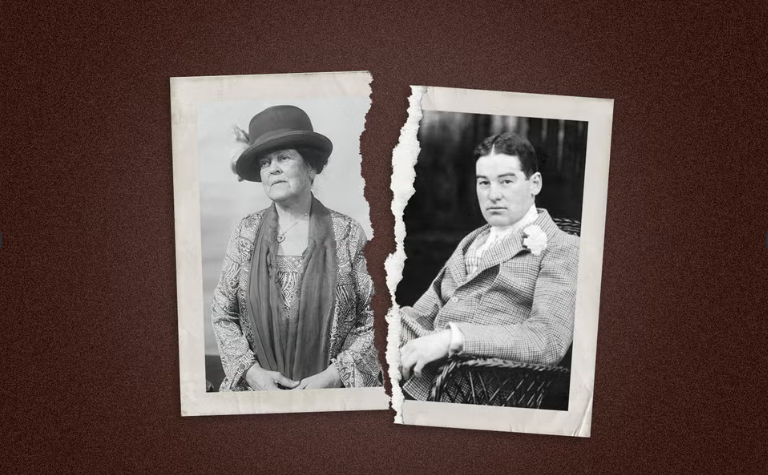
Getty Images. Courtesy newspapers.com. TownandCountryMag.com, https://www.townandcountrymag.com/society/ money-and-power/a64804460/gilded-age-divorce-scandal-alva-vanderbilt/

Scandal Coverage — Reputation in Town Topics

Broken engagements and divorces offer a unique perspective on how gender and morality were publicly debated during the Gilded Age. Town Topics didn’t just report on scandals, it also exposed how women were more vulnerable to reputational damage than men. While men often moved on with little consequence, women’s behavior, and visibility were constantly judged. Gossip acted as a kind of social control, reinforcing double standards around respectability, sexuality, reputation, as well as class. My blog explores these patterns through specific scandal cases, showing how Town Topics shaped public perceptions and also enforced social norms.

Alexander, J.W. National Library of Medicine. https://collections.nlm.nih.gov/catalog/nlm:nlmuid-101392816-img.

“The love for the poppy never dies” – The Discussion of Opium in Town Topics

A divisive topic throughout the 19th and 20th century, the habitual use of opium was as much discussed in New York high society as it was anywhere else. Be it in advertisements for rehabilitation facilities, theater reviews, short stories and poems, or scandals involving the drug—opium gets a mention on Town Topics’ pages again and again. The following timeline traces the history and social perception of the drug, specifically in 19th- and 20th-century America and as described in Town Topics, to illustrate the social climate that allowed it to flourish and ultimately be penalized.

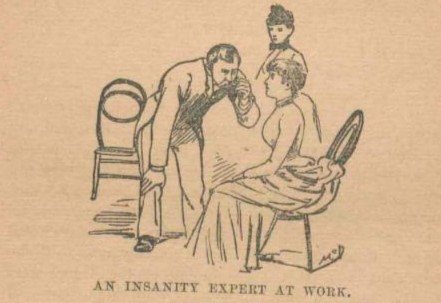
https://archive.org/details/3304680.med.yale.edu/page/n31/mode/2up

Insanity in Town Topics

Charles Deitz in his study ‘A Tomb for the Living’: An Analysis of Late 19th-Century United States Newspaper Reporting on the Insane Asylum demonstrates the role newspapers play in providing the public with information about mental asylums, the problem of stigmatisation and the shift of mental illness from a private matter into the public sphere, “Mental illness evolved from a private/family concern to one of public import over the course of the 19th century” (v). Town Topics: The Journal of Society, provides therefore an example of a somewhat contradicting phenomena where on one hand the language used adds to stigmatisation and marginalisation of mentally ill people, and on the other hand the marginalization occuring in the public sphere integrates the “lunatics” into everyday life of “normal” people. A database of excerpts from Town Topics: The Journal of Society that revolve around the topic of mental illness allows users a glimpse into shifting notions of mental health at the turn of the 20th century. 

All content for educational purposes only.

University of Greifswald

Seminar: Editing Scandal
(Summer Semester 2025)

Instructor: Prof. Dr. Katrin Horn