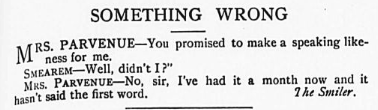
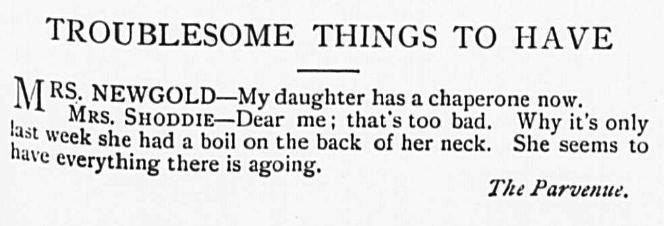
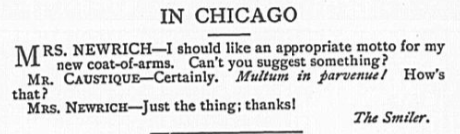
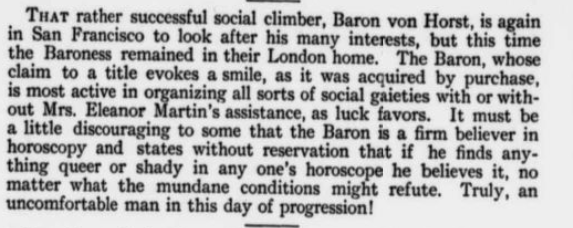
Nouveau Riche in singular describes a person, and in plural an entire class of people “who [have] recently acquired wealth, esp. one who displays this in an ostentatious or vulgar fashion.” (OED, “Nouveau Riche, N.”)
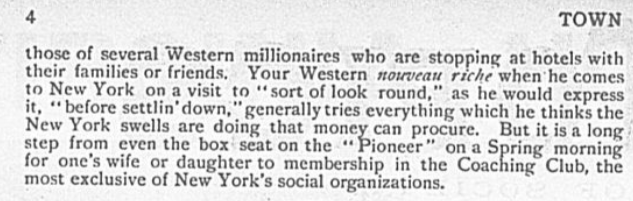
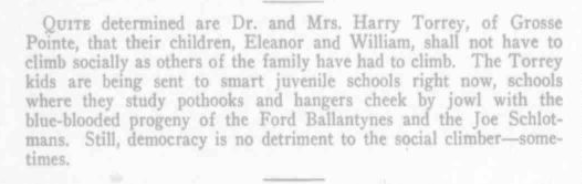
This supposed vulgarity is often mocked in Town Topics. One aspect of this is the language of the Nouveaux Riches, for example. When quoted, it is made clear that they speak differently, using modern language rather than the old English used by long-established members of the upper class. In one situation, a “Western nouveau riche” is described, who comes to New York “to sort of look around before settlin’ down.” In this context, it is also noted that, firstly, he wants to observe how classic New Yorkers behave and what activities they engage in, which can be purchased with money (see fig. 1). However, this attempt is also ridiculed by saying that simply buying a box seat at a play on Sunday morning will not gain entry to the city’s exclusive clubs.
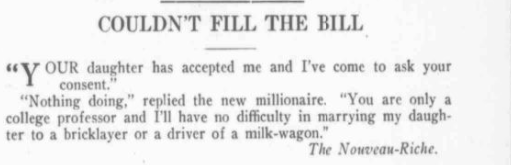
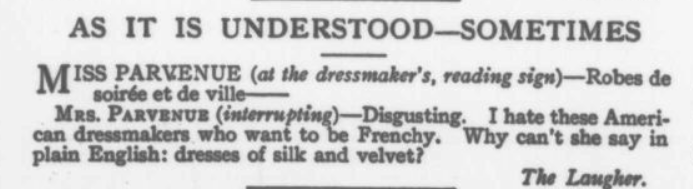
Through the constant cutting remarks in Town Topics about the lack of taste and even the ostentation of the newly rich, it becomes clear that their wealth cannot improve their status within the New York City upper class. The derision of their language also portrays them as uneducated. While the New York City upper class views itself as aristocratic, educated, and generally superior, the Nouveaux Riches are labeled as belonging to the working class despite having been fortunate enough to become wealthy.
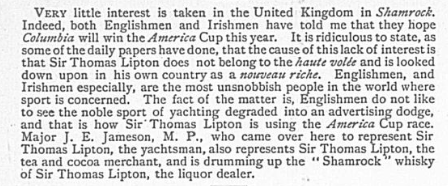
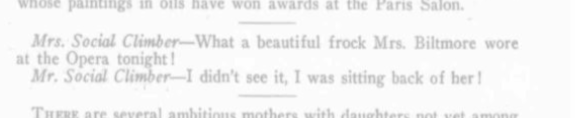
In an article about English and Irish noblemen, it is stated that there is a fear that the Nouveaux Riches will infiltrate a time-honored sport such as sailing, and that, because of their involvement, the competitions will become less about the sport and more about showing off their expensive yachts (see fig. 2). Once again, it is emphasized that the Nouveaux Riches have no class and can only define themselves by their possessions and money, which they must always flaunt.
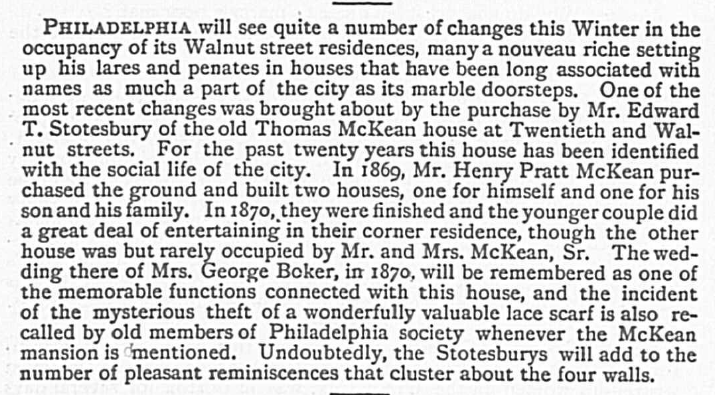
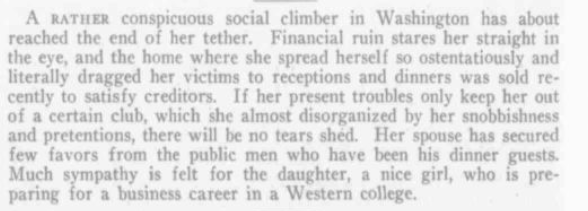
In another report, the Nouveaux Riches are not ridiculed quite so much. It concerns the purchase of a house on Walnut Street in Philadelphia, PA – an exclusive area, then as now. The article laments the times when the neighborhood was still an established part of society, and when this specific house hosted lavish balls and extraordinary events, which are now being appropriated and redefined by the Nouveau Riche. Their arrival marks the end of an era, revealing the extent to which the Nouveaux Riches are threatening and displacing these old institutions. Yet, it is made clear that they will no longer be able to compete with the past. The article ends with the new arrivals adding to the pleasant memories within these four walls. However, it is not entirely clear whether this is meant sarcastically or whether it is accepted as a new era (see fig. 3).
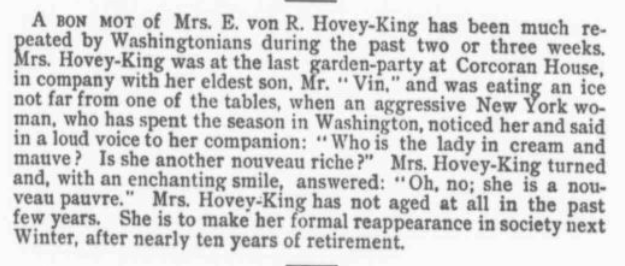
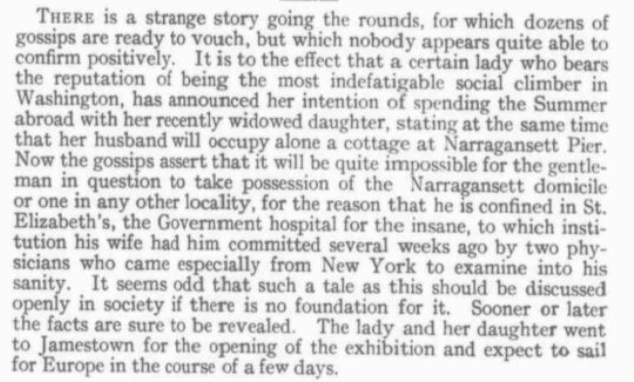
Some reports make fun of the constant bashing of the Nouveaux Riches. One recounts the encounter between an elderly lady who has long been a part of New York City’s high society and a young lady who is also a member of it. When the young woman spots the older woman and loudly asks if she is another Nouveau Riche, the older lady replies that she is a ‘nouveau pauvre’ (English: newly poor) (see fig. 4). It appears that she wants to put the young woman in her place and make her understand what these old New Yorkers are really about by making fun of people who are considerably wealthier than they are. Especially since they are getting richer all the time, thanks to the industrialization that was booming at the time. Often, the only thing that New York City’s established society has to offer is an attitude of superiority, based on their family name and status. At the same time, its own money becomes increasingly scarce.
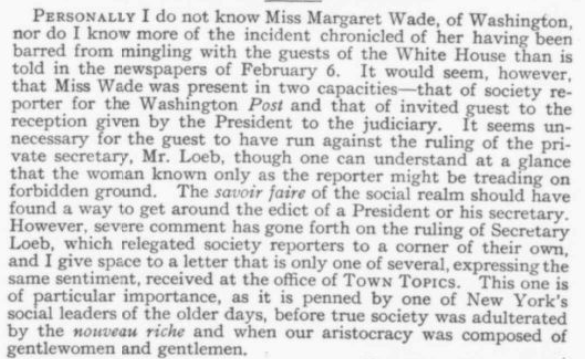
Another comment states that Town Topics pays particular attention to a specific letter to the editor because it comes from an elite leader of society who was famous at a time when society was still composed of gentlemen and gentlewomen, before the Nouveaux Riches took over (see fig. 5). This again clearly establishes that the Nouveaux Riches are not gentle people. By definition, a gentleman/gentlewoman is of decency, lifestyle, and character. It dawns that, as a Nouveau Riche, one cannot possess these qualities. The OED also includes in its definition the note that one must be of gentle birth – a quality that cannot be bought (OED, “Gentleman, N., Sense I.1.a.”).
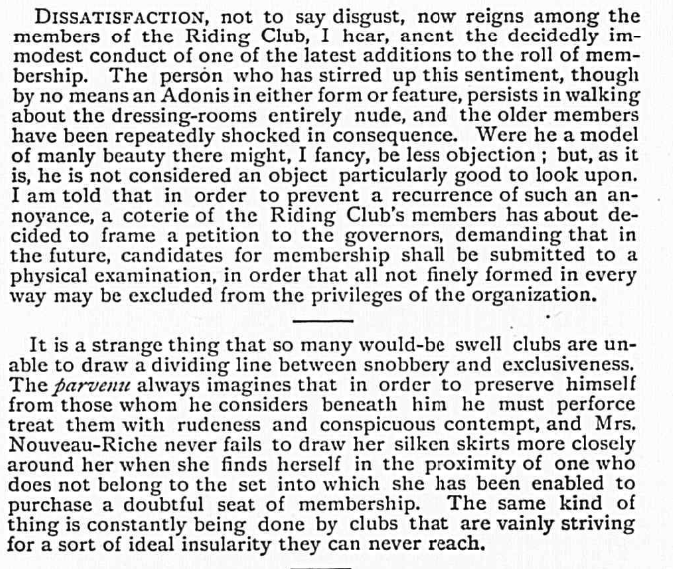
Another commentary strongly criticizes the elite social clubs of New York City for failing to draw a clear line between snobbery and exclusivity by also accepting the Nouveaux Riches as members. It is clarified that all the Nouveaux Riches generally patronize people they consider below themselves and, to establish or to distinguish their standing, are rude to them to make it clear to those around that the newly rich are superior to them. Mrs. Nouveau Riche, an alias for a satirical figure, is said to immediately “tighten her silky skirt around herself” whenever she sees someone from high society (see fig. 6). Here, the stereotypical emphasis is placed on the fact that the Nouveaux Riches lack manners or decency. While the men appear to be rude, the women are portrayed as shameless and promiscuous, characteristics that were highly frowned upon at the time. Thus, allowing the Nouveaux Riches, who are considered to be rather snobbish than exclusive, is condemned by the author. It is an amusing criticism to call someone snobbish while looking down on others precisely because of their innate status, pigeonholing them based on prejudice, and then rejecting them.
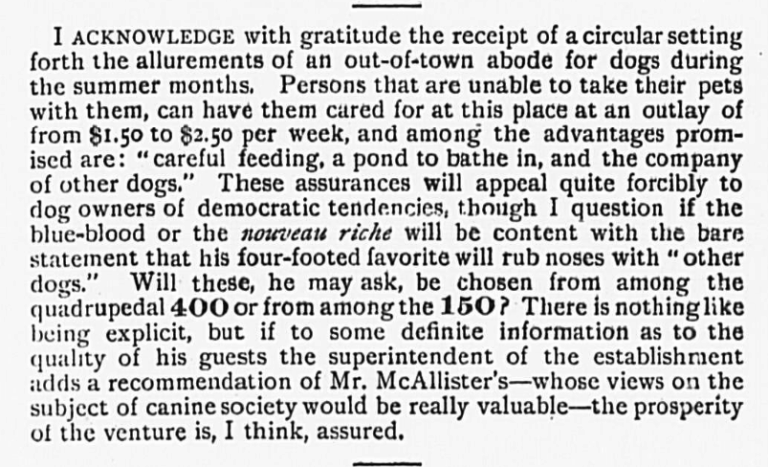
Under an advertisement for a dog boarding facility, it was mockingly commented that it would hardly be enough for the newly rich to read in the ad that their dog would be well looked after and socialized while they were on vacation. The advertisement was recommended to promote the fact that members of the infamous 400, an informal list of the 400 most elite members of New York City’s society, sent their dogs there. Even more so, a direct recommendation from Mrs. Caroline Schermerhorn Astor, the Number 1 in New York City’s upper class, would probably be the ultimate advertisement (see fig. 7). It is implied that the newly rich could not care less about the welfare of their dogs or that they would be prepared to set it aside if this meant they could reach the 400 through their dogs. It is made clear that nothing is more important to the newly rich than getting into the circles of elite New York City’s high society.
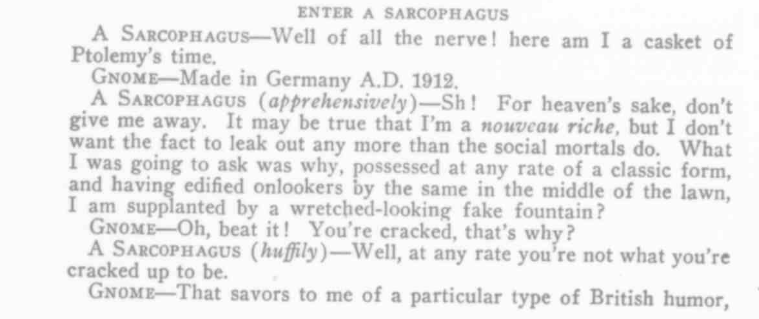
There are also plays dedicated to portraying the Nouveau Riche. In the play From the Inside of a Sarcophagus, the sarcophagus boasts to a gnome that it, the sarcophagus, comes from ancient Greece. The gnome reads aloud the engraving “Made in Germany AD 1912” at the foot of the sarcophagus. The sarcophagus is startled and admits that it is not ancient, but tells the gnome to keep quiet so that no one notices he is a Nouveau Riche (see fig. 8). Once again, it is demonstrated that the worst trait one can have is to be newly rich.
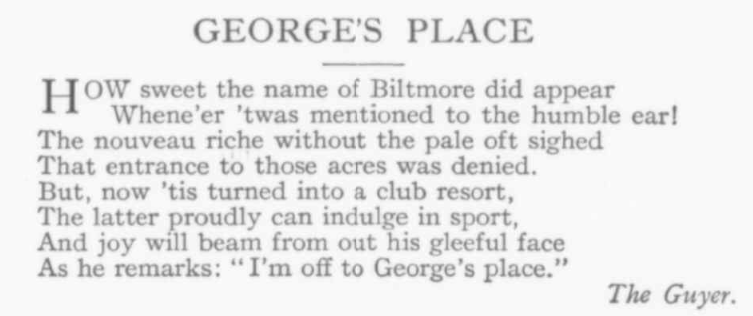
One poem describes how the Nouveaux Riches would always sigh wistfully whenever they heard the name ‘Biltmore House’ (an estate in the Blue Ridge Mountains in Asheville, NC), because they would never be allowed in. It was a mansion built by George Vanderbilt. Later, when it was converted into a club resort, the Nouveaux Riches were also allowed inside (see fig. 9). A subtle hint that the Nouveaux Riches, with their lack of decorum, belonged more in a resort than in a venerable family estate.
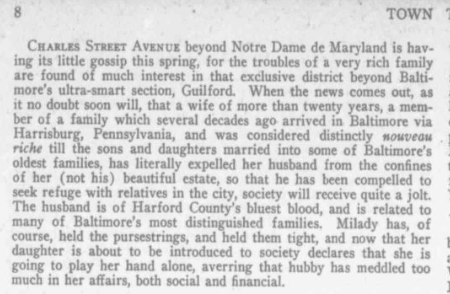
A real scandal occurred in Baltimore, MD. A female descendant from a decidedly nouveau riche family was married to her husband, who had a venerable, respected family name in Baltimore, MD, for 20 years. He brought the name and blue-blooded status into the marriage; she brought the money. She never entirely relinquished control of this money. However, this only becomes clear when she kicks her husband out of her (not his) estate, and he must stay with relatives. Her reason for doing so is that her husband has increasingly interfered too much in her leisure time and finances. The name of this icon was, unfortunately, not revealed (see fig. 10).