The Many Faces of Women in the Gilded Age
Introduction
In the United States of America during the late 19th and early 20th century, women became increasingly visible in public spaces through the appearance of new leisure activities and consumer culture, brought about by developments such as tremendous economic prosperity, industrial and technological progress, new social movements. These circumstances paved the way for the evolution of new female gender ideals which manifested themselves in the emergence of certain female archetypes, three of which constitute the focus of this project, namely the Gibson Girl, the New Woman, and the Suffragette. All of these terms denominate white, middle and higher class women from a younger age to roughly middle age.
The Gibson Girl was mainly an aesthetic phenomenon during the Gilded Age in the United States of America. Its name was derived from the artist Charles Dana Gibson’s name whose illustrations depicted the contemporary ideal of “American” feminine beauty. Gibson Girls adhered to a specific silhouette—tall and slender, curves but a narrow waist—and sported voluminous hairstyles (Patterson “Gibson Girl”, 28). Along with the fashionable silhouette came expectations regarding a respectable character, independence, and confidence (Patterson “Gibson Girl”, 29).
The New Woman, however, does not describe an aesthetic ideal so much as a socio-cultural phenomenon. She is characterized by her independence and strength, her social and political activism, and her challenging of traditional gender roles. Other distinguishing factors were the wearing of practical rather than fashionable clothing and the pursuit of higher education. The archetype of the New Woman does not encompass a homogenous group of women. According to scholar Martha H. Patterson “the New Woman represents all of these contradictory positions and more: suffragist, prohibitionist, clubwoman, college girl, American girl, socialist, capitalist, anarchist, pickpocket, bicyclist, barren spinster, mannish woman, outdoor girl, birth-control advocate, modern girl, eugenicist, flapper, blues woman, lesbian, and vamp” (“New Woman”, 1).
The Suffragette, finally, was a distinctly political figure who fought for women’s right to vote. Deeply unsettling to many men—and women—in their ambitions, women partaking in the suffrage movement were often subjected to ridicule and disdain and were regularly met with thinly concealed hostility (Goodier and Pastorello, 189).
Gender ideals are applied to individuals by their contemporaries and their society. Each period and society has its own idealized concepts, according to which people, their appearance, their values, and their actions are evaluated and judged. This research project examines female gender ideals of the Gilded Age along the three archetypes Gibson Girl, New Woman, and Suffragette, more specifically the stance of Town Topics within their discussion. How are those three individual characters portrayed? What are their connotations? Did the journal´s authors and editors perceive being called a Gibson Girl, for example, as something to be pursued and endeavored, or something to be avoided? What does Town Topics reveal about the social implications of being one or the other?
The data was collected along the following criteria: The database’s own search system was used to collect every mention of each of the three archetypes within the relevant time frames; the temporal distribution is visualized below in one graph per term. To fulfil the requirements for the analysis, the mentions had to appear together with attributes or context utilizable for further study. Mere contextless namings were excluded, as well as jokes, for example, whose content and context is no longer apparent to the contemporary reader. Other than that, there were no strict rules, and the decision was made for each individual mention. The quotes and keywords included in the analysis had be informative, comprehensible, and as diverse as possible in terms of attitudes and standpoints.
How to read this map:
The mind maps’ structure follows several categories. On the one hand, they compile more general information concerning the articles’ authors, the years in which the archetypes’ names appeared regarding the distribution and highest concentration of mentions, and also their context to explain the background and situations in which those three terms would appear. On the other hand, the mind maps show the “Associated Persons”, the people who were often mentioned in connection with the archetypes. To examine the authors’ opinions and attitudes towards the Gibson Girl, the New Woman, and the Suffragette, their tone was analyzed as well as the attributes, key words, and phrases often mentioned alongside the three terms.
The Gibson Girl
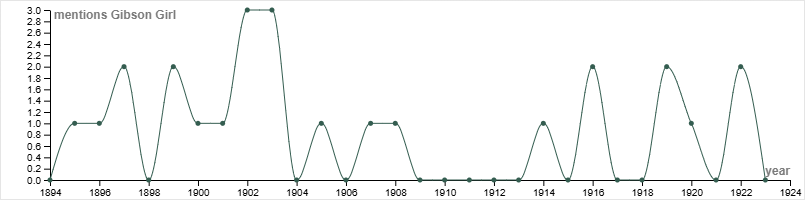
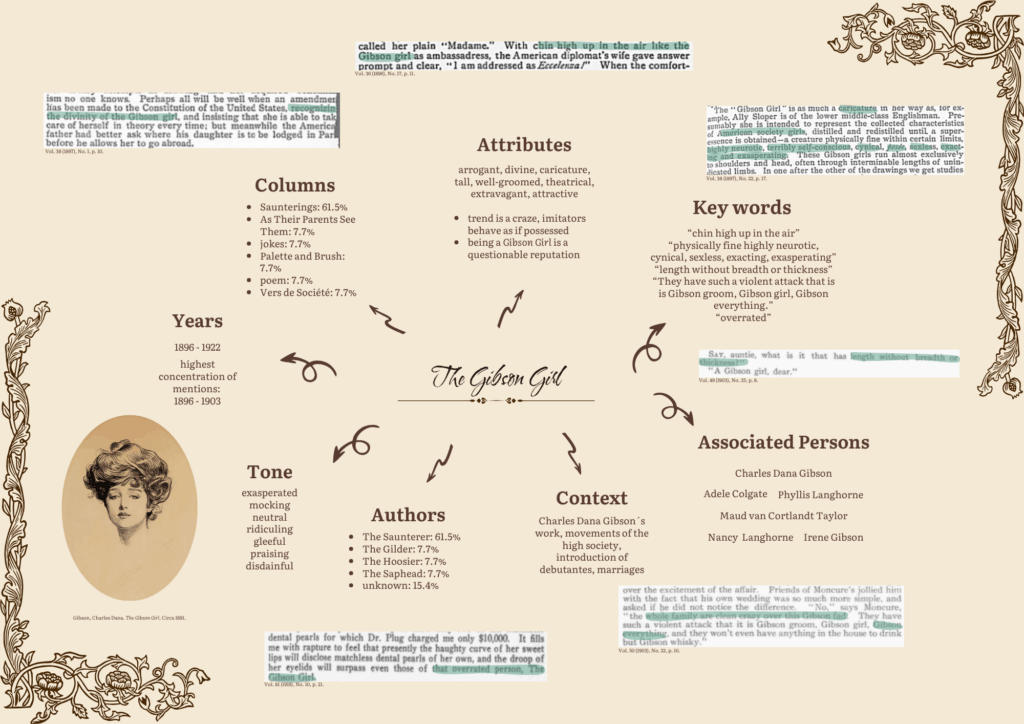
The term Gibson Girl appeared mainly before and around the turn of the century and primarily in the society news column “Saunterings”. Opinions and depictions vary: The Gibson Girl was depicted as aloof, arrogant, and as an overrated fashion trend, but also as attractive and “divine”, depending on the author. This character appears to have been a highly discussed female fashion standard who was met with diverse opinions; however, a distinct atmosphere of ridicule on the part of the authors, especially the Saunterer, prevails. While highly sought after by the young women of the high society, being called a Gibson Girl by Town Topics seems to have been more akin to mockery than anything else.
The New Woman
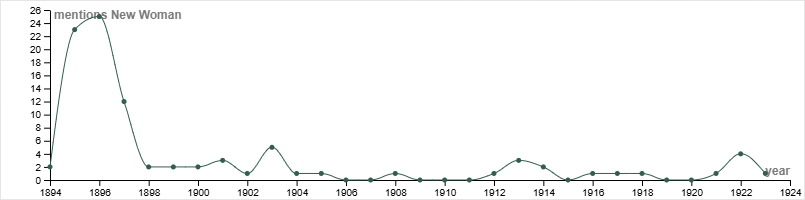
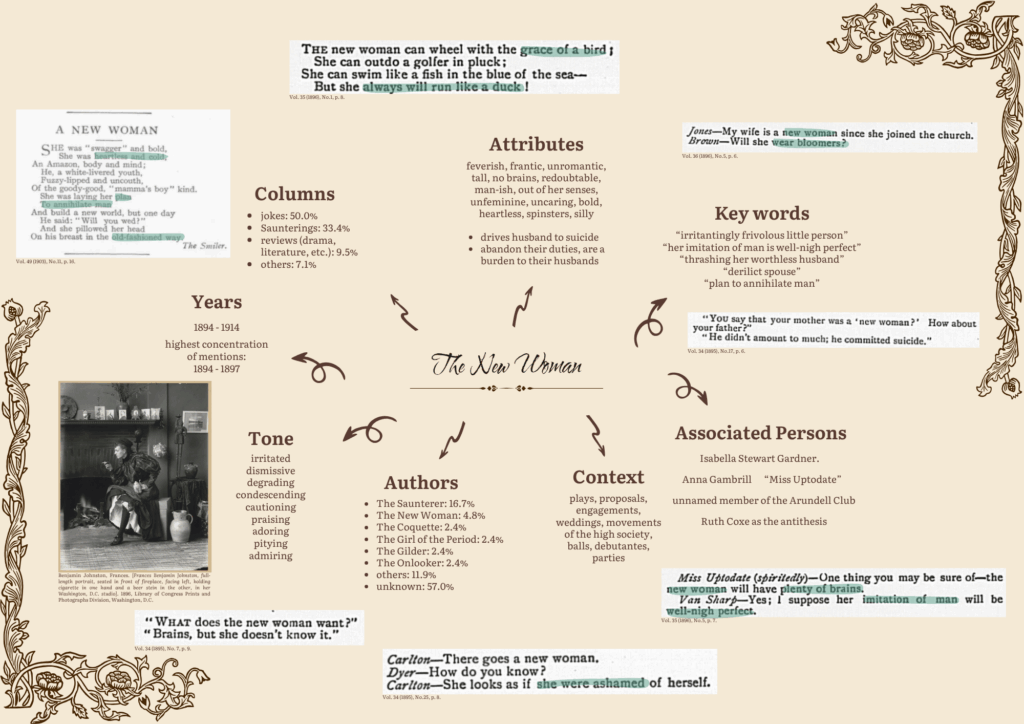
Regarding the New Woman, there is a high concentration of mentions in a very short time, suggesting high topicality immediately before the turn of the century. She appears not mainly in columns, but 50 per cent of the mentions occur within jokes between articles which strongly suggests that she was not taken seriously by the publication’s authors but rather used as joke material. New Women were portrayed by Town Topics as no real women, who appear to think men worthless, and are generally dull and out of their senses. In other words: in the context of this publication, a progressive woman and her ideals and values sparked disdain and ridicule; the idea of her produced immediate reactions of derision and contempt. Consequently, being called a New Woman by the journal could almost be interpreted as an insult.
The Suffragette
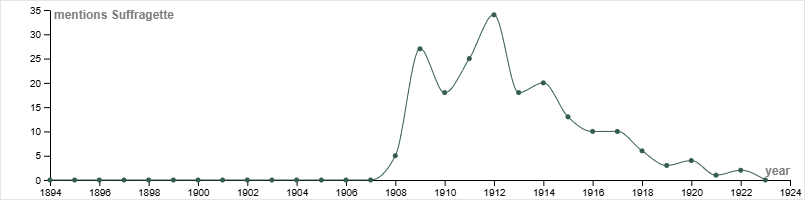
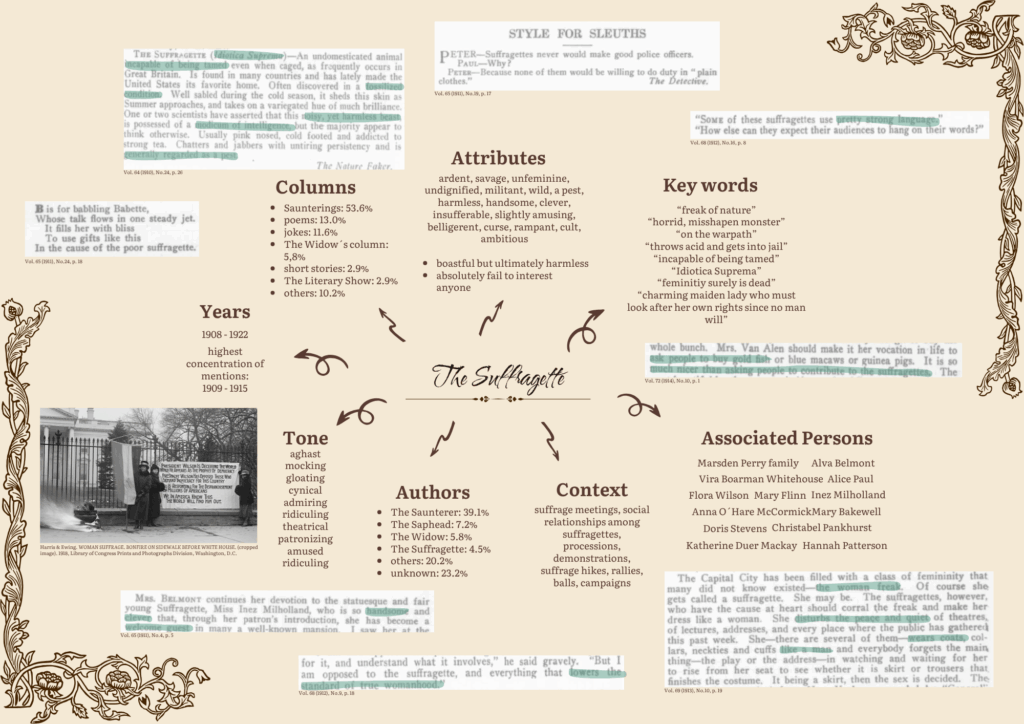
The term Suffragette appeared mainly in the 1910s with more than half of the mentions located within the “Saunterings” column. Using highly drastic language, the Suffragette was characterized as savage, unfeminine, militant, slightly amusing, and ultimately harmless despite the chaos and unrest she was reported to be causing. There is one instance of positive description but the person in question—Inez Milholland—is reduced to her “handsome” appearance with no comment on her actions and values. Out of the three archetypes, the disdain of the authors is most palpable in connection to the Suffragette, almost making it a derogatory term.
By Beatrice Fritz. I want to thank the anonymous reviewer for their helpful feedback and Maia Schiwek for her technical support.

All content for educational purposes only.
University of Greifswald
Seminar: Editing Scandal
(Summer Semester 2025)
Instructor: Prof. Dr. Katrin Horn