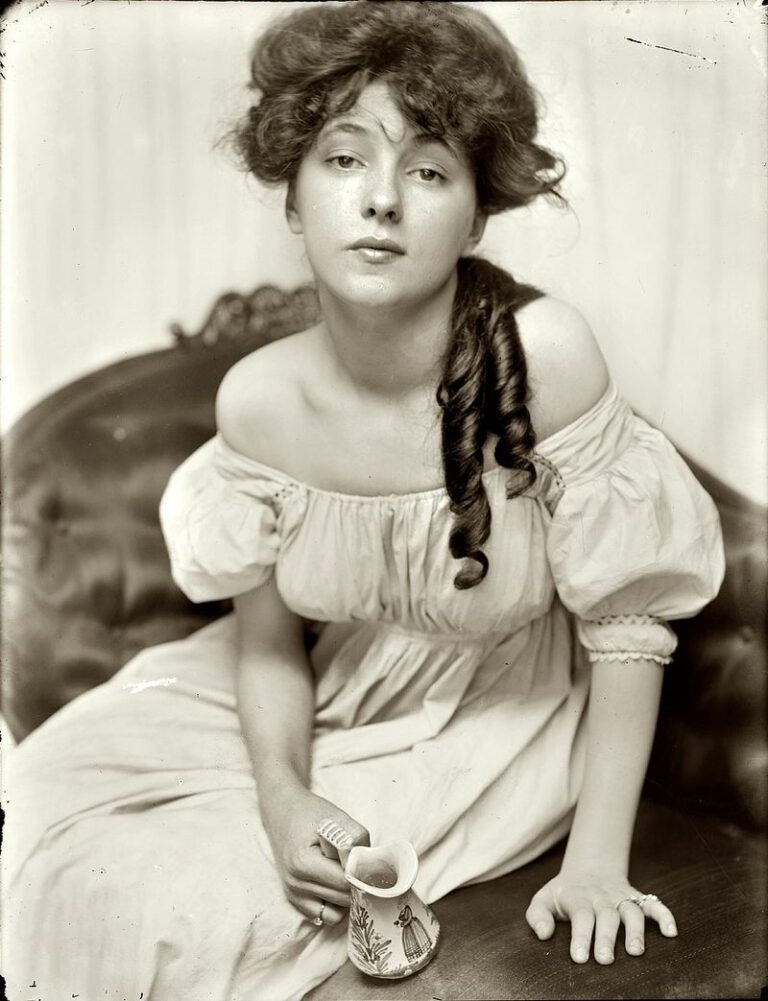
Evelyn Nesbit (1884–1967) was an American actress, model, and chorus girl – a term referring to young women performing in the background of theatrical productions, often in singing and dancing ensembles. In the context of the Gilded Age, chorus girls were frequently associated with scandal and perceived as morally ambiguous figures, particularly when connected to wealthy male patrons.
Town Topics, a notorious New York City gossip magazine, repeatedly featured Evelyn Nesbit. Her media image evolved significantly over time, serving as a powerful representation of how early 20th century gossip journalism constructed, altered, and weaponized female celebrity personas.
The timeline below traces the transformation of Nesbit’s portrayal across different volumes of Town Topics. From celebrated beauty to tragic scandal figure to moral warning, her story reflects broader cultural anxieties around gender, class, and public visibility. To guide the reader through this development, recurring labels such as “the chorus girl,” “the tragic woman,” and “the fallen star” are highlighted to mark key narrative shifts. Where articles are longer than one paragraphs, only the relevant highlights are excerpted for easier navigation. An evaluation on the sources is offered only after the timeline.

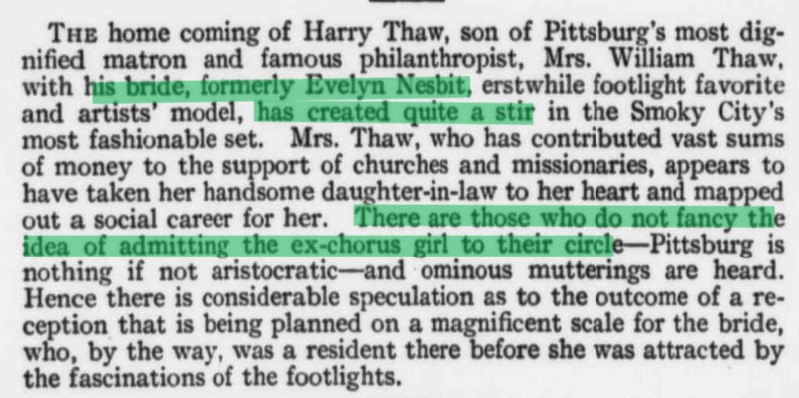
"his bride, formerly Evelyn Nesbit"
"has created quite the stir"
"There are those who do not fancy the idea of admitting an ex-chorus girl to their circle."
"Saunterer, the. "Saunterings." Town Topics, vol. 54, no. 15 (October 12, 1905) pp. 9., ELWA
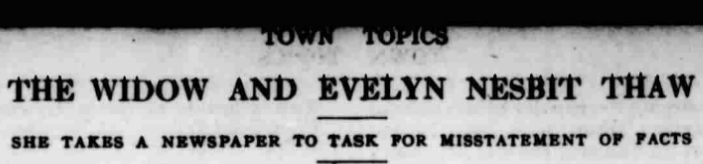
"Not tell the truth", "worse than telling the untruth", "not a hint of real reason why a beautiful young girl could use rest"
"Neither a breath of pity for this poor"
"Tired victim of the sins of other people"
"What kind of humans are we?", "Are we so vile", "or are we so perfect?"
"his poor child", "this young girl", "sad little face", "tired little soul"
"First one hotel and then another refusing her rooms"
"And what had she done to us? Not one thing but tell us a story so pitiful that the hardest heart should weep."
"May have been ill-advised"
"Hunted, hounded, neglected"
"Widow, the." Town Topics, vol. 60, no. 10 (September 3, 1908) pp. 15. ELWA
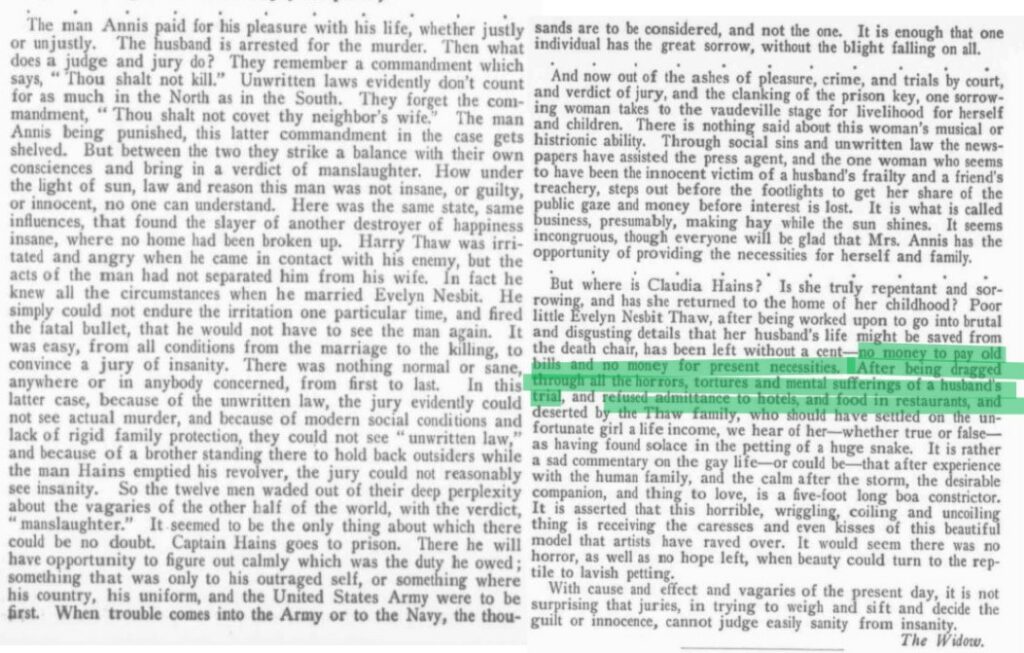
After that, compares the wife's handling during/ after the trial
"After being dragged through all the horrors, tortures, and mental sufferings of a husband's trial"
"Widow. the." Town Topics, vol. 61, no. 22 (June 3, 1909), p. 16., ELWA
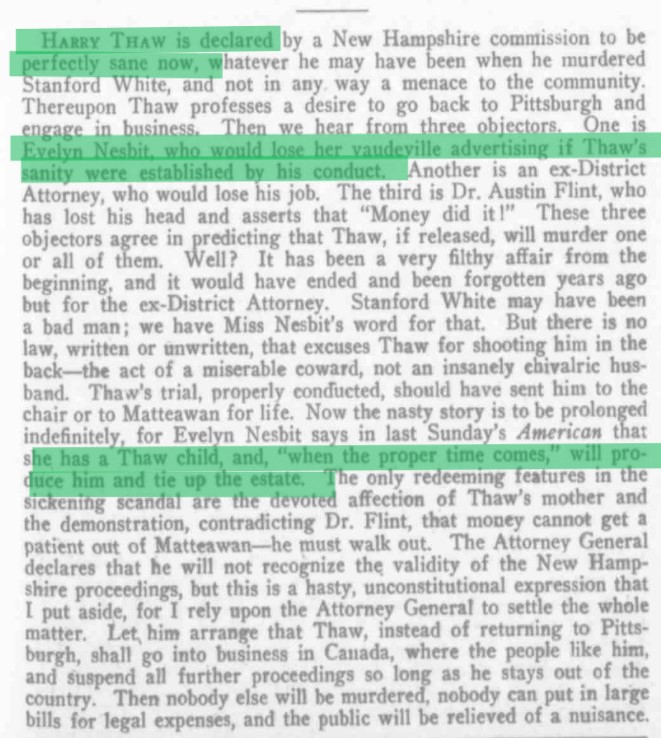
"Evelyn Nesbit, who would lose her vaudeville advertising if Thaw’s sanity were established"
Quotes Sunday’s American, another Newspaper: "she has a Thaw child, and, 'when the proper time comes,' will produce him and tie up the estate."
"Saunterer, the." Town Topics, vol. 71, no. 3 (January 15, 1914) p. 11. ELWA
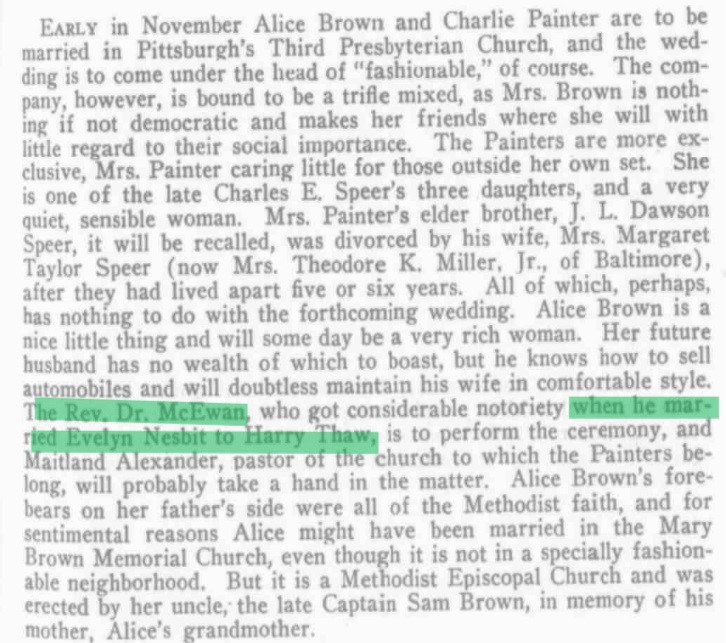
Just mentioned in a short text sentence
"The Rev. Dr. McEwan, who got considerable notoriety when he married Evelyn Nesbit to Harry Thaw"
"Saunterer, the" Town Topics, vol. 72, no. 13 (September 24, 1914), p. 9., ELWA
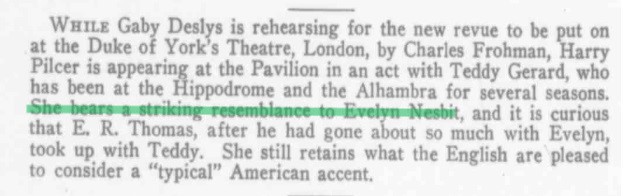
A new revue with Teddy Gerard
"She bears a striking resemblance to Evelyn Nesbit"
"Night Owl, the." Town Topics, vol. 73, no. 5 (February 4, 1915), p. 16. ELWA
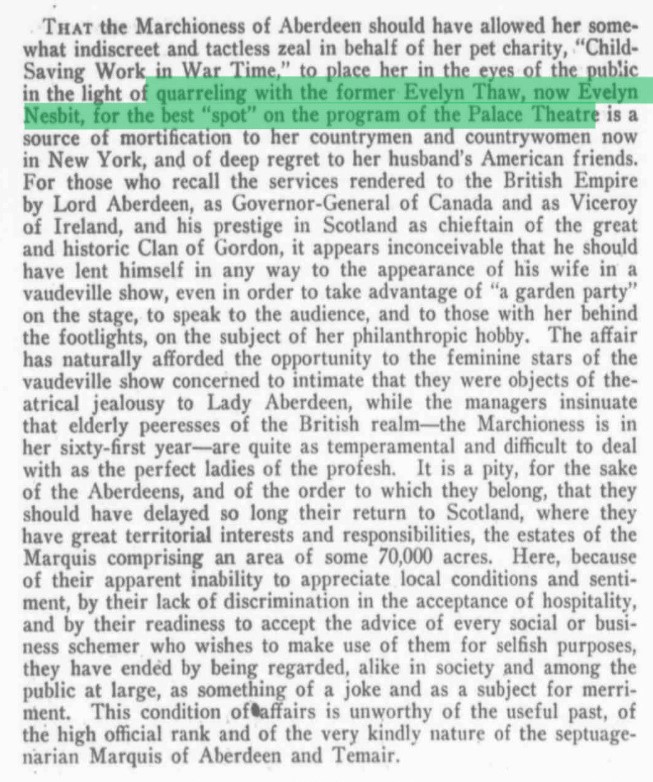
"Saunterer, the." Town Topics, vol. 79, no. 12 (March 21, 1918) p. 12., ELWA
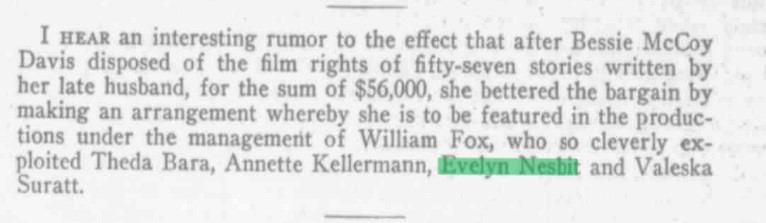
Just mentioned in an enumeration
"The management of William Fox, who so cleverly exploited Theda Bara, Annette Kellermann, Evelyn Nesbit and Valeska Suratt"

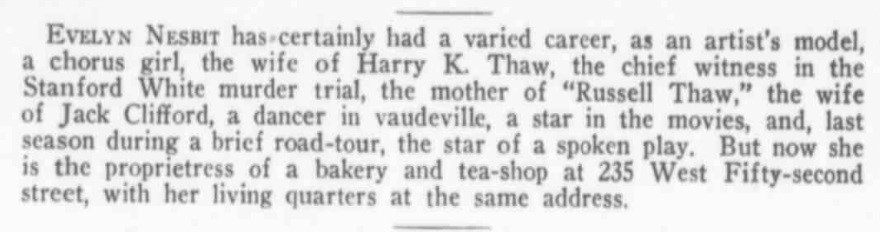
"had a varied career, as an artist’s model, a chorus girl, the wife of Harry K. Thaw, the chief witness in the Stanford White murder trial, …"
"But now she is proprietress of a bakery and tea shop at… with her living quarters at the same address."
"Stroller, the." Town Topics, vol. 85, no. 16 (April 21, 1921) p. 14., ELWA
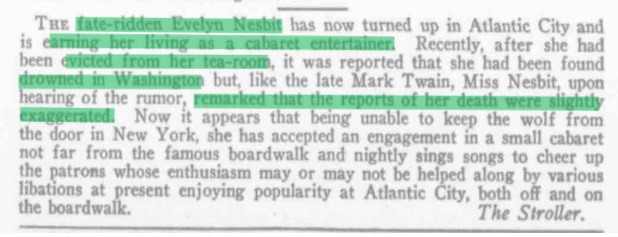
"fate-ridden"
"earning her living as a cabaret entertainer"
"Recently, after she had been evicted from her tea-room"
"reported that she had been found drowned in Washington"
"Miss Nesbit, upon hearing of the rumor, remarked that the reports of her death were slightly exaggerated."
"Stroller, the." Town Topics, vol. 87, no. 12 (March 23, 1922) p. 15., ELWA

In the early years, Evelyn Nesbit—an artist’s model and performer—was introduced to readers as a controversial figure whose marriage to Harry K. Thaw caused “quite the stir” due to her status as a former chorus girl. The framing immediately positioned her as a threat to elite norms and class boundaries in New York City, NY. By 1908, however, the tone of Town Topics had shifted. The column The Widow described her as a “tired victim of the sins of other people” and emphasized her exclusion from hotels and restaurants, drawing attention to society’s harsh treatment of women entangled in public scandal. Described with childlike imagery—“sad little face,” “tired little soul”—Nesbit became a symbol of societal hypocrisy, allowing gossip to take on a moralizing, almost confessional tone.
In the following years, Nesbit’s portrayal was often linked to her relationship with Thaw, her vaudeville career, and her alleged financial motives. Notably, a 1914 entry speculated that she would “produce” a child linked to Thaw in order to claim part of his estate—an allegation quoted from The Sunday American. Here, Town Topics moved away from overt sympathy, presenting Nesbit as both calculating and vulnerable within a scandal-driven public sphere.
By the 1920s, Town Topics had largely relegated Nesbit to a figure of nostalgic curiosity. In 1921, she was noted simply as the owner of a bakery and tea shop—an image of respectable domesticity that stood in sharp contrast to her earlier celebrity. The following year, a false report claimed she had drowned in Washington, D.C.—a rumor she wryly corrected by saying the news of her death had been “slightly exaggerated.” These later references suggest a fading media presence, yet also demonstrate her continued symbolic value as a woman whose identity was repeatedly constructed, deconstructed, and exploited in the press.
Taken together, the Town Topics articles show that Evelyn Nesbit’s story was never allowed to settle. She was remembered not for a singular identity, but as a shifting archetype: the chorus girl, the tragic woman, the fallen celebrity, the cautionary tale. Through gossip and satire, the magazine contributed to—and helped shape—a gendered narrative of fame, judgment, and moral failure. In doing so, Town Topics served as both a mirror and an engine of early 20th century anxieties about womanhood, class, and public visibility.
By Maia Schiwek.
I want to thank Beatrice Fritz for the helpful feedback.
All content for educational purposes only.
University of Greifswald
Seminar: Editing Scandal
(Summer Semester 2025)
Instructor: Prof. Dr. Katrin Horn